

Imagine sitting across from me with a cup of coffee. Steam rising. Conversation slow. And I ask you something simple.
What if robots didn’t belong to a single company?
What if they belonged to everyone?
That’s where the story of Fabric Protocol really begins. Not in a lab. Not in some dramatic sci-fi future. But in a quiet realization many engineers started having at the same time: robots are getting smarter, but the systems controlling them are still incredibly centralized. One company builds the robot. One company controls the data. One company decides what it can do.
And that… is fragile.
Now here’s where things get interesting.
Fabric Protocol looks at robots the same way blockchains looked at money years ago. Instead of a single organization controlling machines, Fabric imagines a global network where robots, AI agents, developers, and humans all coordinate through a shared infrastructure. Not owned. Shared.
Think of it like the internet, but for robots.
Let me explain.
Picture a warehouse robot moving boxes. Today that robot is usually locked inside the ecosystem of the company that built it. Its data lives in one place. Its updates come from one place. If the company disappears, the robot’s future disappears too.
Fabric flips that idea completely.
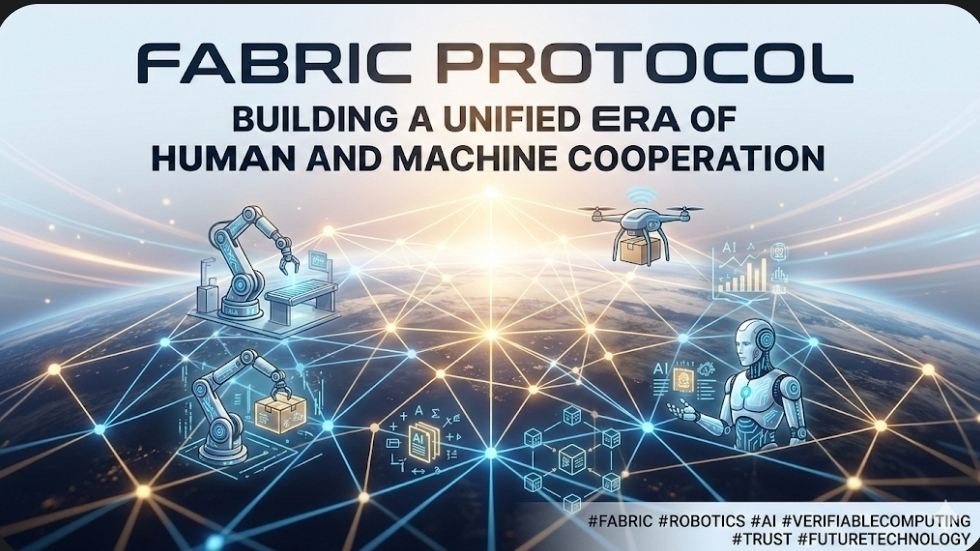
Instead of isolated machines, robots become participants in a public network. They can request computation, share data, verify tasks, and coordinate actions using a ledger that everyone can see but no single entity controls. Suddenly a robot isn’t just hardware anymore. It becomes an agent in a global system.
And this is where the phrase “agent-native infrastructure” starts to make sense.
You and I use apps. Robots use agents.
These agents act like digital brains connected to the network. They manage tasks, negotiate resources, verify information, and communicate with other agents. A delivery drone might talk to a traffic monitoring agent. A warehouse robot might consult a logistics AI. A factory arm might coordinate with supply chain systems.
It starts to feel less like machines and more like an ecosystem.
But here’s the thing. Robots working together creates a big problem.
Trust.
If a robot claims it completed a task, how do you verify it? If an AI system provides instructions, how do you know they’re correct? If thousands of machines share data, how do you stop manipulation?
This is exactly where Fabric introduces something powerful: verifiable computing.
Instead of blindly trusting a machine’s output, the network can verify that the computation actually happened the way it was supposed to. Think of it like math homework where the teacher doesn’t just see the answer but can check the steps instantly.
So when a robot reports that it sorted 10,000 packages, the network can confirm the computation behind that claim.
No guessing.
No blind trust.
Verification.
Now imagine this happening at scale.
Thousands of robots. Millions of interactions. Data moving across factories, cities, hospitals, farms. All coordinated through a public ledger that records actions, permissions, and outcomes.
It sounds complicated. But strangely, it simplifies things.
Because when infrastructure becomes modular, developers can build pieces instead of entire systems. Someone might create a navigation module. Someone else builds a safety layer. Another team designs regulatory compliance tools.
Fabric becomes the foundation these pieces plug into.
Like Lego blocks for robotics.
But here’s where the deeper idea appears.
Governance.
Who decides how robots should behave?
Right now the answer is corporations. Sometimes governments. But rarely communities.
Fabric experiments with something different. The network itself can participate in governance decisions about standards, safety frameworks, and upgrades. Developers propose improvements. Participants validate them. Systems evolve collectively.
It’s messy sometimes.
But real systems usually are.
And when I step back and think about it, Fabric Protocol isn’t really just about robots. It’s about coordination. It’s about creating infrastructure where intelligent machines can collaborate with humans without being trapped inside walled gardens.
Because the future we’re walking into isn’t one robot here and there.
It’s millions.
Warehouse robots. Delivery drones. Autonomous vehicles. Industrial arms. Medical assistants. Agricultural machines.
All talking.
All learning.
All evolving.
If those systems stay fragmented, progress slows down. But if they share a common coordination layer, innovation compounds in ways that are hard to predict.
That’s the quiet ambition behind Fabric.
A global open network where machines aren’t isolated tools anymore, but participants in a cooperative digital economy.
And maybe that sounds futuristic.
But honestly?
We’re already seeing the early pieces forming.
The robotics industry is exploding. AI agents are becoming more capable every month. Distributed computing networks are getting stronger. When those trends collide, systems like Fabric start making a lot of sense.
Because the real challenge of the next technological era isn’t just intelligence.
It’s coordination.
And Fabric Protocol is trying to solve exactly that.
Slowly.
Openly.
Together.