
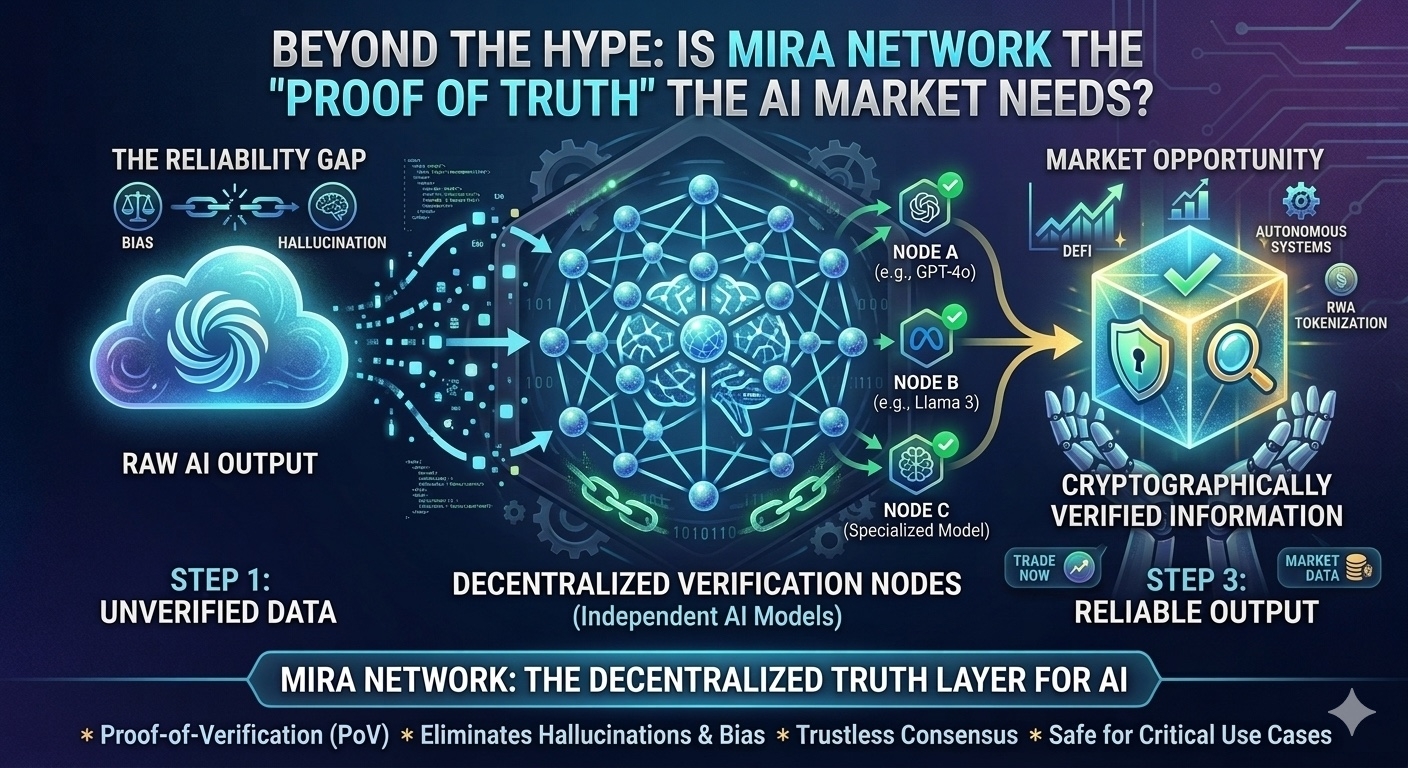
In the current digital landscape, we are witnessing an unprecedented collision between Artificial Intelligence and Blockchain. As AI models become more integrated into our financial and autonomous systems, a glaring problem has emerged: The Reliability Gap. AI hallucinations and biases aren't just technical glitches; they are economic risks. Enter Mira Network, a decentralized verification protocol that doesn't just promise better AI—it seeks to cryptographically prove it.
The Problem: The High Cost of "Almost Accurate"
Most modern AI models operate in a "black box," where users must trust the output without a way to verify its accuracy. In high-stakes sectors like decentralized finance (DeFi) or medical research, a 5% error rate is unacceptable. Mira Network addresses this by transforming AI outputs into "claims" that are cross-verified by over 110 independent AI models across a decentralized network.
Market Performance: MIRA Token Under the Microscope
As of March 2026, the MIRA token (trading on the Base and BNB blockchains) is navigating the volatile waters of the AI-crypto sector.
• Current Trading Price: MIRA is currently trading around $0.082 to $0.088, reflecting a period of consolidation following its initial 2025 launch.
• Market Capitalization: With a circulating supply of approximately 245 million tokens, Mira maintains a market cap of roughly $21 million.
• Liquidity and Volume: The 24-hour trading volume remains robust at nearly $9 million, indicating strong active interest from traders on exchanges like MEXC and KuCoin.
Unique Mechanics: Proof-of-Verification (PoV)
Mira sets itself apart from "hype-based" AI tokens through its Hybrid Security Model. Instead of traditional Proof-of-Work (PoW) where miners solve useless puzzles, Mira nodes perform "Proof-of-Verification."
1. Work: Nodes run actual AI inference to validate claims.
2. Stake: Economic alignment is ensured via staked MIRA tokens, meaning dishonest verifiers lose their collateral.
This creates a self-strengthening cycle: as the network grows, more diverse models join, further reducing bias and driving accuracy—which has reached a recorded 96% in partner testing.
2026 Roadmap: Real-World Assets and Beyond
The project is currently in its "Growth Phase." The roadmap for Q2 2026 hints at a transition toward Real-World Asset (RWA) tokenization. By converting traditional businesses into on-chain assets and using AI to manage automated dividends, Mira is moving from a pure "verification tool" to a foundational infrastructure for the autonomous economy.
The Bottom Line
While MIRA faces the typical headwinds of a token unlock schedule—with about 80% of its 1 billion supply still vesting—its utility is undeniable. If decentralized AI verification becomes the industry standard for autonomous agents, Mira is positioned not just as a participant, but as the Trust Layer for the entire ecosystem.