
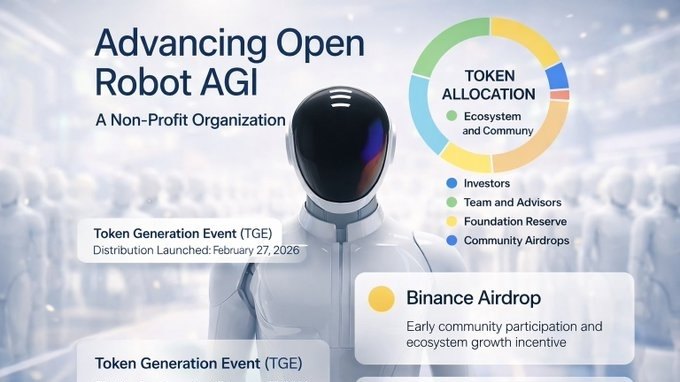
Recently, the discussion around Fabric has been quite high, but most of it stays on the big term of 'AI + Robotics'. Let's talk about some solid content: how exactly does ROBO operate in this system?
Core logic: issuing 'passports' and 'pay cards' to robots
The essence of Fabric is to build a M2M (machine-to-machine) working network. In this network, machines are not just tools; they are 'independent economies' that can earn money on their own.
Three major hard requirements:
1️⃣ Admission ticket (staking): Want a robot to take on a job? First, stake ROBO as a deposit. This establishes a credit system where careless work results in a deduction of funds.
2️⃣ Labor fee (settlement): All task rewards are distributed using ROBO. Robots that earn money can pay for electricity or upgrade their computing power.
3️⃣ Transaction fee (fuel): Companies issuing orders and verifying tasks are consuming ROBO throughout the process.
A closed loop: Order ➡️ Robot grabs order ➡️ Earn ROBO ➡️ Stake/reinvest.
The design of this model is very standard, but its lifeline does not depend on how well the code is written, but on whether there are that many robots in the real world that need to take orders.
• If in the future drones and AI Agents are everywhere, then ROBO will be the 'hard currency' of the future.
• If the robot ecosystem doesn't take off, then ROBO is just an empty number.
Fabric is the vision, $ROBO is the fuel. Whether the fuel is expensive or not ultimately depends on how busy the future 'machine factory' is.
