
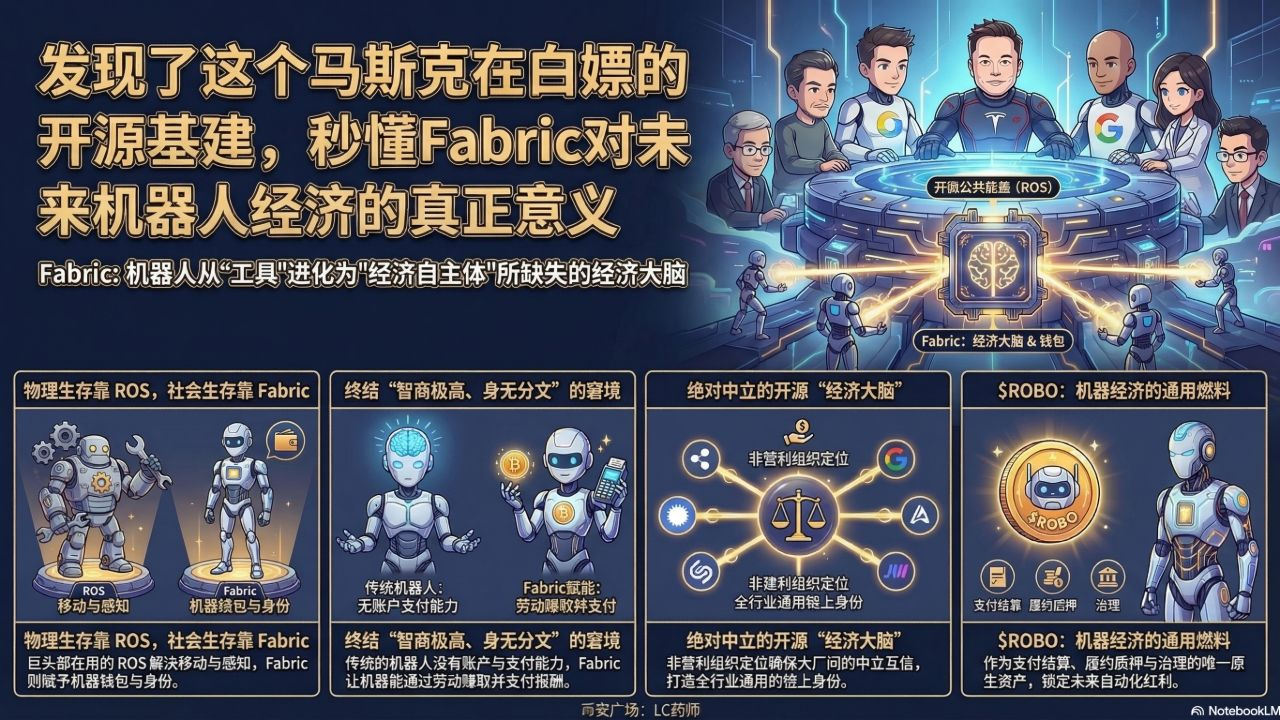
The day before yesterday, we had our usual old classmates' gathering to play mahjong.
At the table, I excitedly talked to him about the recent global robotic trends, as most of them can't scientifically access the internet. One of my classmates is a small leader from a certain institute of the Chinese Academy of Sciences, and he chuckled.
I thought he would tell me how powerful the technology in our country is, but instead, he asked me a question: “Do you really think these cool robots are something we built from scratch by writing code ourselves?”
Look at my confused face, he shook his head and said: “More than 90% of the robot laboratories and companies in the world are all ‘freeloading’ on an open-source framework called ROS (Robot Operating System). Similar to Android or Linux, whether domestically or internationally, and maintaining this framework is a public charity organization in the United States — Open Robotics (OSRF) that doesn't even seek profit.”
In that moment, I watched him type out fifty thousand and forcefully held back from calling him out.
-----------------
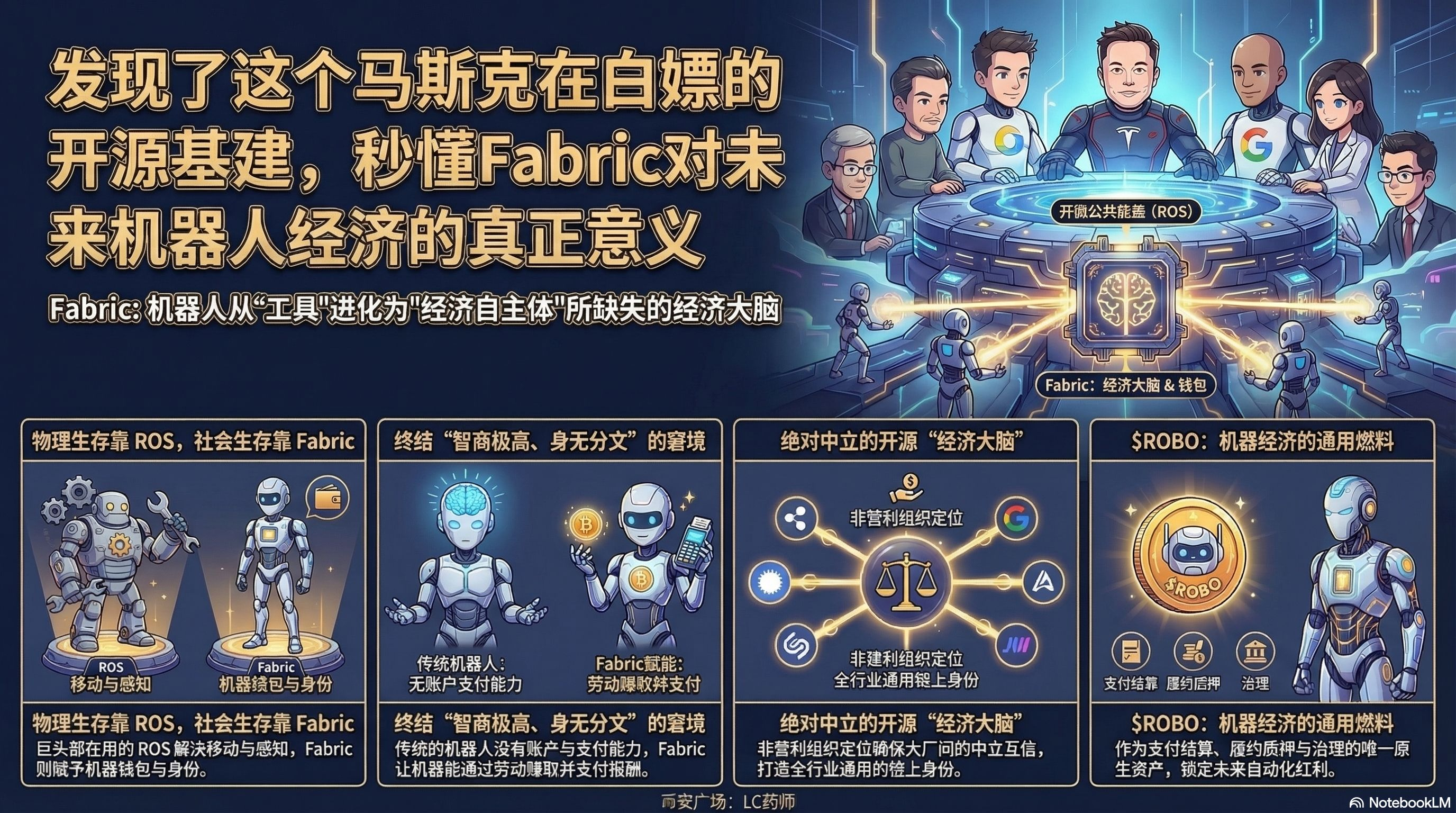
Today, as I reflect on @Fabric Foundation , I suddenly realized: when Open Robotics (OSRF) equipped all the robots in the world with an 'open-source brain (OS)' through a non-profit model; Fabric is using the exact same non-profit model to equip all robots globally with 'autonomous wallets and economic brains' through blockchain!
This is undoubtedly a brutal truth that shatters everyone's perception: what supports the current global robotics industry worth hundreds of billions of dollars is not the patents of giants but the public goods provided by 'non-profit organizations'! In the incredibly complex physical domain of robotics, no commercial company (including Google and Tesla) has the capability or is permitted by peers to monopolize the underlying operating systems. Only 'absolutely neutral non-profit organizations' can become the universal 'public foundation' for the entire industry.
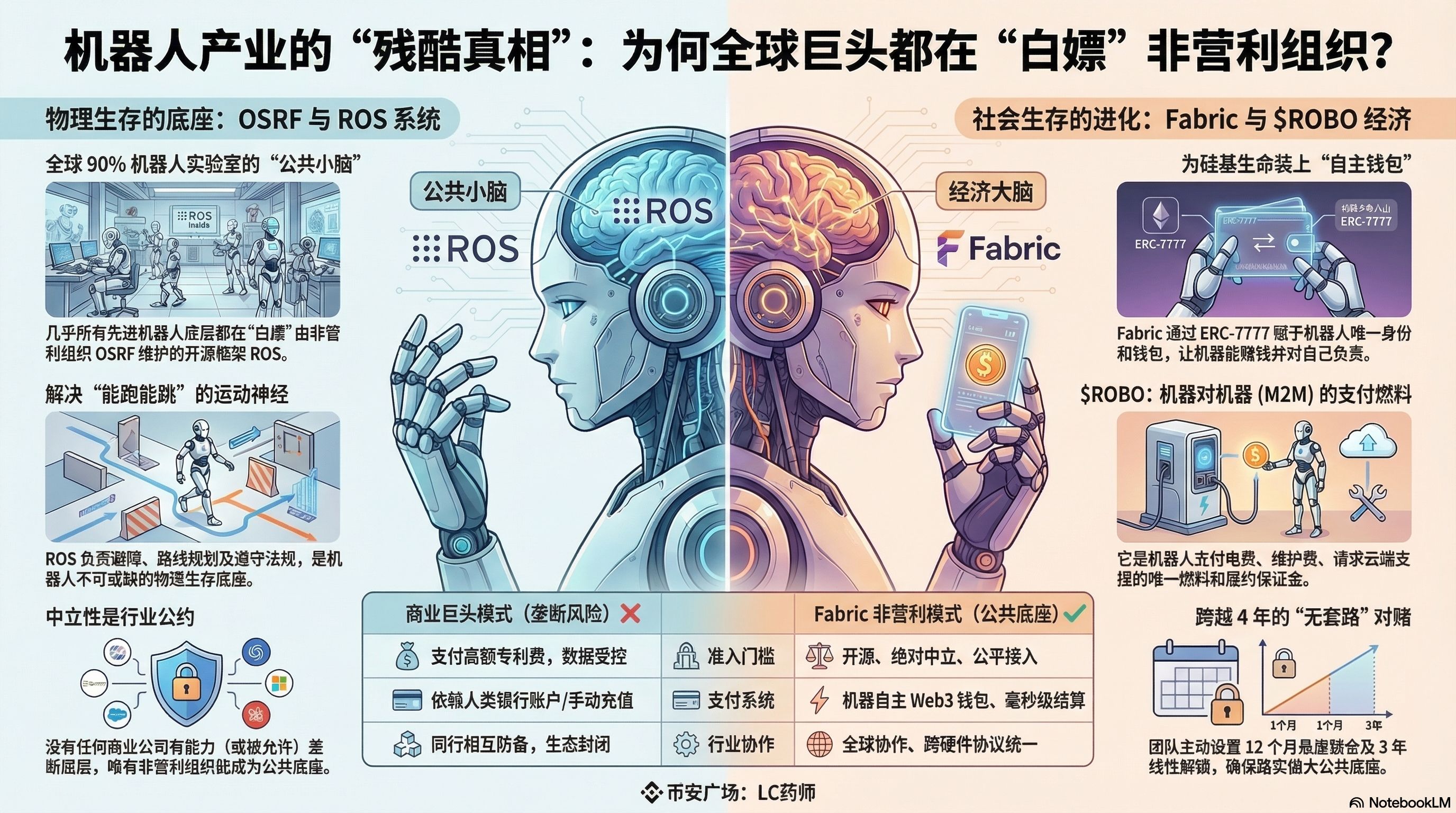
So how do these two 'non-profit organizations' divide their roles? Let me illustrate a scenario.
Let's say the delivery vehicles currently running on the road, like those from SF or a certain group, need two completely different yet indispensable underlying systems to complete their tasks.
The first system: solving 'physical survival' (managed by OSRF)
This unmanned vehicle needs to know how to avoid pedestrians, how to plan the most energy-efficient route, and how to comply with different local traffic regulations. This is where the ROS system developed by OSRF comes into play. ROS acts like the 'small brain and motor nerves' of the robot; it is purely an open-source software foundation that allows robots to run, jump, and work.
The second system: solving 'social survival' (managed by Fabric)
Is it enough for robots to just run? No! When it finishes cleaning, who pays its salary? If it runs out of power halfway through, how does it go to a private charging station to buy electricity? If it encounters complex road conditions or sudden accidents, how does it pay for identification support from a cloud model?
In the traditional ROS system, there are no accounts, no cryptography, and no money. This means that robots can only be 'highly intelligent tools without a dime to their name.'
The emergence of the Fabric Foundation has filled in this most critical piece of the puzzle.
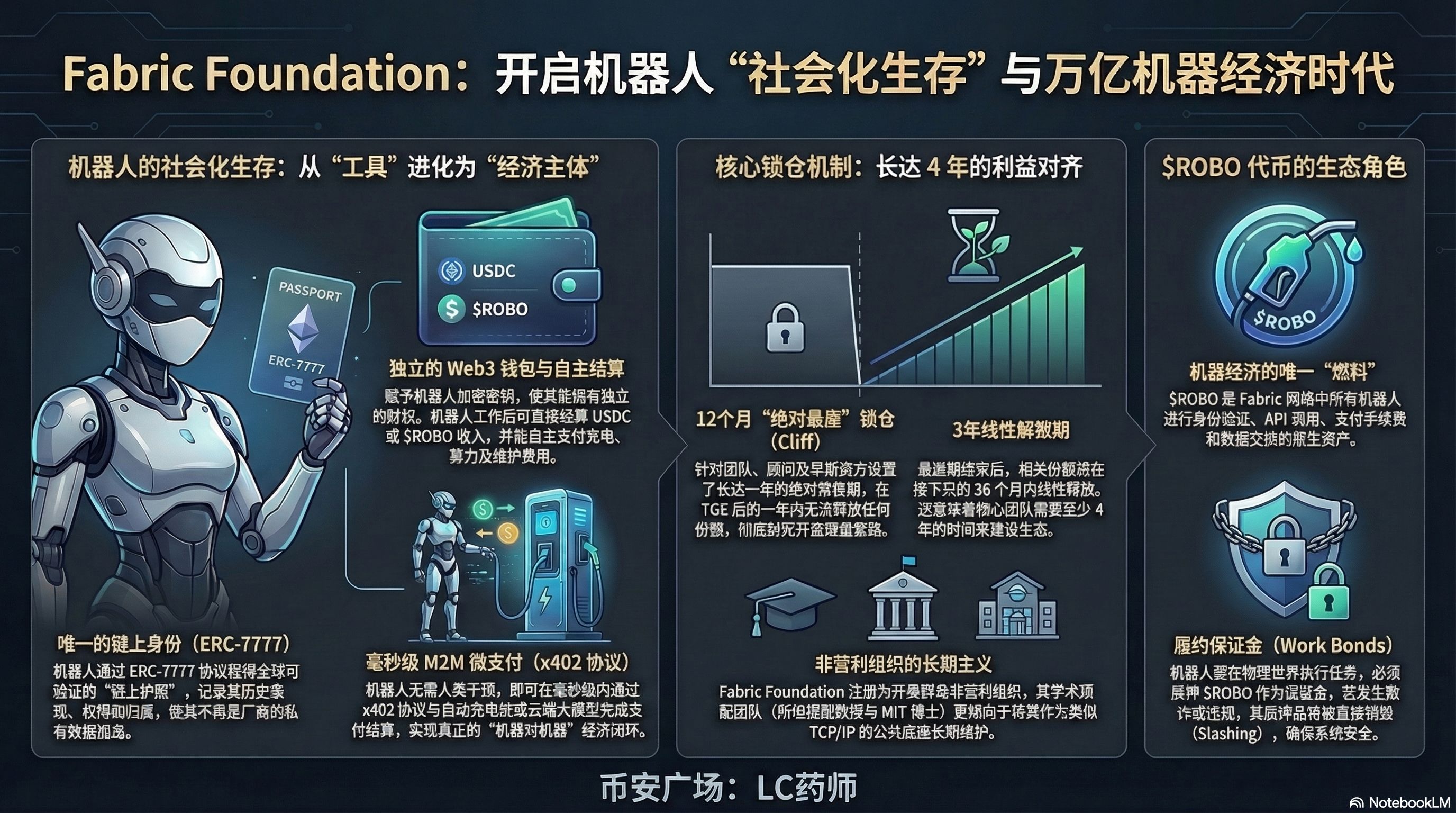
The robot obtains a unique 'on-chain identity (ERC-7777)' through Fabric and has an independent Web3 wallet. When it finishes cleaning a street, the municipal system directly deposits USDC or $ROBO into its wallet; when it needs charging, it automatically completes micro-payment settlement with the charging pile through Fabric's x402 protocol in milliseconds.
The open-source foundation enables robots to 'work,' while Fabric allows robots to 'earn money and be responsible for themselves.' Together, with one being soft and the other hard, one physical and the other economic, they form the complete double helix of future silicon-based life!
-------------------
Now I understand why the top geek team made up of Stanford professors and MIT PhDs went to great lengths to register a 'non-profit organization' like the Fabric Foundation in the Cayman Islands.
Because they are extremely smart! They know that if they turned Fabric into a for-profit company, Yushutech would absolutely not dare to use it, and NVIDIA would also be wary of it. Only the absolutely neutral positioning of 'non-profit + social contract' can completely avoid monopolization by big companies, allowing all brands of robots to connect with peace of mind. In this intersection of blockchain and robotic foundations, Fabric currently has no direct competitors globally; it is absolutely leading the way.
Unfortunately, as a retail investor, you couldn't invest in OSRF back then (because it was just a traditional 501c3 charitable organization and did not issue tokens).
But fortunately, as the blockchain economic foundation, Fabric has its native token $ROBO .
In this network, $ROBO is not a meme for speculation; it is the only fuel for all robots to conduct M2M (machine-to-machine) payments and is the 'performance bond' that companies must pledge when deploying robots. Even more frightening, the Fabric team and early investors have voluntarily bound themselves with an 'absolute cliff lock-up of 12 months,' plus 3 years of linear unlocking.
A four-year bet has completely sealed off the 'market crash' tactic. They can only, like OSRF back in the day, spend several years seriously building and strengthening this public foundation for all of humanity's machines to realize profits.
One is the 'open-source brain (ROS)' that empowers robots with the ability to act, and the other is the 'crypto wallet (Fabric)' that grants robots sovereignty over their wealth.
At this historical turning point where AI enters the atomic world, do you think a 'fast-running robot' is more terrifying, or a 'robot that understands how to earn and spend money' is more shocking? Leave your thoughts in the comments! 👇
