
Every震荡 in the Middle East ultimately transmits to every corner of global finance. This is not an isolated story of geopolitics, but the unchanging order between resources, currencies, and assets. History repeatedly reminds us: behind the complex appearance of financial markets, the logic of operation has never changed—one trade route, one piece of land, or one barrel of oil is often enough to leverage the entire system.
Oil has always been one of the key variables in global asset pricing. In 1973, Arab oil-producing countries imposed an oil embargo on the West, and within just a few months, oil prices soared to four times their original level, U.S. inflation surged sharply, and the stock market subsequently crashed. Half a century later, this chain remains effective, but at the end of the chain, there is a new link: crypto assets.
2022 Revelation: The Russia-Ukraine War, Oil, and Bitcoin
To understand the current situation, it is necessary to review 2022.
After the outbreak of the Russia-Ukraine war, the market’s most immediate concern was directed at Russia’s energy supply. Brent crude oil surged to $127 within two weeks, with some varieties even breaking $130, reaching a ten-year high with an increase of over 30%.
Bitcoin, known as 'digital gold', dropped from $39,000 to around $34,300 within hours of the war starting, a decline of over 12%. Although it briefly rebounded to $44,000 in early March, gaining some breathing room from the 'digital safe-haven asset' narrative, the good times didn't last long.
Rising oil prices drive inflation, and inflation forces the Federal Reserve to initiate the most aggressive interest rate hike cycle in decades, leading Bitcoin into a long winter. By June 2022, Bitcoin had fallen below $20,000. From the peak in November 2021, the drop exceeded 60%; looking only at the six months after the outbreak of war, the market value evaporated by more than 50%.
At that time, some people were vaguely aware that Bitcoin is not gold. It resembles a high-leverage reflection of the Nasdaq—when oil prices rise, inflation increases, the Federal Reserve tightens liquidity, funding costs rise, and risk assets are prioritized for sale. Bitcoin is often at the top of the selling list.
However, there is a key difference between 2022 and today: at that time, Russian oil had not truly exited the global market, but maintained supply through 'shadow fleets' and alternative routes. Now, the daily production capacity of 3 million barrels from Iraq's Rumaila oil field is offline, and the physical strike on Tehran's oil reserves indicates substantial infrastructure damage—this is no longer a problem that can be solved by rerouting.
Last weekend, the situation in the Middle East continued to escalate. Oil storage facilities and desalination plants became targets, and Iraq confirmed a daily interruption of 3 million barrels of oil production. This gap has exceeded the extreme expectations of the market regarding Russian supply cuts in 2022, and this time it is a real loss on a physical level. Qatar even warned that oil prices could rise to $150.
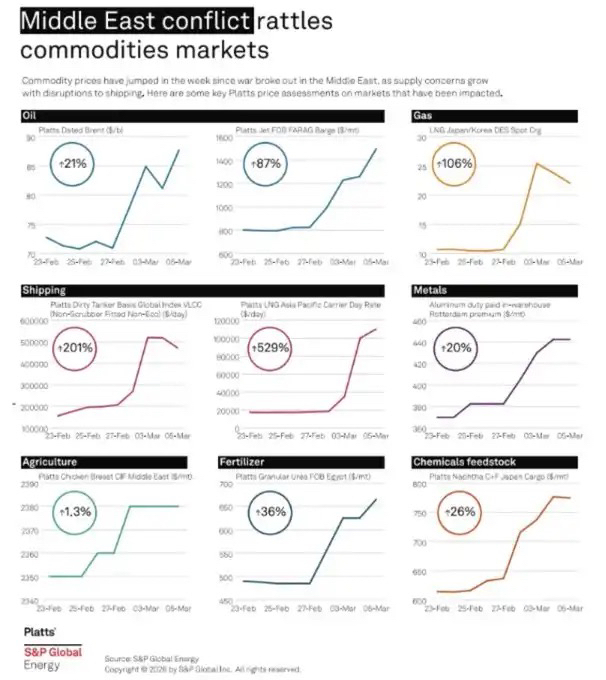
This morning, both U.S. and Brent oil prices broke through the $100 mark, with Dow futures expanding their initial drop to 2%, Nasdaq futures down 1.65%, and S&P 500 index futures down 1.7%. Bitcoin fell below $66,000, almost fully retreating its rebound from last week.
Looking back, there seems to be an implicit transmission chain between oil prices and Bitcoin: oil prices → inflation expectations → Federal Reserve policy → liquidity → crypto assets.
This week, several macro data points will sequentially test every link in this chain.
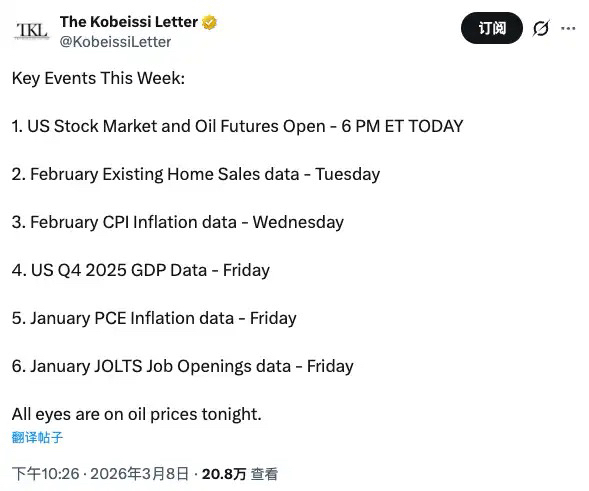
Macro nodes worth paying attention to this week
Most traders only focus on the CPI release date, neglecting the logical sequence between the data.
First, the U.S. stock market and oil futures opened. After the news of Iraq's production halt fermented over the weekend, oil prices opened as the market's first real pricing response to this event. This morning, WTI crude oil futures surged by 22%, breaking through $110, and Brent also rose by 20% to $111—oil prices jumped significantly, setting the direction for this round of inflation.
Next, on Wednesday, the February Consumer Price Index (CPI) will be released; this will validate or correct market expectations following the oil price shock.
On Friday, three data points, GDP, PCE, and JOLTS, will be released on the same day. GDP reflects whether the economy is actually slowing down; PCE is the inflation indicator most valued by the Federal Reserve; JOLTS reveals whether the labor market is truly easing. If all three point to 'persistent inflation, the economy has not cooled down,' expectations for rate cuts will be suppressed, and the crypto market may come under pressure.
Of course, the market is not entirely pessimistic. Raoul Pal, co-founder of Real Vision, believes that the current oversold state of the crypto market presents a good opportunity. His core logic is based on global liquidity: since 2012, the correlation between Bitcoin and global liquidity has reached 90%, and its correlation with Nasdaq has reached 97%, and this relationship continues to strengthen.
He listed several supporting factors:
The liquidity environment remains loose: GMI financial conditions lead global liquidity by about 6 months, and currently still point to looseness;
The total liquidity in the United States is accelerating its recovery, having about a 3-month leading effect on the crypto market;
Structural benefits are accumulating: the Federal Reserve's rate-cutting cycle has not yet ended, China is expanding its balance sheet, the issuance of stablecoins increased by 50% last year, and the (CLARITY Act) is expected to clear obstacles for institutional entry;
Technically near the bottom: both the weekly and daily DeMark indicators suggest that a bottom confirmation may be completed in the next two weeks.
However, Pal also pointed out that the greatest uncertainty still lies in the persistence of oil prices.
A ceasefire is not easy; oil price fluctuations may continue.
From a military perspective, Iran's strike capability has been significantly weakened—missile stockpiles have decreased, launch vehicles have been continuously targeted, the navy has basically lost combat capability, and there are very few drones left. The goals of the U.S. and Israel are not just the existing weapons but to destroy its military industrial system. According to Israeli estimates, in about two weeks, Iran's ability to manufacture missiles and drones may be completely shattered.
This also affects concerns about the Strait of Hormuz: blocking the strait would cut off Iran's own foreign exchange sources, making a long-term blockade unrealistic. However, the risk of short-term navigation interruption does indeed exist.
Military actions will eventually have an endpoint, but the real challenge lies in the political evolution within Iran. Whether it be the Pahlavi dynasty or the Khomeini regime, the core logic has always been 'modernization interrupted, filled by traditional authority.' Even if external forces overthrow the current regime, it cannot simply rewind to the past.
A more likely trajectory is a state similar to Venezuela: the regime has not completely collapsed, but is bleeding continuously, with internal contradictions accumulating until a qualitative change occurs from within. The clerical class is not a monolith; when the Revolutionary Guard's strength weakens, the long-dormant moderates may rise to the surface.
This process does not take weeks, but years.
What does this mean for oil prices and Bitcoin? Military actions can have an endpoint, but the uncertainty of Iran's political reconstruction will disturb the global energy market for quite some time. The volatility of oil prices may last longer than most expect. Each time oil prices fluctuate, the transmission chain from inflation to liquidity and then to Bitcoin will be tightened again.
Short-term traders should pay attention to tonight's oil price opening, Wednesday's CPI, and Friday's PCE. If the data consistently points to 'persistent inflation, no hope for rate cuts,' the script of 2022 will be the recent reference—Bitcoin may come under pressure.
Looking at it from a broader perspective, if military actions wrap up within weeks, the geopolitical premium will gradually dissipate, and the liquidity expansion logic and technical bottom signals described by Pal will provide clearer judgment criteria.
The further future is left for the Middle East political situation to evolve slowly.
