
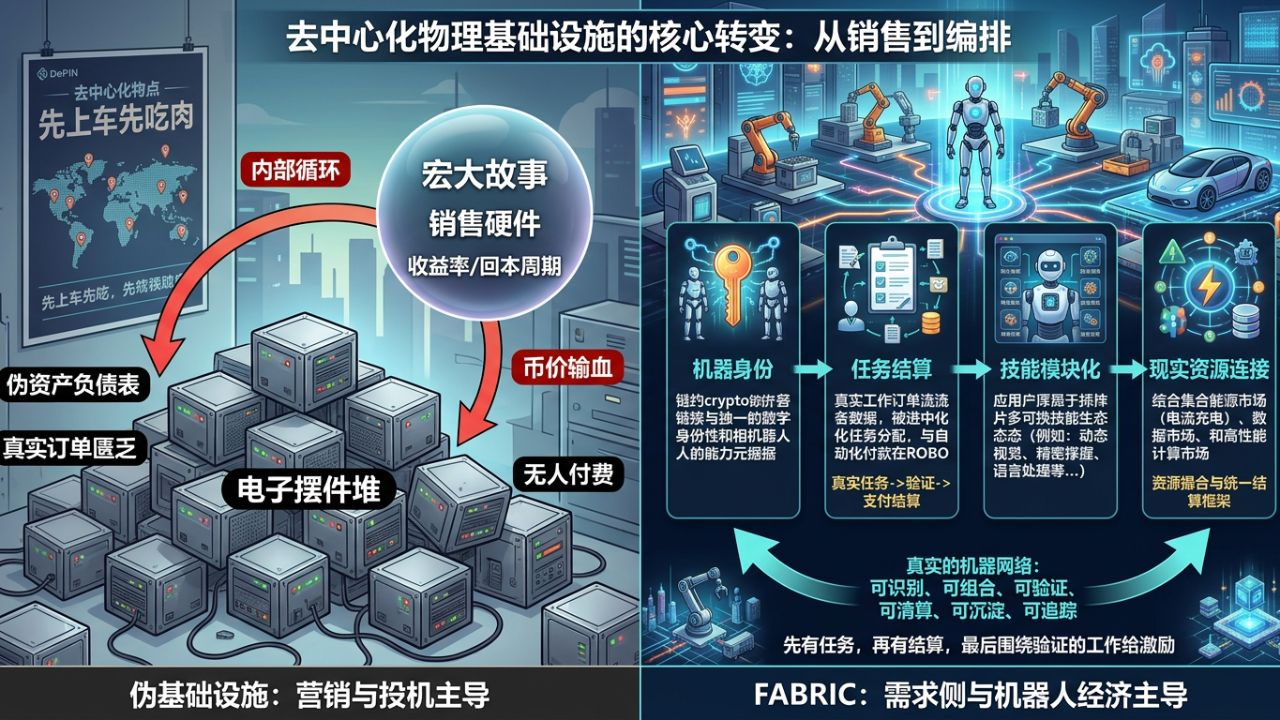
In the past two cycles, many people still associate decentralized physical infrastructure with that extremely crude formula: first tell a grand story, then shove in a packaged piece of hardware, and finally keep retail investors' attention firmly nailed to the payback cycle with returns. The story is about challenging cloud giants, the hardware is marketed as standardized boxes, and what is truly magnified is the illusion of speculators thinking 'first come, first served.' Thus, you will observe a very absurd phenomenon: the number of people claiming to be involved in physical networks is increasing, but the network services that people are genuinely willing to continuously pay for are scarce; machines are being sold more and more, yet real orders are not growing in sync; the node map is increasingly resembling a densely packed promotional poster rather than a business network graph that is continually lit up by demand.
This is why I've always felt that the simplest way to judge whether a project is pseudo-infrastructure isn't by how many devices it's sold, how many "nodes" are online in the community, or how many exaggerated annualized returns it's offered to early participants. The only thing you really need to look at is: has it first successfully implemented demand-side mechanisms? Without real tasks, there's no real settlement; without real settlement, there's no real cash flow; without real cash flow, even the most impressive device distribution map is nothing more than a bunch of electronic ornaments waiting for the coin price to inject capital. So-called decentralization, once it loses external funding, is essentially just internal circulation. Such a system isn't infrastructure; it's merely a money game disguised as hardware.
What interests me about the Fabric Foundation is precisely that it doesn't stop at simply "getting more people to buy a box, plug it in, and turn it on." Instead, it pushes the issue a step further: if machines truly do enter manufacturing, healthcare, education, logistics, and numerous real-world scenarios in the future, then how these machines are identified, constrained, assigned tasks, held accountable, settled, and collaborate with humans are fundamental issues far more complex than simply "selling mining rigs." The official website clearly outlines this direction: it aims not for single-point device sales, but for an open infrastructure where machines and humans participate together. This includes machine-human identity systems, decentralized task allocation and accountability, a payment system governed by location and human gating, and machine-to-machine communication and data channels.
This means that what Fabric is truly trying to address is not "recreating a market for routers that can mine cryptocurrency," but rather "integrating machines into a verifiable, settlement-enabled, and collaborative economic system." The difference between these two seemingly minor distinctions represents two entirely different worlds. The former's core is sales; the latter's is orchestration. The former focuses on getting you to buy quickly; the latter focuses on how machines can be reliably invoked in different scenarios. With the former, once the hardware is sold, the subsequent costs can be addressed later; with the latter, a series of complex questions must be answered: Who is the machine? What are its capability boundaries? Who assigns it tasks? Who is responsible for problems? How is task completion verified? How is payment made automatically? How are the benefits distributed among data and model contributions?
According to the white paper, Fabric's answer has several key pillars. First is machine identity. The white paper clearly states that in the future, each robot should obtain a unique identity based on cryptographic primitives and publicly expose metadata related to its capabilities, composition, interests, and behavioral rules; at the same time, the technical roadmap proposes to use standards related to identity, governance, and trust, and, where feasible, utilize hardware solutions such as trusted execution environments to support identity.
Without identity, a machine is merely an anonymous terminal; with identity, a machine can become a responsible and service-oriented entity within the network. The biggest problem with many so-called physical networks today is not a lack of devices, but rather that these devices are not "entities" at the protocol level, but merely numbers on a statistical panel. You cannot build long-term trust in them, design sophisticated pricing around them, or securely entrust them with real-world tasks. Machine identity is not just a marketing term; it determines whether the entire network can upgrade from "online means mining" to "trustworthy means order taking."
Second, it's about task settlement, not idle incentives. The white paper is very straightforward in its economic design section: ROBOs are used to pay for network-native fees, and services include data exchange, computing power tasks, and API calls. To lower the barrier to entry, task prices can be quoted in stable assets or fiat currency, but on-chain settlement will ultimately be converted to ROBOs. Meanwhile, the official roadmap prioritizes the initial deployment of robot identity, task settlement, and structured data collection in the first quarter of 2026; the second quarter focuses on contribution incentives based on verified task execution and data submission; and the third quarter further supports more complex tasks, repetitive use, and multi-robot workflows.
The most important aspect of this approach isn't the technical terminology, but rather the sequence: first, there's the task; then, there's the settlement; and finally, incentives are provided based on the validated work. This sequence is crucial because it directly reverses the "issue tokens first, then fabricate requirements" approach favored by many pseudo-infrastructure projects. Only when incentives are built upon completed work, submitted data, and provided services do tokens truly function as network fuel, rather than simply an exit strategy.
Third, it features modular skills, rather than a closed black box. The white paper describes ROBO One as a modern cognitive stack composed of dozens of functional modules. Specific capabilities can be added or removed through skill chips, similar to a mobile app store. The technical highlights further mention skill chips and app stores, which anyone can build and contribute to. As long as the underlying hardware and low-level software are sufficiently abstract, the ecosystem can migrate between different devices.
This point is often overlooked by the market, but it actually determines whether Fabric can form a true network effect. Because what's truly scarce is never a chip in a plastic shell, but rather "reusable capabilities." If a capability can only be locked into a certain brand of hardware, it's just a product; if a capability can be packaged, invoked, verified, billed, and migrated across multiple machine platforms, then it's close to a protocol. Today, most pseudo-hardware projects sell equipment at a premium, while Fabric attempts to facilitate the circulation of capabilities. Once capabilities become tradable units, the value of hardware no longer comes solely from the moment it's sold, but from every continuous invocation.
Fourth, it connects the machine economy with real-world resource markets, rather than allowing equipment to operate in isolation. The white paper specifically lists the electricity, skills, data, and computing power markets, explicitly stating that robots need electricity, real-time data, and computing power. Humans can provide high-end computing power to robots, and those with access to electricity can sell electricity to robots through automated charging facilities. Humans and robots can also share skills through constrained models.
This is crucial because it reveals that Fabric's potential extends beyond simply "robots making money on their own," placing robots within an open market comprised of various production factors. Electricity is a resource, data is a resource, computing power is a resource, and skills are also a resource. Whoever can establish a unified settlement framework for facilitating the exchange of these resources will have a greater chance of securing pricing power in the next generation of the machine economy. Many envision the future as the emergence of a super robot, but I believe a more realistic and impactful scenario is the first development of an underlying network that allows various machine resources to mutually access, pay for, and settle transactions. At that point, value won't necessarily reside solely in the companies that manufacture the robots; it's more likely to be embedded in the protocols responsible for identification, matching, settlement, and governance.
So if you absolutely must ask what the difference is between Fabric and those projects on the market that started by selling boxes, my answer is: the former attempts to establish a settlement syntax for a machine society, while the latter has merely invented a sales pitch more like consumer finance. A true machine network must allow machines to be identifiable, capabilities to be combinable, tasks to be verifiable, payments to be cleared, data to be accumulated, and responsibility to be traceable. Otherwise, no matter how many "nodes" there are, they are just balance sheets piled up on the ground. The biggest problem with many pseudo-narratives you see today is not that they are completely technologically nonexistent, but that they deliberately avoid the most difficult and crucial questions: who pays the bill, why should they continue to pay, and why should they pay through your network?
Of course, this doesn't mean Fabric has already secured its success. On the contrary, the real challenge for those working on the underlying technology is usually ten times greater than selling a set-top box. The white paper itself acknowledges that at this stage, it will first deploy smart contracts on existing compatible environments to create functional prototypes, while simultaneously designing the first-layer network to meet the specific needs of non-biological machines, and eventually moving towards a more complete mainnet form; the roadmap shows that it is currently in the early stages of component deployment, data collection, contribution incentives, and multi-robot workflow verification.
In other words, it's currently more like building a skeleton than a fully-fledged, muscular behemoth. Whether identity standards can be implemented across platforms, whether task verification can resist forgery, whether data quality can continuously improve, whether the open skills market can create positive feedback, and whether multi-machine collaboration can operate stably in real-world scenarios—all these still require time. The market has no shortage of people who treat roadmaps as reality, visions as revenue, and slogans as moats. If Fabric wants to prove itself different from those pseudo-infrastructures disguised as physical entities, it must continuously deliver verifiable results in the future: not by telling bigger stories, but by enabling more real-world tasks to be settled on-chain, enabling more machine identities to build credibility within the network, and enabling more contributors to be rewarded for their real work.
But it's precisely because it's difficult that it deserves serious attention. All infrastructure that truly has the potential to transform industry structures isn't particularly appealing in its initial stages. It lacks the simple, straightforward narratives of instant wealth, and it doesn't present exhilarating return-on-investment tables. Most of the time, it's tedious, reduced to words like protocols, standards, interfaces, drivers, verification, settlement, and governance—words that seem devoid of emotional value. Yet, what truly transcends economic cycles often resides precisely in these seemingly mundane aspects. Excitement is a friend to hardware sales; tedium is a friend to infrastructure.
I prefer to understand Fabric's potential value this way: it's not about teaching the market how to buy another new machine, but rather attempting to answer the question of how the massive number of machines, both existing and soon to emerge, can be integrated into a single, accountable, governable, and scalable network. If this is successful, the beneficiaries won't just be a single device category, but the entire machine economy. At that point, you won't see "whose boxes sell faster," but rather "whose protocols can handle more real machine activity." That will be a watershed moment, shifting from sales-driven to usage-driven growth, from a device narrative to a task narrative, and from speculative online rates to real productivity.
Therefore, stop lumping all projects related to physical equipment into the old framework of "buying machines and waiting for them to appreciate in value." That era is most prone to creating frenzy, and also most prone to creating ruin. What's truly worth watching isn't how many devices someone has pre-sold, but who is slowly piecing together the fundamental components like machine identity, task settlement, skill marketplaces, data collection, and cross-device collaboration. Fabric, at least in its public documentation, presents a route closer to this direction: first, bring machines into order; then, let machines create value; and finally, let that value be distributed within an open network. As for how far this path can ultimately go, the market will certainly continue to debate; but at least it raises a question more like the future than "mining air online," and offers an answer more like infrastructure than "selling boxes and pumping water."