

There is something about seeing numbers on a screen that makes people trust them almost instantly.
Maybe it is because numbers feel clean. They feel honest. They do not sound emotional, and they do not look confused. When someone is trying to understand their cycle, especially after months of guessing and second-guessing, that kind of clarity can feel like a lifeline. It feels better than wondering. Better than hoping. Better than staring at a calendar and trying to convince yourself that this month will somehow make more sense than the last one.
That is one of the reasons Mira has become so attractive to so many people. It offers something that feels more real than predictions. Instead of just telling you that ovulation “might” happen based on dates, it gives you hormone readings. It lets you watch patterns develop. For someone who has spent a long time feeling disconnected from their own body, that can be incredibly comforting. It can feel like the fog is finally lifting.
And honestly, that comfort is not fake. Mira can be useful. It can show changes in hormones that help a person understand when ovulation may be near and whether it likely happened afterward. That is valuable information. It can help with timing. It can reduce some of the monthly confusion. It can make a person feel a little less lost.
But this is where people often start expecting too much from it.
The problem is not that Mira gives useless information. The problem is that useful information can sometimes look bigger than it really is. A person sees a good-looking pattern and starts building hope around it. They think, my hormones look fine, so maybe everything is fine. If ovulation seems to be happening, then maybe there is no real problem. Maybe I just need more time.
That thought is understandable. It is also where things can quietly go wrong.
Because a tool can confirm one piece of the story without being able to rule out the rest.
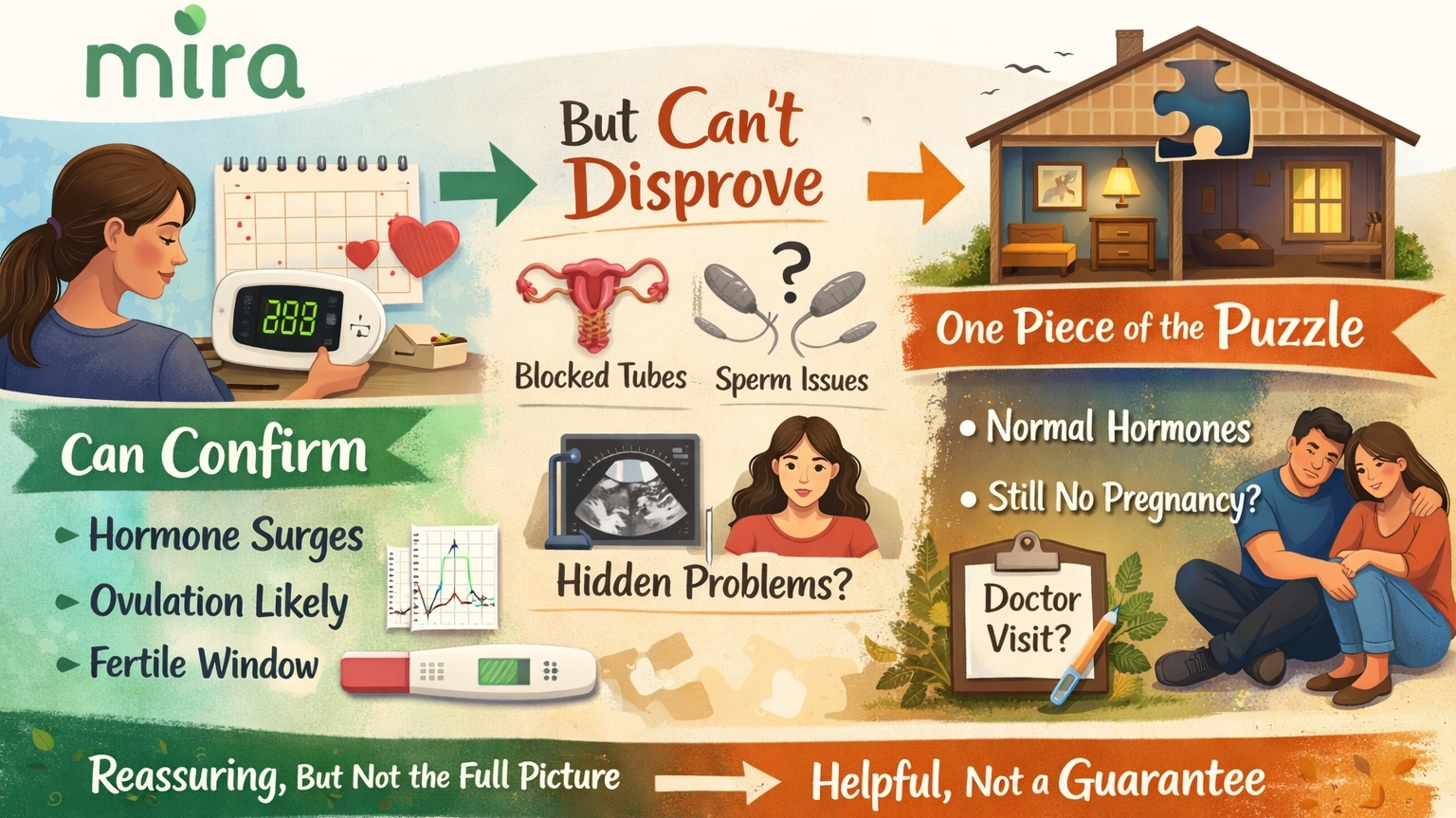
That difference may sound small at first, but it is actually huge. Confirming something is not the same as disproving everything else. A monitor might suggest that ovulation likely happened. That does not mean it can rule out fertility struggles. It does not mean it can prove there are no hidden issues. It does not mean it can tell you that pregnancy is only a matter of waiting.
Real life is rarely that simple.
A person can ovulate and still have trouble getting pregnant. Someone can have neat-looking hormone patterns and still deal with blocked tubes, endometriosis, sperm-related issues, or other problems that hormone tracking cannot see. That is the part many people forget when they get attached to a chart. The chart feels personal. It feels like evidence. And it is evidence, just not complete evidence.
It is a little like looking through one window of a house at night. You can see that the kitchen light is on. That tells you something real. But it does not tell you what is happening in every room. It does not tell you whether something is broken upstairs or whether another part of the house is in complete darkness. One visible sign can be true without telling the whole story.
That is what makes fertility tracking both helpful and tricky. It offers real clues, but not the full answer.
And people do not usually want clues. They want certainty.
That is especially true when emotions are already involved. Trying to conceive can turn even calm people into overthinkers. Every symptom starts to feel meaningful. Every cycle feels loaded. Every month carries hope, pressure, and fear all at once. In that kind of emotional space, a device like Mira can start to mean more than it should. It becomes more than a tool. It becomes reassurance. It becomes proof in the user’s mind, even when it was never designed to carry that much weight.
That is why a normal-looking pattern can sometimes create false comfort. Not because it is lying, but because people naturally want it to say more than it really can.
And to be fair, that reaction is human. When someone has been worrying for a long time, they want good news wherever they can find it. They want a sign that their body is working. They want something solid to hold onto. So when a chart looks promising, it is easy to breathe out and think, okay, maybe I’m fine.
But “maybe” is doing a lot of work in that sentence.
A person can have one part of their cycle working well and still have another issue sitting quietly in the background. Fertility is not made up of one single moving piece. It is a chain. And when pregnancy is not happening, the missing link is not always where people expect it to be.
That is why confirmation has limits.
Mira may help confirm that a hormone rose when expected. It may support the idea that ovulation likely took place. It may even help someone understand their fertile window much better than a basic app ever could. Those things matter. They can genuinely help. But they do not cancel out everything the device cannot measure.
It cannot check fallopian tubes. It cannot say anything about sperm. It cannot look for endometriosis. It cannot fully explain why pregnancy has not happened after months of trying. It cannot turn a “probably” into a guarantee.
And that is where many people get emotionally stuck. They start with a helpful tool, then slowly begin treating it like a final answer. When that happens, the disappointment can hit even harder. A person may think, but my chart looked good, so why am I still not pregnant? That confusion can feel brutal, especially when they have already invested so much hope into the data.
The truth is that the chart was only ever showing one part of the picture.
That does not make it useless. It just makes it incomplete.
In a way, that is what makes this whole subject so frustrating. People are not just looking for data. They are looking for relief. They want something to quiet the noise in their head. They want something that says, your body is okay, you are not failing, you are not running out of time, you are not missing something. But a hormone monitor cannot say all of that. It can only report what it sees.
Sometimes what it sees is helpful enough to guide better timing. Sometimes it helps someone notice patterns they never understood before. Sometimes it even gives a person a starting point for a much-needed conversation with a doctor. That might actually be one of its best uses. Not replacing medical care, but helping someone arrive at care with better information than they had before.
That is a much healthier way to look at it.
A tool like Mira works best when it is treated like a guide, not a judge. It can point. It can suggest. It can reveal patterns. But it cannot settle every fear and it cannot answer every question. Once people stop asking it to do that, they can appreciate what it does well without letting it create a false sense of certainty.
There is also something else worth saying here, and it matters just as much as the science: detailed tracking changes the emotional experience of having a cycle.
For some people, that is empowering. They feel more connected to their body. They feel informed instead of confused. They stop relying on random guesses and start noticing real patterns.
For others, it becomes exhausting. Every reading carries emotional weight. Every small shift feels loaded. A number that looks good can make the whole day feel hopeful. A number that looks strange can ruin the mood before breakfast. The body starts to feel less like a body and more like a puzzle that must be solved perfectly.
That can be a hard way to live.
The danger is not just misinformation. The danger is also emotional overinvestment. A person can start reading each chart like it is delivering a verdict on their future. That is a lot of pressure to put on a device that was never meant to provide certainty in the first place.
Sometimes what people need most is not more testing, but a gentler relationship with the information they already have.
Because not every useful thing has to become a final answer.
Mira can help someone understand timing better. It can make the fertile window less confusing. It can support the idea that ovulation likely occurred. It can help a person notice when something seems off and needs more attention. Those are meaningful strengths. They should not be dismissed.
But it cannot disprove fertility problems simply because part of the cycle looks normal. It cannot promise that nothing is wrong. It cannot see the full story of a person’s reproductive health.
That is the heart of it.
What Mira can confirm is not always what it can disprove.
And maybe that is the part people need to hear most. Not because the tool is bad, but because hope can make people stretch small answers into big ones. When you are waiting for something important, even a little reassurance can start to feel like certainty. But those two things are not the same.
A clearer window is still only a window.
It can help you look in. It can show you movement. It can give you signs you did not have before. But it cannot show every room, every corner, every hidden problem, or every reason something is not happening the way you hoped.
That does not make it worthless. It just means it should be held with honesty.
And sometimes honesty is more helpful than false comfort. A tool can support you without saving you. It can inform you without defining your entire situation. It can be part of your journey without being the whole truth.
That is a much more human way to see it.