
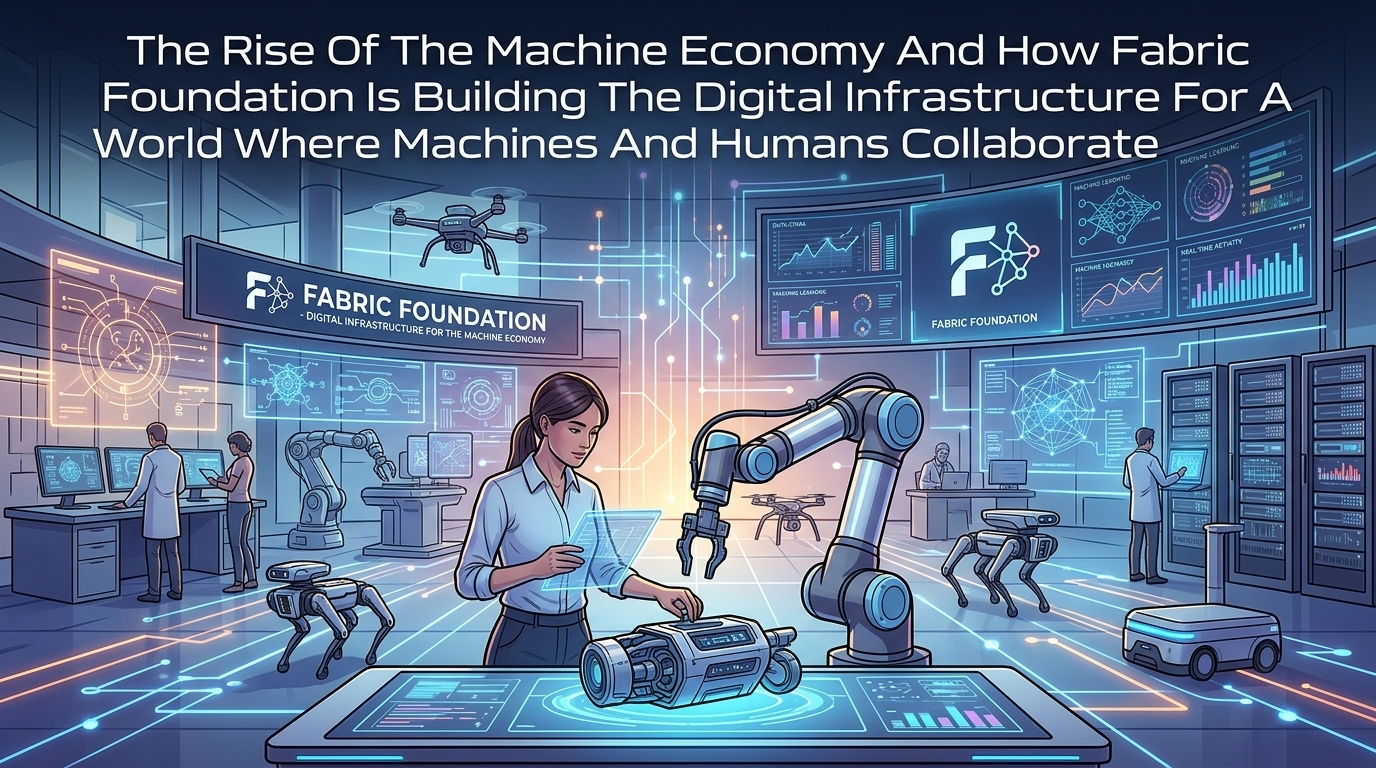
The world is slowly entering a technological era where artificial intelligence and robots are becoming part of everyday life. When I look at how fast technology's evolving I think we are witnessing the early stages of something much bigger than simple automation. Machines are no longer limited to doing the tasks over and over in factories. Today intelligent systems can look at information learn from data and even make decisions that once required human judgment. They are becoming participants in many industries from logistics and healthcare to finance and digital services.. While these machines are becoming smarter and more capable the systems that manage our economy and digital infrastructure were never designed with intelligent machines in mind. Most financial systems, governance structures and identity frameworks are built around users. This creates a gap between the capabilities of technology and the systems that support it. Fabric Foundation is trying to address that gap by creating an infrastructure where humans and machines can interact, collaborate and participate in decentralized economies together.
When I think about the concept of a machine economy it feels like something that once belonged in science fiction.. The more I study how technology is developing the more real this idea becomes. A machine economy is essentially a system where intelligent machines such as robots and artificial intelligence agentsre able to perform tasks generate value and participate in economic activities without constant human supervision. Of being passive tools that simply execute commands these machines can become independent participants in digital networks. They can complete tasks, access services. Even receive payments for the work they perform. Fabric Foundation is focused on building the economic framework that allows this type of system to exist. The project is not simply building another blockchain platform. It is trying to create the foundation for an economic environment where machines and humans operate together in a decentralized and transparent way.
As automation continues to expand across industries the number of machines operating around the world could grow dramatically. Imagine millions or even billions of devices performing tasks every day across transportation networks, manufacturing systems, supply chains, digital platforms and service industries. Many of these machines will operate autonomously meaning they will be capable of making decisions and executing actions in time. For this to work efficiently machines must have the ability to identify themselves communicate with systems and exchange value with other participants in the network. Traditional infrastructure does not support these requirements well because it was designed for human identities, human banking systems and centralized control. Fabric Foundation is developing a blockchain-based infrastructure that allows machines to interact with networks as independent participants. This creates a framework where machines can operate securely and transparently while still remaining part of an economic ecosystem.
One of the important ideas behind Fabric Foundation is the concept of machine identity and trust. In society identity is verified through systems such as passports and national identification cards. These systems allow individuals to prove who they are when interacting with institutions and services. Autonomous machines do not have access to these types of identification systems. They still need a reliable way to prove their authenticity and maintain trust within digital networks. Fabric introduces decentralized identities that allow machines, robots and artificial intelligence agents to establish a verifiable presence within the ecosystem. These identities allow machines to demonstrate that they are participants rather than malicious actors or compromised devices. Over time these digital identities can also build reputations based on their behavior, reliability and performance. This reputation layer becomes extremely important in a world where machines interact with each other constantly because trust becomes a factor in maintaining secure and efficient systems.
Another major component of Fabric Foundation is enabling financial interactions between machines. When I think about the future of automation I often imagine devices completing tasks and services without any involvement. A delivery robot might transport goods across a city or an artificial intelligence system might analyze datasets for research organizations. In all of these scenarios the machine is performing work that generates value. However traditional payment systems require intermediaries to receive payments and manage financial transactions. This creates friction and complexity. Fabric Foundation uses blockchain technology and smart contracts to allow machines to exchange value directly with each other. For example a robot completing a delivery could automatically receive payment once the task is verified. These automated transactions create an economic flow where machines can function as independent economic agents.
Governance is another area where Fabric Foundation introduces an innovation. As decentralized machine networks grow larger there must be systems in place that determine how the network evolves how security is maintained and how decisions are made about upgrades or changes. Traditional centralized systems rely on a company or authority to manage these decisions. Fabric instead embraces governance where participants in the ecosystem help shape the direction of the network. This governance structure allows developers, users and other stakeholders to collaborate in maintaining the system. By distributing decision-making across the network the platform reduces the risk of control and encourages a more transparent and resilient environment for innovation.
The ecosystem surrounding Fabric Foundation is also designed to encourage builders and innovators to explore possibilities. Developers, robotics companies, artificial intelligence researchers and technology startups can use the infrastructure provided by Fabric to create applications that connect machines with networks. These tools make it possible for autonomous devices to interact with blockchain systems execute contracts and participate in automated service marketplaces. Over time this could lead to new industries built around machine-driven services. Of relying on centralized platforms to coordinate activities machines could collaborate through decentralized protocols that allow them to negotiate tasks distribute rewards and share resources efficiently.
Within this ecosystem the ROBO token plays a role in supporting economic activity. The token acts as the native utility asset that powers transactions across the network. Machines and users can use ROBO to pay for services, access network resources and interact with applications built on the platform. This creates an economic layer that aligns incentives across the entire ecosystem. When participants contribute value to the network they are rewarded through the economic system that powers machine interactions. This alignment of incentives helps ensure that the ecosystem continues to grow while maintaining stability and transparency.
One of the fascinating possibilities that emerges from this type of infrastructure is machine-to-machine commerce. In this environment intelligent devices can interact economically without requiring human supervision. Autonomous vehicles might coordinate transportation routes while automatically distributing payments for fuel, charging or maintenance services. Artificial intelligence agents might purchase data or computational resources in order to complete research tasks. Robots working in manufacturing environments could collaborate on production processes while automatically dividing revenue based on their contributions. These interactions create a new model of economic activity where machines become productive digital participants rather than passive tools controlled by humans.
The real-world applications of this technology extend across different sectors. In logistics autonomous delivery systems could operate continuously while managing their payments and scheduling tasks through decentralized networks. In healthcare robotic assistants might coordinate services, supply management and patient support more efficiently than traditional systems. In industries artificial intelligence agents could provide analytics, automation and other services through decentralized marketplaces where customers access machine-powered tools directly. By providing the infrastructure that allows these interactions to take place Fabric Foundation opens the door to a range of innovations that could reshape how industries operate.
Course building a machine economy is not a simple challenge. Integrating robotics, artificial intelligence and blockchain technology requires engineering and collaboration across multiple fields. Security is an important concern because autonomous machines operating within open networks must be protected from malicious attacks or system failures. There are also questions that governments and policymakers will need to address as machine-driven economic systems become more common. These challenges require planning, responsible development and cooperation between technology organizations, researchers and regulators.
With these challenges the long-term direction of technological progress suggests that autonomous systems will become an increasingly important part of global industries. Artificial intelligence models continue to improve robotics hardware is becoming more capable and affordable and decentralized networks are gaining greater adoption across the world. Fabric Foundation positions itself at the intersection of these trends by building infrastructure that supports collaboration between humans and machines. Of waiting for the future to arrive the project is actively working to build the systems that could support it.
What makes this vision particularly powerful is the shift in perspective it represents. For decades machines have been viewed as tools that simply follow instructions. In the future machines may become participants in digital ecosystems capable of making decisions performing work and exchanging value within decentralized networks. Fabric Foundation is trying to create the structure that allows this transformation to happen in a safe and transparent way.
When I reflect on this idea I realize that the machine economy is not about technology. It is also about redefining how value is created and distributed in a world where intelligent systems play a role in productivity. Humans will still design, guide and benefit from these systems. Machines will increasingly contribute to economic activity in ways that were never possible before. Platforms like Fabric Foundation may become the bridges that connect creativity with machine intelligence.
As the boundaries between humans, machines and digital networks continue to blur, infrastructures, like Fabric could become components of the global digital landscape. The machine economy is slowly moving from theory to reality and the systems that support it are beginning to take shape. Fabric Foundation represents one of the efforts focused on building that foundation creating a decentralized framework where intelligent machines and humans can collaborate, transact and grow together in an open economic environment.
@Fabric Foundation #ROBO $ROBO
