


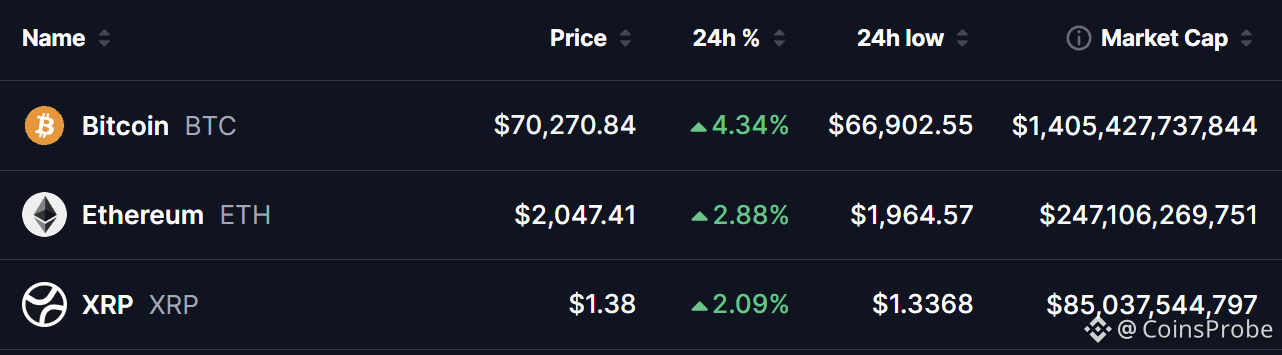
In a striking rebound amid ongoing global tensions, Bitcoin (BTC) has reclaimed the psychologically significant $70,000 level, trading at $70,270.84 as of early March 10, marking a robust 4.34% gain over the past 24 hours. Ethereum (ETH) followed suit, climbing to $2,047.41 (+2.88%), while $XRP surged to $1.38 (+2.09%). The moves come after a period of volatility driven by the U.S.-Israel-led conflict with Iran, but today's pump signals a clear shift toward risk-on sentiment in crypto markets.
 Source: Coinmarketcap
The total cryptocurrency market capitalization has risen by 3.44% over the past 24 hours, with Bitcoin’s dominance remaining relatively stable as major altcoins like ETH and XRP join the upside.
During the same period, $BTC fell to a 24-hour low of $66,902.55 before staging a sharp rebound, highlighting the strength of the recovery from recent dips. Bitcoin’s market capitalization has now surpassed $1.4 trillion, reinforcing its leading position in the digital asset market.
Geopolitical Tensions Ease, Boosting Risk Assets
One of the primary catalysts behind the rally appears to be easing fears surrounding the ongoing conflict with Iran.
In recent interview with CBS news, U.S. President Donald Trump stated that military operations were “very complete, pretty much,” noting that Iran had reportedly lost significant military capabilities, including naval and air force assets. He also indicated that the campaign was progressing far ahead of the originally projected four- to five-week timeline, suggesting that the conflict could conclude sooner than expected.
These remarks helped calm concerns about prolonged instability in the Middle East—particularly fears of energy supply disruptions through the Strait of Hormuz, a critical global oil transit route.
As geopolitical uncertainty began to fade, investors shifted back toward risk assets, including equities and cryptocurrencies.
Oil Price Decline Adds Fuel to the Rally
Another factor supporting today’s crypto rebound is the sharp drop in oil prices.
Reports indicate that G7 finance ministers are discussing a coordinated release of up to 400 million barrels from strategic petroleum reserves, potentially in cooperation with the International Energy Agency (IEA). The move aims to stabilize energy markets after earlier price spikes triggered by Middle East tensions.
The possibility of a large-scale reserve release has pushed U.S. crude prices lower, easing concerns about inflation and supply shocks. Lower energy prices often improve overall market sentiment, encouraging capital flows into higher-risk, high-growth assets like cryptocurrencies.
Technical and Market Forces Amplify the Move
Beyond macro developments, several market dynamics are also contributing to the rally:
Short squeezes: Negative funding rates earlier in the week forced bearish traders to cover positions, accelerating upward momentum.
Institutional demand: Spot Bitcoin ETFs recorded positive net inflows of roughly $57.08 million on March 9, providing additional buying pressure.
Risk-on rotation: Global equity markets have rebounded alongside crypto, reinforcing the trend toward riskier assets.
This combination of macro relief and technical momentum has helped propel Bitcoin and major altcoins higher.
Looking Ahead
Despite the strong rebound, traders remain cautious as the market approaches key technical levels.
Resistance: $72,000–$74,000 range, where Bitcoin previously faced selling pressure.
Support: $66,000–$67,000 zone, which could act as a cushion if momentum slows.
Any sudden changes in geopolitical developments or renewed volatility in oil markets could quickly alter sentiment.
For now, however, the narrative has shifted from fear to cautious optimism. With geopolitical tensions easing and energy prices stabilizing, investors appear increasingly willing to return to crypto—pushing Bitcoin, Ethereum, and XRP back into the green
Disclaimer: The views and analysis presented in this article are for informational purposes only and reflect the author’s perspective, not financial advice. Technical patterns and indicators discussed are subject to market volatility and may or may not yield the anticipated results. Investors are advised to exercise caution, conduct independent research, and make decisions aligned with their individual risk tolerance.