


A few years ago, the industry's focus was on GameFi and NFTs; today, almost the entire ecosystem is discussing two new keywords: RWA and AI.
From stablecoins to government bonds, from real estate to commodities, an increasing number of real-world assets are entering blockchain systems. Meanwhile, AI is also changing the way software is developed, vulnerabilities are discovered, and security audits are conducted.
But behind these grand narratives, a more practical question remains: as more and more real assets enter the on-chain system, is the blockchain's security model truly ready?
In this conversation, Hyperbridge core member Seun shared some very frank opinions.
In his view, the biggest risk of RWA doesn't actually come from the technology, but from counterparty risk—that is, whether the asset issuer truly holds sufficient real-world assets. As more institutions enter the blockchain space, more transparent issuance models, such as listed companies issuing stablecoins or asset certificates, may become an important trend in the future.
At the same time, AI may also profoundly change the blockchain security environment. Seun believes that the most direct impact of AI is actually accelerating the speed of vulnerability discovery. In the future, if AI can automatically scan protocols and attempt to attack systems, the entire industry may enter a stage of "Darwinian evolution," where only truly secure and robust protocols will survive in the long term.
Furthermore, Seun shared Hyperbridge's focus for 2026, shifting from infrastructure to new application scenarios – cross-chain payments. Seun believes these demands are continuously growing, but the core driving force behind this is actually on-chain foreign exchange. Currently, more and more fiat stablecoins are being added to the blockchain, such as the Japanese yen, Brazilian real, and Indonesian rupiah stablecoins. Cross-border payments and foreign exchange transactions are gradually migrating to the blockchain, while the foreign exchange market itself has a daily trading volume of up to $9 trillion.
In response to this trend, Hyperbridge is developing a new product direction, HyperFX, which will allow users to not only transfer stablecoins across chains, but also trade stablecoins directly on the same chain, thereby serving cross-border payments and the on-chain foreign exchange market.
Continue reading to see the latest and most exciting discussions from PolkaWorld's live stream!
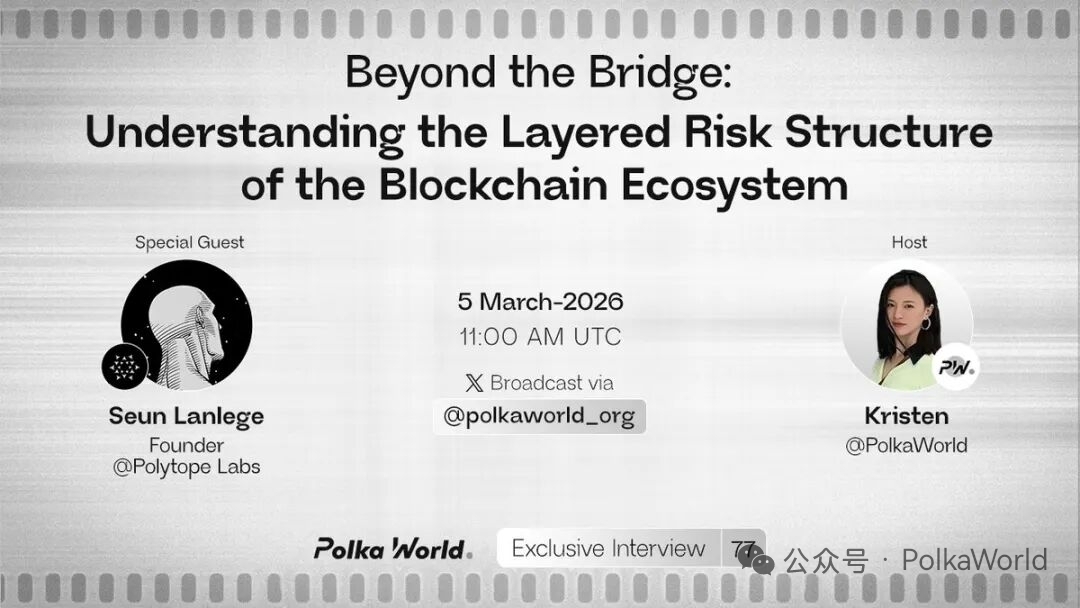
Kristen: As the industry evolves, application trends are constantly changing. Previously it was games and NFTs, but now, RWA has become a popular direction across almost all ecosystems. What are your thoughts on the potential risks of RWA applications?
Seun: To be honest, I don't see too many technical risks at the moment. The only relatively obvious risk is counterparty risk. That is, the asset issuer may not actually be using real-world assets as sufficient collateral. But I think this problem can be mitigated by making the asset issuer a publicly traded company.
For example, I recall that Circle is now a publicly traded company. This means their balance sheet is public, which in a sense is similar to the transparency of blockchain.
Therefore, I believe that the best model for future asset issuance is for it to be conducted by transparent and open institutions.
Kristin: Another very hot trend right now is AI. Do you think AI will bring new technological risks or security threats to the crypto industry?
Sean: I think the main change AI will bring is accelerating the speed of vulnerability discovery. More precisely, it will accelerate the discovery of vulnerabilities in existing protocols. From a strange perspective, this will actually make the entire ecosystem more secure. Because vulnerabilities will be discovered faster, and they will also be exploited faster.
If a future environment emerges where AI automatically scans for vulnerabilities in blockchain systems and attempts to exploit them, then those protocols that ultimately survive will follow a Darwinian evolutionary process: only the strongest and most adaptable protocols will survive.
Kristin: Speaking of AI, do you have any plans to incorporate AI into your development roadmap?
Seun: We are now exploring this “Agentic era” and what it means for software products as a whole.
We are currently seeing a trend where more and more software products are incorporating AI systems as their user interface. This means that in the future, users may not operate software through traditional interfaces, but rather interact with it directly through AI.
I'm still observing whether this will truly become the primary way software products are used in the future. The possibility certainly exists, but I think a truly comprehensive shift will take some time.
However, one thing is certain: we will indeed begin to explore AI as a new direction for the user interface of software products.
Kristin: Let's get back to the topic of security. From a broader perspective, as you just mentioned, if we want to ensure protocol security, developers must be more responsible, and builders need to be accountable for their protocols.
But the question is, can security be designed into the protocol itself? In other words, can security become part of the system?
Currently, it seems that security responsibility often falls on developers. However, in an ecosystem, there are many other roles, such as infrastructure providers and various application developers, each with different responsibilities. If we simply say "developers need to be responsible for security," then we ultimately come back to the human element. And humans are inherently unpredictable. Therefore, can security become a system-level mechanism, rather than relying solely on humans?
Seun: Yes, that's actually our core philosophy. Our system must be designed to be "resilient".
I emphasize the word "resilience" because problems can occur at any layer of the entire technology stack. For example, an RPC provider might return incorrect data, or the infrastructure might be attacked.
For example, suppose there is a cross-chain bridge that relies on a group of trusted people to verify data, but if these people's RPC providers are attacked and provided with incorrect data, then these people will submit the error information to the cross-chain bridge system.
Technically, they were actually fulfilling their duties normally. However, because the infrastructure they relied on was compromised, and the protocol itself lacked sufficient resistance to attacks, the entire protocol was compromised.
So when designing a system—and I'm going to put it a bit more abstractly now, especially in a blockchain system—you need to start with a basic assumption: don't trust anything.
This is also Hyperbridge's core philosophy: Nothing can be trusted. Everything must be proven.
This is the cornerstone of our security model.
This is why our relayers can even use public RPCs. Even if these public RPCs provide them with incorrect data, they still cannot generate valid proofs using that incorrect data.
So my philosophy is very simple: if you're building a blockchain system, you shouldn't trust anything. Once you introduce a trusted layer, a trusted person, a trusted account, that "point of trust" becomes a vulnerability, an entry point, a potential backdoor, and could even become a backdoor that the project team itself can exploit.
Kristin: Before we conclude, I'd like to ask one last question: What are Hyperbridge's biggest priorities for 2026? And what developments should the community most expect?
Seun: We are still working on Hub integration. However, before Hyperbridge can be truly deployed on Polkadot Hub and support cross-chain asset flows, there are some fundamental issues on the Hub that need to be fixed. So from the perspective of DeFi use cases, this is still our top priority.
But frankly, we are now also exploring a new application scenario: cross-chain payments.
Currently, there are two main demand drivers for cross-chain asset flows: DeFi and payments.
When I say DeFi, I mean users crossing blockchains to trade, yield farm, and perform various DeFi operations. For example, I might cross-chain assets to Polygon to participate in Polymarket trading, or to Hyperliquid for perpetual contract trading. However, based on our experience, the demand for cross-chain transactions in DeFi is actually quite volatile. If token prices perform poorly, as we've seen in the past few months, the demand for cross-chain asset liquidity will decrease significantly.
However, we have recently observed a continued increase in demand for cross-chain asset flows used for payments. Therefore, we are now paying closer attention to this market trend and making it a key focus of our business development.
However, I'd like to add that the concept of "payment" is actually very broad, and it doesn't fully explain what drives these payment demands. In fact, we later discovered that the real driving force behind this payment demand is on-chain foreign exchange. Simply put, people pay each other with stablecoins on the blockchain, and then exchange and withdraw these stablecoins to their local bank accounts.
At the same time, we are also seeing a new trend: more and more fiat-backed stablecoins are going on-chain. For example, the Japanese yen stablecoin, the Brazilian real stablecoin, and the Indonesian rupiah stablecoin are all going on-chain. I believe that eventually every major country will have its own stablecoin on-chain. Therefore, one of our core judgments is that as these stablecoins continue to increase, the entire foreign exchange market will gradually migrate to the blockchain.
The foreign exchange market is enormous, with a daily trading volume of approximately $9 trillion.
Of course, a large part of this is speculative trading, such as leveraged foreign exchange trading and speculative market trading, but at the same time, a large amount of demand also comes from cross-border payments, cross-border remittances, and international trade.
Therefore, we are currently focusing on developing a new product called HyperFX. This product will allow users to not only trade stablecoins across chains, but also trade stablecoins on the same chain. From our perspective, this is a very important product strategy, and it can even be said that it will run through the entire future development cycle of Hyperbridge.
As I just mentioned, we must understand why people need to transfer funds across blockchains.
Only by understanding these real needs can we find better ways to serve these users.
Of course, there will be more news about this product in the future. We will release some official announcements in the coming weeks.
But overall, this is the direction of our new product strategy.
Kristin: Okay, I'm glad to hear that. Last year I attended Hong Kong FinTech Week, and I found that almost 90% of the booths were related to payment applications or projects. So I think payments are definitely a very promising area of development.
Okay, thank you very much for sharing, and thank you to all the viewers for listening today. That concludes today's program.
Seun: Have a nice day, goodbye.
Original video: https://x.com/i/broadcasts/1OGwblnyglvKB
PolkaWorld Telegram group: https://t.me/+z7BUktDraU1mNWE1
PolkaWorld YouTube Channel:
https://www.youtube.com/c/PolkaWorld
PolkaWorld Twitter:
@polkaworld_org