

If a traditional robodog has a broken leg, it instantly turns into a useless piece of metal. Engineers decided to eliminate this vulnerability by proposing a completely new concept. They created modular mechanisms that adapt to rough terrain and continue to operate even after being cut in half. The severed parts do not become dead weight — they can crawl back on their own to reunite with the main body and complete missions of any complexity.
Evolved walking metamachines
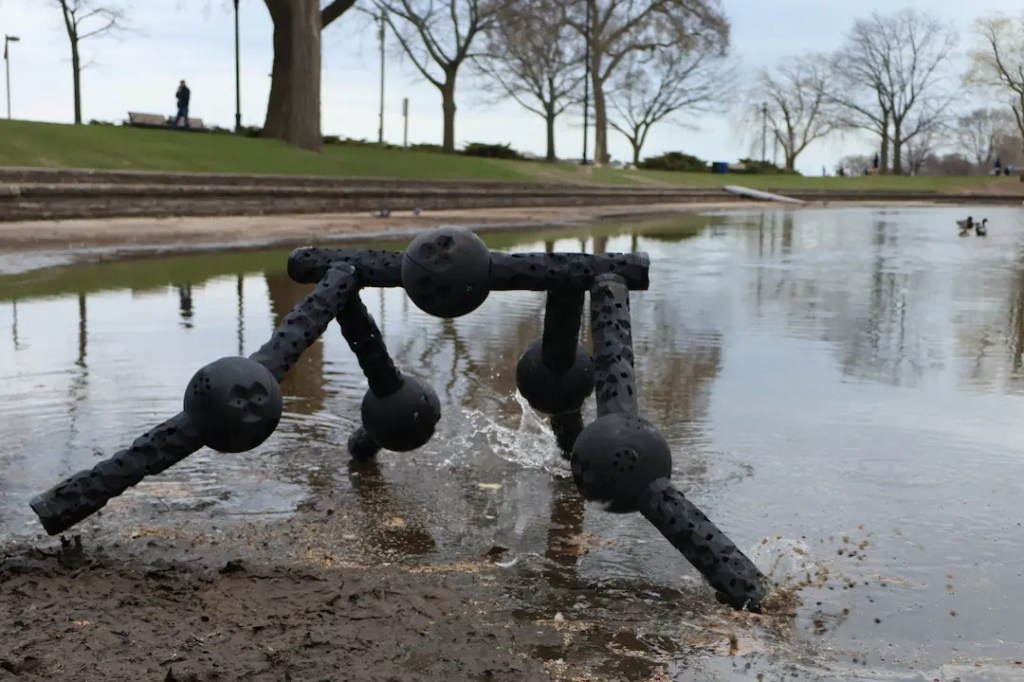
Modular robots capable of changing shape and recovering from damage. Authors: Northwestern University. Source: techxplore.com.
DIY or Do It Yourself
Popular science
Overview
If a traditional robodog breaks its leg, it instantly turns into a useless piece of metal. Engineers decided to eliminate this vulnerability by proposing a completely new concept. They created modular mechanisms that adapt to rough terrain and continue to operate even after being cut in half. The severed parts do not become dead weight — they can crawl back on their own to rejoin the main body and complete missions of any complexity.
Evolved walking metamachines
AI-generated modular robots move across uneven terrain
Modular robots capable of changing shape and recovering from damage. Authors: Northwestern University. Source: techxplore.com.
The image shows AI-generated modular mechanisms assembled from spherical nodes and rods, moving through a natural landscape. Authors: Northwestern University. Source: techxplore.com.
Anatomy of a 'living' constructor
The research results, published in the scientific journal Proceedings of the National Academy of Sciences, introduce a new term to robotics — 'walking metamachines.' Essentially, these are robots entirely made up of other, smaller robots.
The basic building block is a half-meter module, resembling a pair of sticks connected by a central sphere. The lead researcher, assistant professor Sam Krigman, compares the contents of this sphere to biological systems: hidden inside are a 'nervous system, metabolism, and muscles' — that is, a microchip, a battery, and an electric motor.
Despite their mechanical simplicity and ability to rotate only on one axis, each such module is a fully autonomous agent. Individually, they can roll, jump, and turn. But as soon as several spheres connect together like a Lego constructor, they exhibit what is called athletic intelligence. Composite machines begin to move in a wave-like manner, similar to seals, make sharp jerks like lizards, or jump like kangaroos.
Evolution in silicon
Engineers did not construct the bodies of the metamachines manually by copying dogs or humans. Instead, they delegated the task to artificial intelligence, which was instructed to simulate natural selection. In a virtual physical environment, the AI randomly connected blocks, tested the resulting configurations, ruthlessly discarded the failures, and 'crossbred' the best options.
Thanks to artificial mutations, bizarre three-, four-, and five-legged forms emerged, which a human would hardly have thought of. Depending on the final design, the same basic blocks took on roles of legs, a flexible spine, or a tail.
For Krigman's laboratory, this is not the first similar experiment. According to CBS News, in October 2023, the same team demonstrated an algorithm that designed a soft purple robot from scratch in 26 seconds, learning to walk on its own. However, those early models lacked coordination and could not perceive their own body. The new metamachines, in contrast, are capable of assessing their environment and coherently managing dozens of components.
Wildlife testing
A key stage of the work was the transition of the mechanisms from simulation to the real world. The metamachines were sent outside, where they encountered gravel, grass, tree roots, mud, sand, and uneven cobblestones. According to the researchers, this is the first case in history where robots generated by an evolutionary algorithm successfully operated outside the laboratory walls.
In rough terrain, the devices demonstrated frightening resilience. They jumped, spun in the air, and when overturned, instinctively flipped back over, doing so without any additional training. If a critical failure is simulated and a leg is torn off the machine, the system instantly reorganizes: the remaining modules change their movement pattern, compensating for the loss, while the severed limb crawls back on its own to reattach.
https://youtu.be/kelysQlBnao?si=-TqkYPOYhKxqONi9
The development, supported by the U.S. National Science Foundation and the Schmidt Sciences AI2050 program, could radically change the approach to rescue operations. In the future, autonomous swarms of such metamachines could explore disaster zones and hard-to-reach areas. If one component gets buried under rocks or fails, the robot simply reassembles itself on the fly and continues searching for survivors, blurring the line between a fragile tool and a living organism.
#robo @Fabric Foundation $ROBO
