

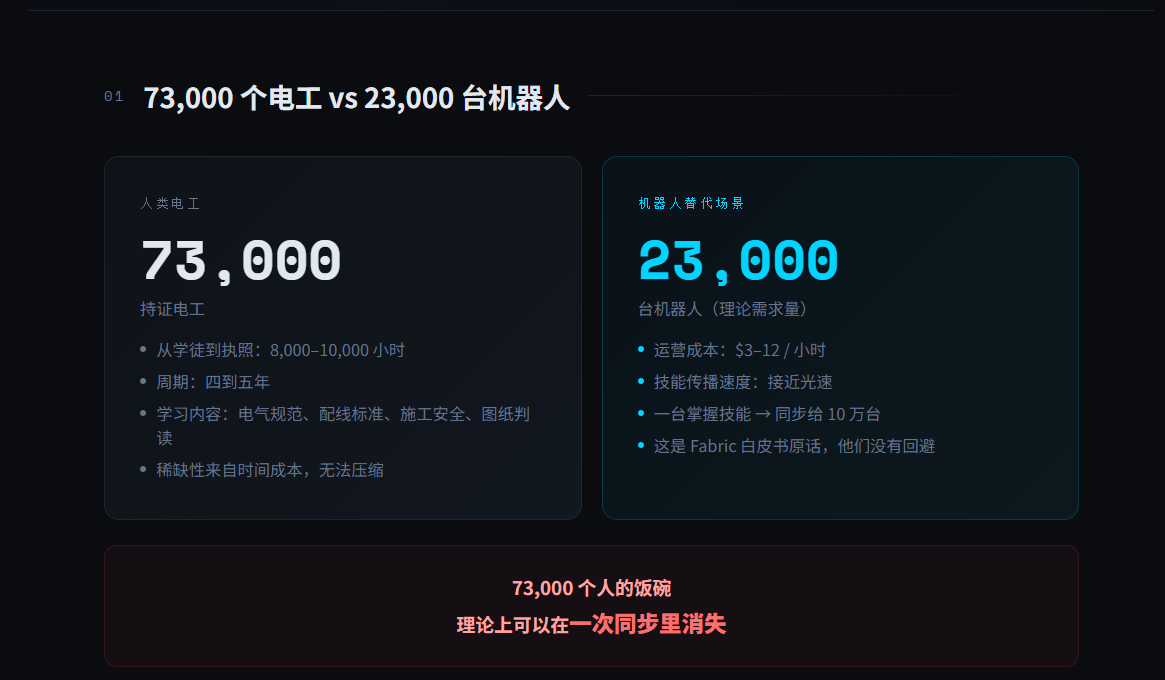
73,000 certified electricians.
Every person, from apprentice to licensed, takes an average of 8,000 to 10,000 hours.
Four to five years.
During this time, you need to learn electrical standards, wiring standards, construction safety, and blueprint interpretation.
This scarcity comes from the cost of time.
You cannot compress a decade of an electrician's experience into a USB drive.
But robots can.
@Fabric Foundation There is a passage that I have read several times:
Once a robot masters electrical standards and the required operational capabilities, it can synchronize this skill to 100,000 other robots.
It is not about copying configuration files.
It is the skills themselves that spread between machines at near-light speed.
If this really happens, the electrician work theoretically only needs about 23000 robots, with an operational cost of $3 to $12/hour per robot.
73000 people's livelihoods disappeared in a single synchronization.
I am not inciting panic. This is a direct quote from the white paper, written by the Fabric Foundation itself.
They did not shy away from this issue but placed it right at the forefront.

However, there is a premise that is rarely discussed:
The ability for robots to share skills does not equate to robots being qualified to share skills.
How do you know that the "electrician skill" synchronized by this robot is genuine and effective?
Where has it worked? How many tasks has it completed? Have there been any accidents?
Where are the records of compliance? Who will vouch for it?

Electricians have licenses, work records, and liability traceability in case of issues.
Currently, robots have nothing.
Skills can spread instantly, but trust cannot.
This is where Fabric truly aims to solve problems.
It is not about making robots faster, but making the dissemination of robot skills trustworthy.
Every robot accessing the Fabric network holds a globally verifiable identity on-chain.
Who it is, who controls it, historical task completion status, quality rating, and whether it has been punished.
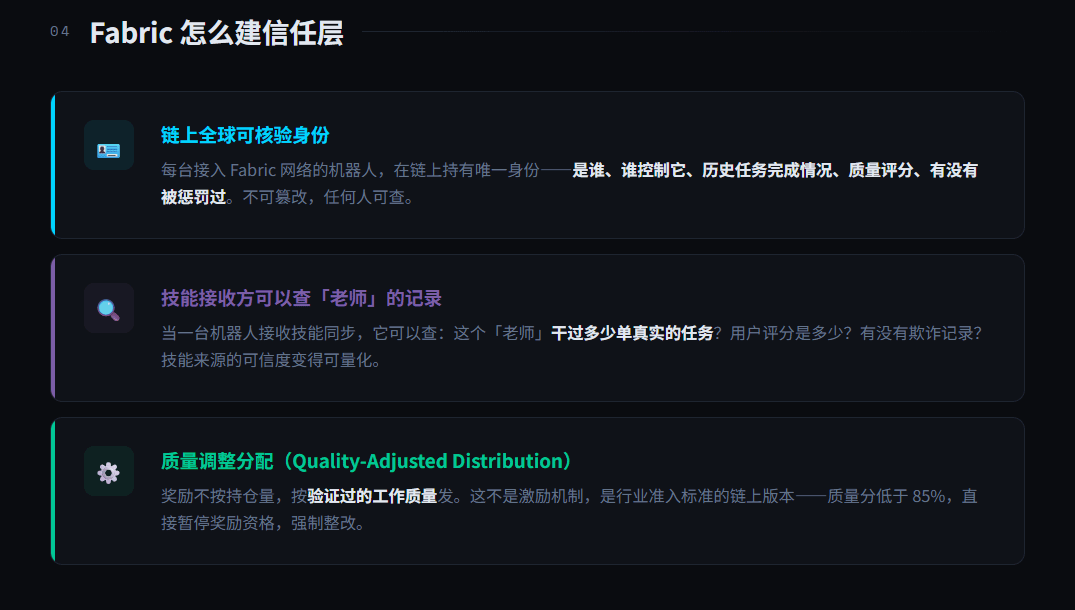
When one robot synchronizes skills to another, the receiving party can check:
How many real tasks has this "teacher" completed?
What is the user rating?
Is there a fraud record?
There is a mechanism in Fabric called Quality-Adjusted Distribution:
Rewards are distributed based not on the amount held, but on the verified quality of work.
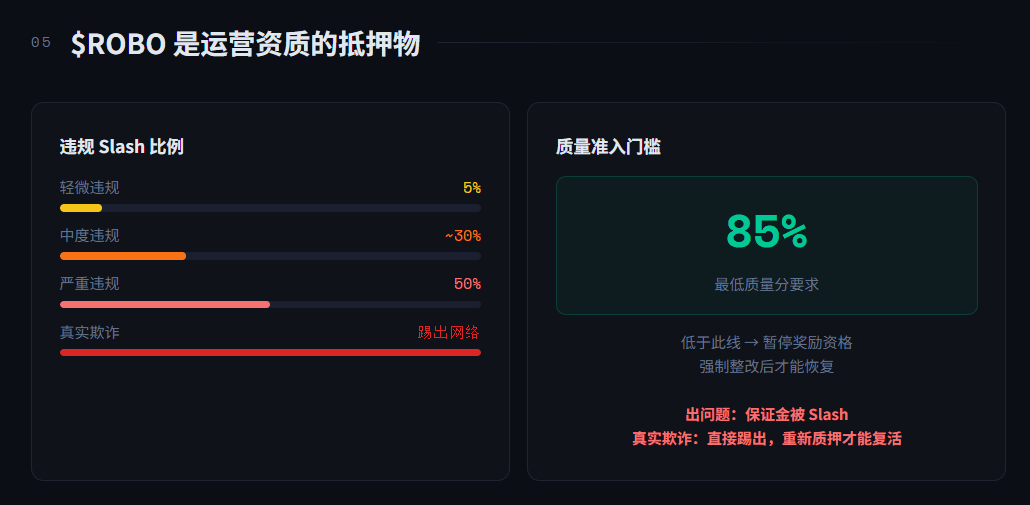
A robot with a quality score below 85% will have its reward eligibility suspended and will be forced to rectify.
This is not an incentive; it is the on-chain version of industry entry standards.
I feel there is a deeper aspect here worth discussing.
The skill system of humanity is essentially a trust infrastructure.
Licenses and certifications serve not to prove that you "can," but to prove that you are "trustworthy."
The speed of robot skill sharing has already been solved.
But the trust infrastructure was blank before this.

Without this, the robot economy is not expansion; it is uncontrolled expansion.
A robot without any records took on an unverified electrician skill and accepted a real construction task—
When something goes wrong, who is responsible?
Where is the traceability chain?
$ROBO In this structure is not a speculative item, but a pledge for operational qualifications.
To access the Fabric network, robots must stake $ROBO as a performance guarantee.
The amount of the guarantee is linked to the declared service capacity.
If problems arise, the guarantee is slashed, with the percentage varying from 5% to 50% based on the severity of the violation.
Real fraud results in immediate expulsion from the network; re-staking is required for revival.
I believe this design is more fundamental than most people understand:
It is not about paying robots; it is about establishing credit records for robots.
A robot with two years of high-quality performance records and a zero penalty history has its on-chain identity as an asset.
The recipient of skills will prioritize it, and task issuers will be willing to offer it a higher unit price, with relatively relaxed guarantee requirements.
Back to those 73000 electricians.
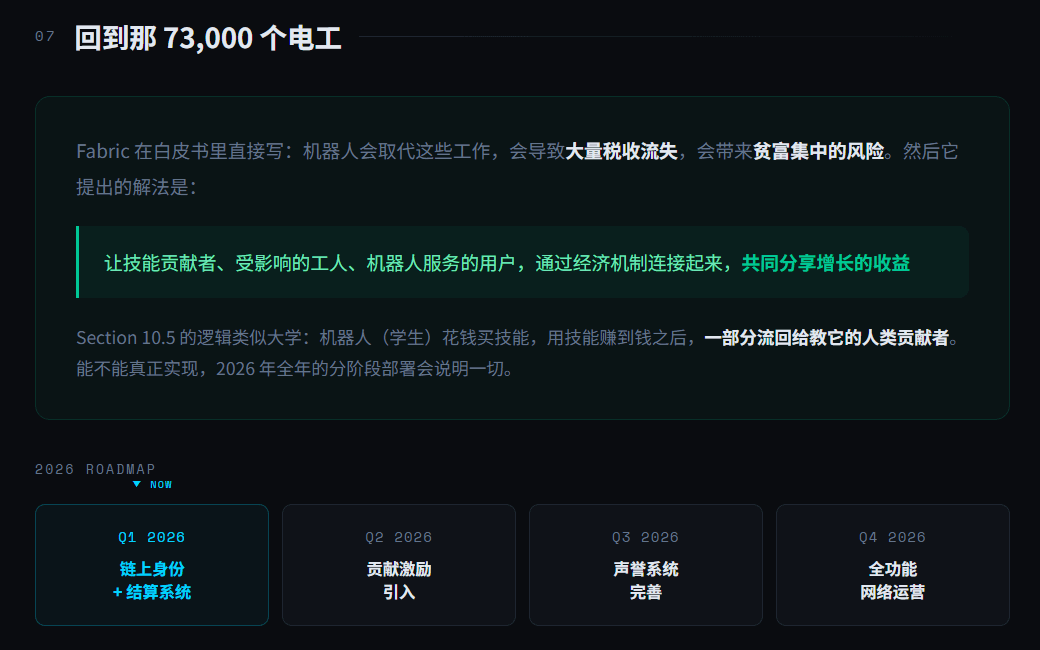
Fabric states directly in the Introduction: robots will replace these jobs, leading to a massive loss of tax revenue and a risk of wealth concentration.
Then its proposed solution is:
To connect skill contributors, affected workers, and users of robot services through economic mechanisms to jointly share the growing benefits.
How to split it specifically, Section 10.5 has a part that I think is worth discussing separately:
Robots return a portion of their income to the humans who help them learn a skill.
The logic is similar to a university—students (robots) spend money to buy skills (skill chips), and after earning money with the skills, a portion flows back to the person who taught them (human contributors).
Whether it can be truly realized will be indicated by the phased deployment throughout 2026.
Q1 is about identity and settlement, while Q2 will begin to introduce contribution incentives.
The speed of skill sharing has already been resolved.
The trust infrastructure is still being built.#ROBO