


In a sweeping 62-page ruling, a US federal court has dismissed every single claim in a high-profile lawsuit that accused Binance of enabling terrorism—handing the crypto giant a complete legal victory and a powerful rebuke of what it calls "false narratives."
For Binance, the past few years have meant fighting battles on multiple fronts: regulators, media scrutiny, and now, the courts. But this week, the world's largest crypto exchange secured a win that its leadership hopes will silence one of the most damaging accusations leveled against it.
On March 6, a US federal judge threw out a major lawsuit brought by 535 plaintiffs under the Anti-Terrorism Act. The plaintiffs had alleged that Binance provided material support for 64 terrorist attacks. After reviewing the evidence—or lack thereof—the court didn't just dismiss parts of the case. It dismissed all of it.
"Every count. Every allegation. Gone," said a source close to the company. "This isn't a partial win or a procedural technicality. This is total vindication."
What the Court Actually Found
The 62-page ruling makes for uncomfortable reading for anyone who bought into the narrative that Binance was complicit in terrorism. The court found that the plaintiffs failed to show that Binance:
Assisted terrorists in any meaningful way
Associated itself with the attacks in question
Participated in or sought success for those attacks
Conspired with any terrorist organization
In essence, the judge concluded that the plaintiffs couldn't connect the dots. They couldn't prove that Binance knew specific wallets belonged to bad actors at the time of the transactions, nor could they link any activity on the platform to the 64 specific attacks that harmed them.
General awareness that bad things happen in the world? That's not enough. The law requires proof that a defendant knowingly and substantially assisted specific attacks. And that proof, the court ruled, simply wasn't there.
"Truth Always Comes with Time"
Binance's response was measured but firm. Eleanor Hughes, the company's General Counsel, didn't mince words: "The court has unambiguously rejected the false and damaging narrative that Binance assisted terrorists. We have always maintained that these claims were without merit, and today's ruling confirms it."
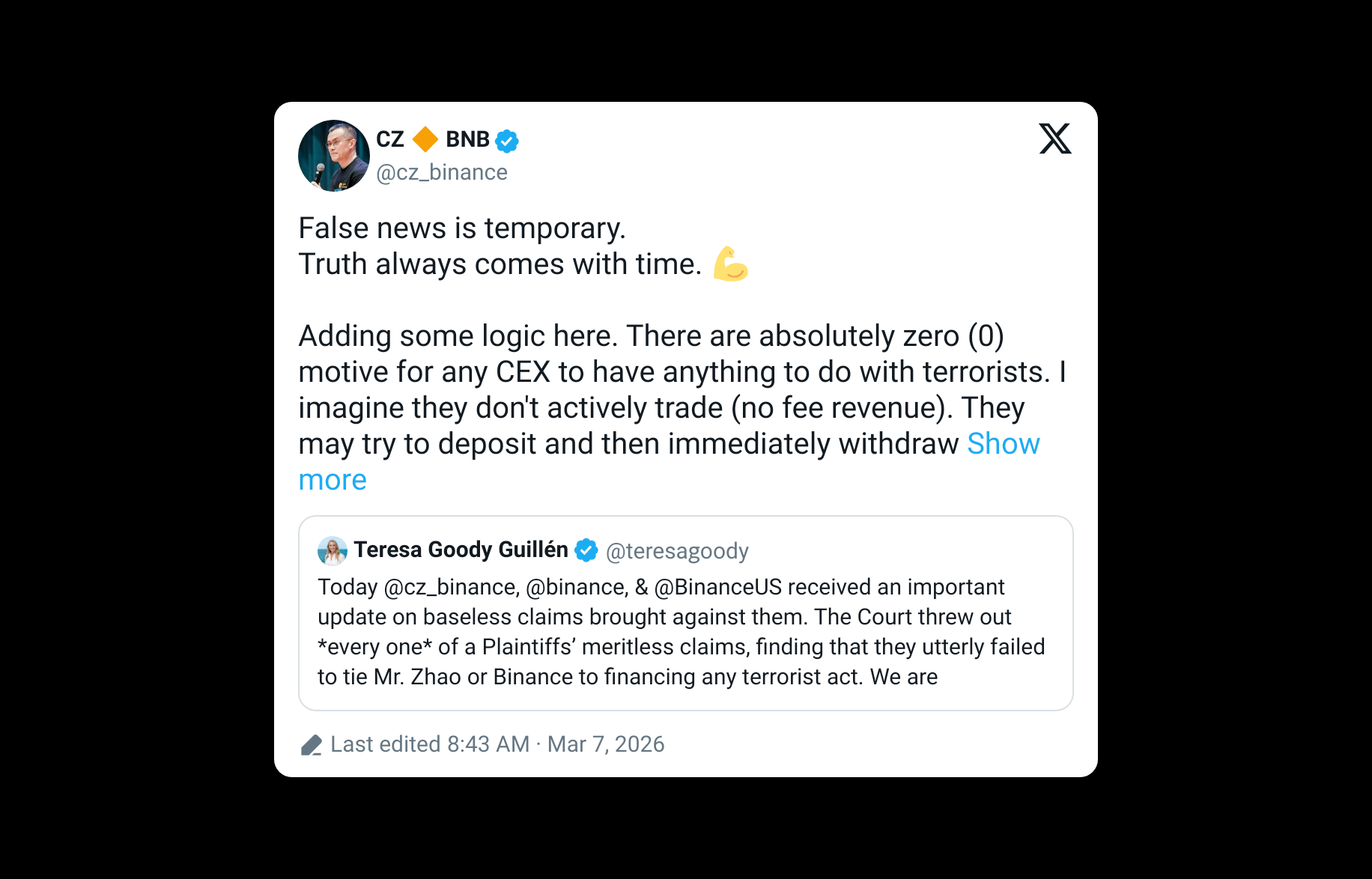
Even Changpeng Zhao (CZ) , the company's founder and former CEO, weighed in with a characteristically straightforward take on social media: "Truth always comes with time." He added a practical observation that cuts to the heart of the matter: "There are absolutely zero (0) motive for any CEX [centralized exchange] to have anything to do with terrorists."
His logic is simple: terrorists don't generate meaningful fee revenue. They deposit and withdraw quickly. For a business built on transaction volume, that's not a feature—it's a bug.
Why This Ruling Matters Beyond Binance
This case was always about more than one company's legal exposure. It became a proxy for a broader narrative about crypto and illicit finance—a narrative that has been fueled by headlines and, Binance would argue, thin evidence.
This ruling pushes back hard against that narrative. It's a reminder that in the United States, courts—not cable news or Twitter threads—are where facts are supposed to be decided. And when a federal judge spends 62 pages explaining why accusations don't hold water, it matters.
"This is what happens when you fight meritless claims instead of settling them," one observer noted. "Binance's legal strategy here was aggressive and principled. And it worked."
Compliance Isn't Just a Buzzword
For Binance, this victory is also an opportunity to reset the conversation around its compliance efforts. The company has spent years and billions of dollars building what it describes as one of the most sophisticated compliance programs in the financial world. It works with regulators and law enforcement globally, and it has repeatedly stated that it has "no tolerance for bad actors" on its platform.
This ruling, Binance hopes, lends credibility to those claims. It's one thing to say you take compliance seriously. It's another to have a federal court confirm that accusations of enabling terrorism are legally baseless.
What Comes Next
Technically, the plaintiffs have 60 days to file an amended complaint. This is due to a separate appellate ruling in an unrelated case, not because the judge saw any hope for the current claims. Binance is confident that any revised filing will meet the same fate.
For now, the company is savoring the moment—and hoping that the message lands. Litigation without merit has long been used as a tool to damage reputations in the crypto industry. This ruling suggests that strategy has limits.
As CZ put it: truth always comes with time. This time, it came with a 62-page court order.