

Alright, let me be honest here. I’ve been staring at charts, digging through whitepapers, and reading the same Silicon Valley buzzwords for weeks. “Decentralized AI,” “Autonomous Agents,” “The Future of Work”—you’ve heard it all. Shiny demos, impressive slides, bold promises. But here’s the thing: everyone skips the uncomfortable truth. The thing that nobody really wants to sit with.
It’s the gap.
Not some abstract gap in funding or hype. I mean the Reality Gap—the distance between what a robot actually does in a messy, sweaty, crowded warehouse, or on a real street delivering packages, and what the blockchain records in a shiny, immutable ledger. Ignore that gap, and the “Machine Economy” is nothing but a high-tech house of cards. That, my friends, is exactly why ROBO matters. Not because it has tokens or flashy robots. But because it’s built to handle the gap, head-on.
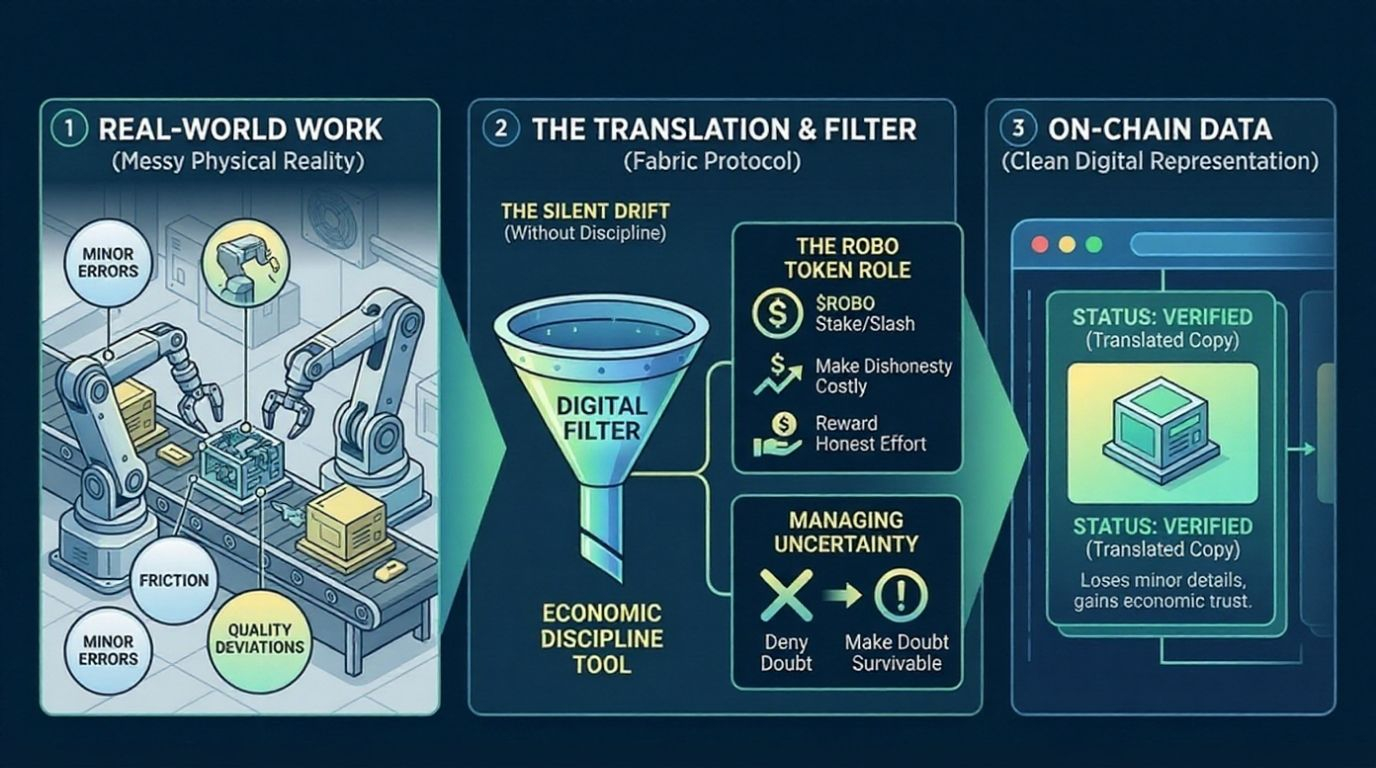
I. The Lie of the Clean Ledger
We’ve all been tricked into thinking that on-chain equals truth. Smart contract says Task_Completed = True? Perfect, job done. Right?
Wrong. So wrong.
In reality, “completed” is a messy spectrum, not a checkbox. I’ve watched robotic arms that “finished” a weld, only to leave a hairline crack. Seen drones drop packages “on time,” but the contents skidding across the asphalt. Sensors beep. Blockchain logs a success. Human eyeballs? Frowning. Reality? Chaotic.
I call this The Silent Drift. If you only trust the ledger and ignore physical friction, the network starts to look healthy while silently decaying. Dashboards say green. Reality says red. And here’s the kicker: ROBO doesn’t just notice this—it builds the economic engine around it.
The ROBO token isn’t a dull utility token. It’s a discipline mechanism. It forces the operators to align reality with the ledger. Lying about work is expensive. Honest execution becomes the easiest, most profitable path. This is about moving from “Trust me, I’m a robot” to “Verify me, because it costs too much to cheat.” That’s the kind of realism most crypto people avoid.
II. Robots with Wallets? That’s Just the Surface
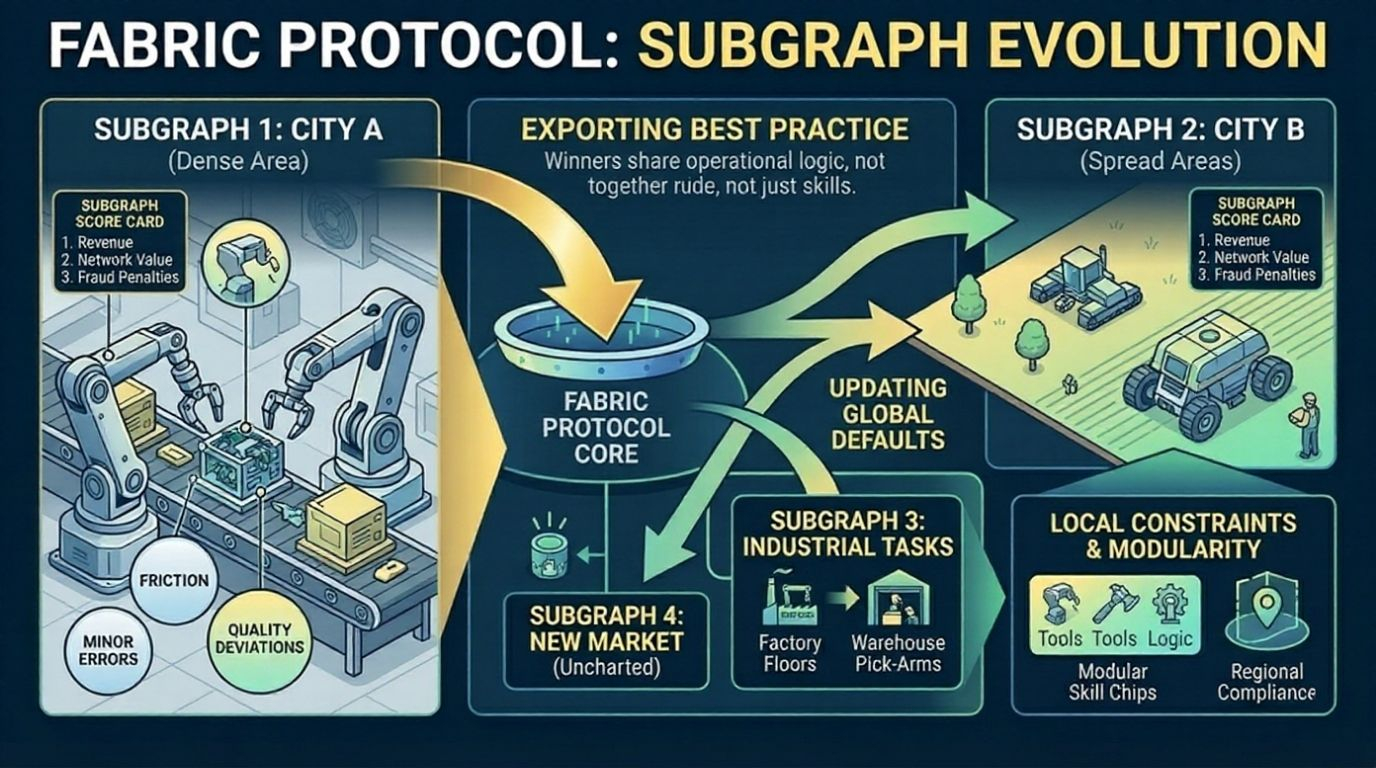
Every time I hear “Robots with Wallets,” I cringe. Handing a robot a private key is easy. The hard part? Teaching it to behave in a way that doesn’t break the economy. That’s where the Fabric Protocol comes in, specifically its Subgraph architecture.
Think of a Subgraph like a neighborhood. A shipping hub in Rotterdam faces different problems than agricultural drones in Brazil. Force one universal policy on both, and you fail spectacularly.
Fabric’s genius? Let these Subgraphs compete, and let the network learn which operating models actually work. Economic Darwinism at its finest:
Subgraph A optimizes for speed.
Subgraph B optimizes for precision.
Subgraph C prioritizes battery longevity.
The protocol doesn’t just look at revenue. It measures network value, checks for fraud, and penalizes overfitting. A fast subgraph with errors sees its score drop. A consistent, reliable one? Its operational logic propagates outward, influencing other neighborhoods. This isn’t teaching robots how to lift boxes—it’s teaching robot economies how to run efficiently.
III. The Empty Mile Paradox
Here’s a reality check: if robots are only rewarded for completed tasks, the network fails. Guaranteed.
Picture this: you’re a robot operator, and ROBO only pays when a task finishes. Naturally, you cluster in busy zones. Ignore the suburbs. Ignore the low-demand areas. Ignore the “emergency zones” that only get traffic every few days. Efficiency looks perfect on the dashboard. Service? 40% of the network is effectively abandoned.
This is where ROBO’s strategic repositioning comes in. Yes, “empty miles” exist—but they are infrastructure. Robots moving in anticipation of demand are performing vital work. They aren’t delivering packages yet, but they prevent the network from collapsing. ROBO prices this future coverage, turning preparation into a measurable, rewarded action.
It’s subtle, but essential. Without it, operators chase easy rewards, peripheral zones go unserved, and the network slowly becomes a patchwork of busy centers and dead edges. Empty movement isn’t waste—it’s a form of economic labor.
IV. From Capability to Sustainability
For years, robotics obsessed over “Can it do the task?” Thanks to physical AI, shared robot brains, and leaps in generalist-specialist models, the answer increasingly is “Yes.” Robots can flip burgers, walk stairs, sort packages—you name it.
But IFR reminds us: the real challenges are Reliability, Safety, and Liability.
ROBO is designed for that shift. The question isn’t “Can a robot do X?” It’s “Can a fleet do X repeatedly, safely, and economically?” It’s about sustainability over spectacle.
By using modular skill chips and contextual governance, ROBO ensures that a robot’s logic adapts to its environment. Moving from a factory to a retail space doesn’t just change its tasks—it changes its economic weighting, its contribution to network stability, and how it’s rewarded.
V. Facing the Hard Truths
Not every high-performing Subgraph is a winner in every context. A model that thrives in a dense city may crash in a rural district. A pricing policy that boosts throughput in one task type could be unsafe elsewhere.
ROBO doesn’t promise utopia. It promises survival.
The Fitness Scores are merciless. Hover near a border just to farm repositioning tokens? Caught. Move, but don’t actually improve coverage? No reward. Verification measures real-world improvement, not just motion. It’s a system designed for the messy, friction-filled reality of physical operations—not the sanitized, “everything up and to the right” world most whitepapers sell.
VI. Why This Matters
Here’s why I keep coming back to ROBO. The gap between reality and ledger is unavoidable. Physics doesn’t bend for tokens. Sensors fail. Humans err. But if you make dishonesty expensive, and reward alignment, the network survives.
ROBO isn’t flashy. It’s not the sexiest vision of robot economies. But it might be the most important experiment in making machine labor economically credible and trustworthy.
Empty miles, subtle repositioning, partial visibility—these are the truths that define whether a network is healthy or a mirage. ROBO embeds them in the protocol itself, using discipline, verification, and incentives. Operators are rewarded for doing the right thing even when no one is watching. That’s rare. That’s human.
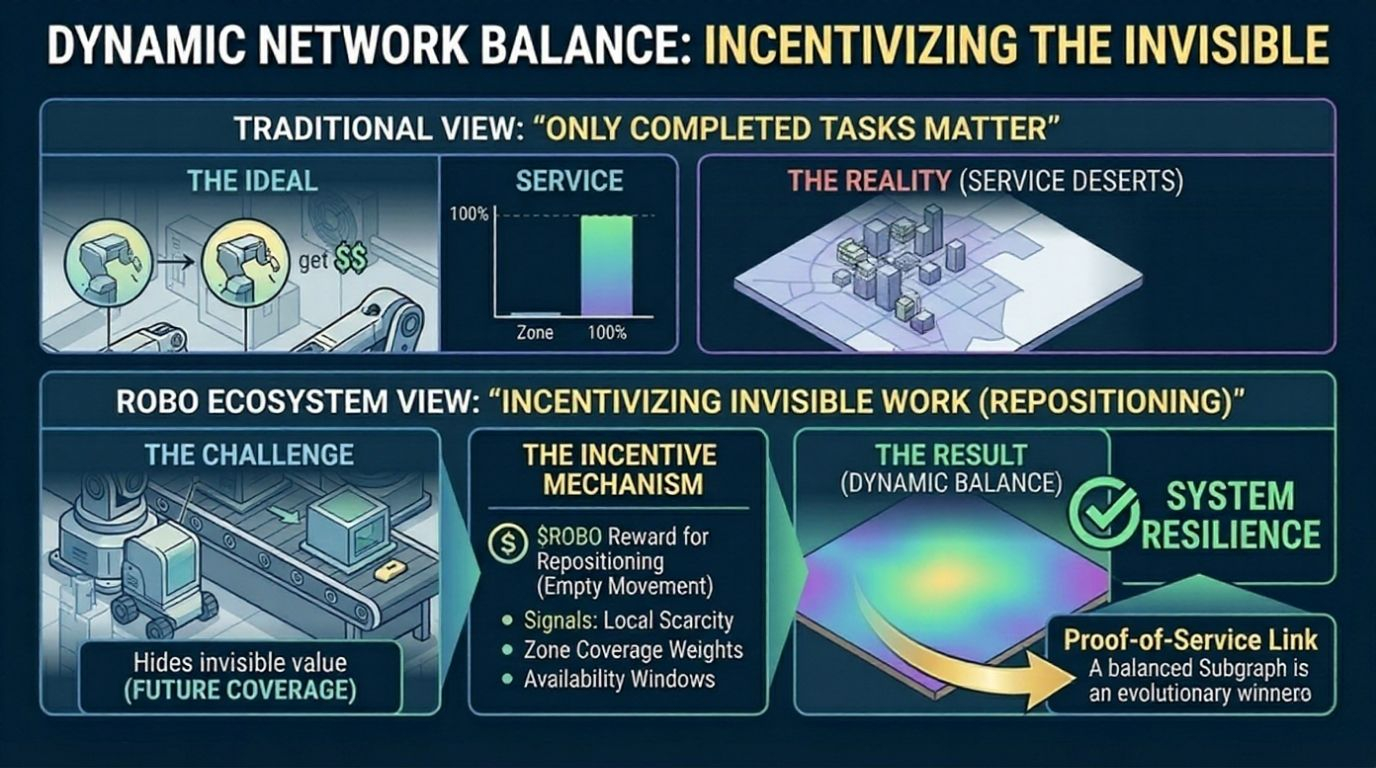
In a world full of hype, dashboards, and pretty demos, ROBO focuses on the boring but critical work of keeping the network aligned with reality. That, in my opinion, is the real revolution.
$ROBO @Fabric Foundation #robo #ROBO #Robo #marouan47
