There was a time, not so long ago, when "shipping code" meant moving pixels on a screen. You’d spend months perfecting a dashboard or a checkout flow, hoping to capture another $20-a-month subscription in an increasingly crowded SaaS graveyard. But as we move deeper into 2026, the smartest developers I know aren’t building another CRM. They’re building "Skill Chips" for the Fabric Foundation.
If the 2024 AI boom was about "brains in a jar" (chatbots), 2026 is about "brains in a body." And thanks to the OM1 operating system, the barrier between a line of code and a physical action has finally collapsed.
The End of the Software Seat
For decades, the software business model was simple: sell a seat, charge a monthly fee. But in the robot economy, a robot doesn’t care about a "seat." It cares about an outcome.
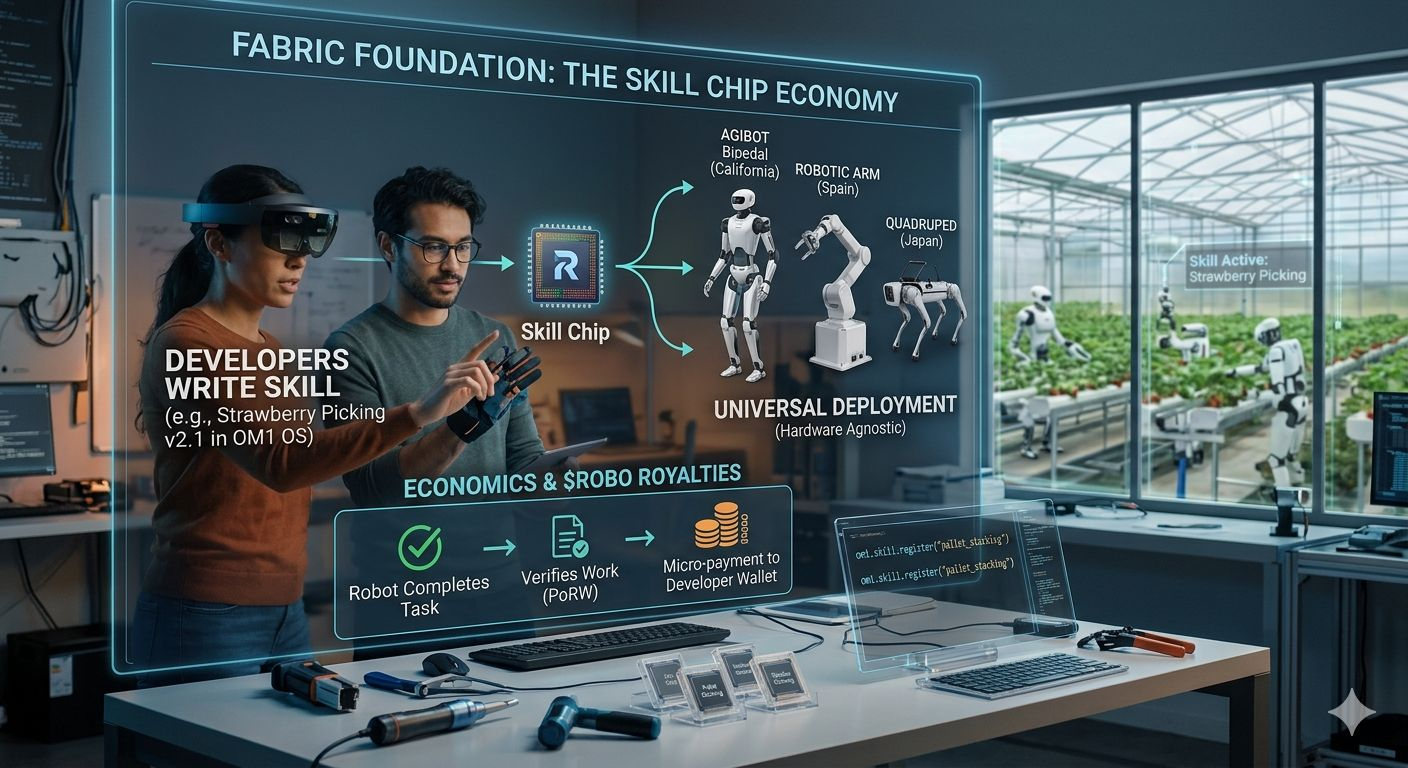
Enter the Skill Chip. Think of it as a modular, hardware-agnostic "muscle memory" package. Using Fabric’s OM1—the "Android of Robotics"—a developer can write a sophisticated script for, say, delicate strawberry picking or window cleaning on a high-rise.
The magic isn’t just that it works; it’s that it works everywhere. Because OM1 is hardware-agnostic, that single "Strawberry Picking v2.1" Skill Chip can be deployed onto a bipedal AgiBot in California, a robotic arm in Spain, or a quadruped in Japan.
Trading Muscle Memory for ROBO Royalties
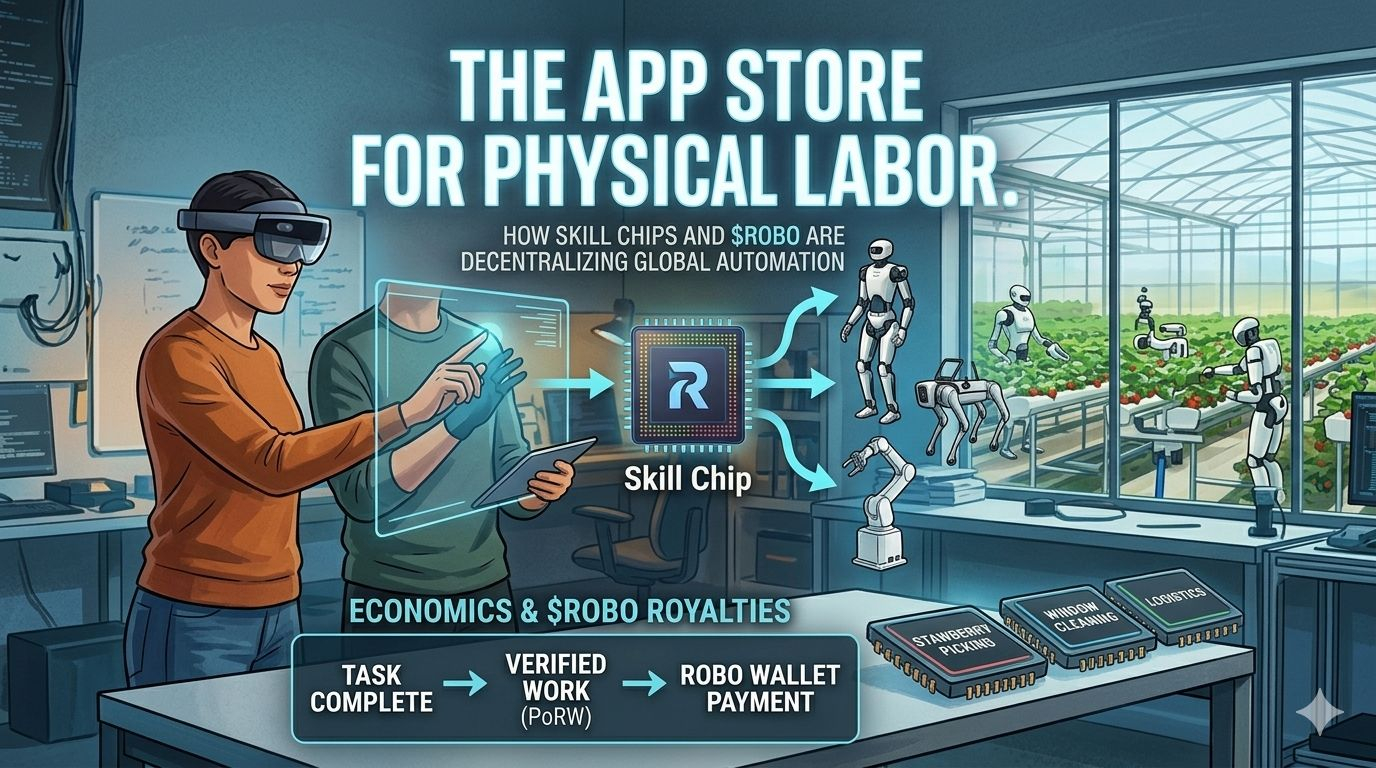
The shift from SaaS to Skill Chips is driven by a fundamental change in how developers get paid. In the Fabric ecosystem, every time a robot uses your skill to complete a task, the network’s Proof of Robotic Work (PoRW) mechanism verifies the action, and a micro-payment of ROBO is triggered.
I used to chase enterprise contracts for my logistics software," one developer told me recently. "Now, I have a 'Pallet Stacking' skill live in the Robot Crafter App Store. I don’t deal with sales calls. Every time a robot somewhere in the world moves a pallet using my code, I get a royalty in ROBO. My code is literally working for me while I sleep.
This is the Physical Labor App Store. It’s a marketplace where muscle memory is a commodity. For the first time, intellectual property (the code) is directly tied to physical productivity (the work) without a human middleman taking a 70% cut.
Why the "Wall" is Falling
In the past, robotics was a walled garden. If you wanted to write software for a robot, you had to work for the company that built the hardware. You were locked into their proprietary silos.
The Fabric Foundation changed the game by separating the "brain" from the "body." By providing a universal identity (DID) and a payment layer for machines, they’ve turned robots into independent economic agents. A robot can now "decide" to buy your Skill Chip because it calculates that the ROBO it earns from the task will outweigh the cost of the license.
We are witnessing the birth of a self-sustaining economy where code doesn’t just manage data—it manages the movement of the world.
The Bottom Line
The "Skill Chip" economy is more than just a new way to monetize software; it’s the decentralization of labor itself. As more manufacturers like UBTech and AgiBot adopt the OM1 standard, the demand for modular skills will explode.
For developers, the message is clear: the most valuable code you write this year won’t be for a human to click on. It will be for a machine to live by.