
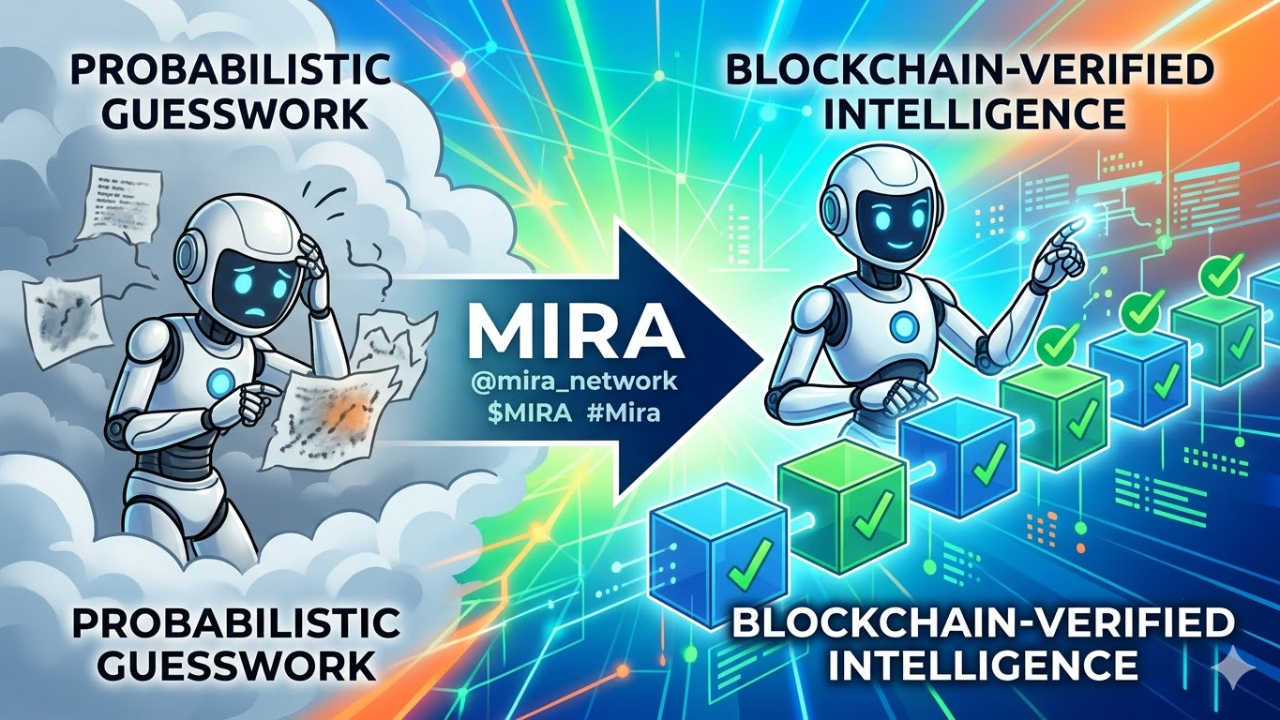
AI today mostly works on probability.
When a model gives you an answer, it is choosing the most likely sequence of words based on patterns in its training data. That can feel impressive. But underneath, it is still a statistical guess.
Sometimes the guess is right. Sometimes it is confidently wrong.
The quiet issue isn’t intelligence.
It’s verification.
Right now if an AI tool gives you an answer, the only way to fully trust it is to check the sources yourself. That puts the responsibility back on the user. The system generates information, but the trust still has to be earned somewhere else.
This is the gap Mira Network is trying to explore.
The idea is simple at its foundation.
Treat AI outputs not as final answers, but as claims that can be checked.
When an AI model produces a result, the network allows participants to verify whether the response holds up. Those participants review the output, evaluate the reasoning or data, and submit their validation to the network.
That verification is recorded on-chain.
So instead of a single model producing an answer in isolation, the output gains a layer of collective checking. The information develops a kind of texture over time - some answers get confirmed, others get challenged.
In theory, this shifts AI slightly away from guesswork.
Not by changing the model itself, but by building a system around it where accuracy can be evaluated and tracked.
Participants who verify outputs can earn rewards tied to the work they perform. The system tries to make validation something people contribute to, not just something users silently hope exists.
That creates a small economy around checking AI results.
Whether that economy scales is still uncertain.
Verification takes time, while AI models produce answers almost instantly. A system that checks outputs has to keep pace with that speed, or the layer of trust risks falling behind the flow of information.
Still, the direction is interesting.
Right now most AI systems focus on generating answers quickly. Mira seems more focused on building a steady layer of verification underneath those answers.
If that layer holds, AI responses might gradually move from “likely correct” to something closer to “checked and agreed upon.”
But that outcome depends on participation, incentives, and whether people actually show up to do the verification work.
So the real question might be simple.
Can a network of validators keep up with the pace of AI generation, or will verification always lag behind the models themselves? @Mira - Trust Layer of AI $MIRA #Mira