
This morning, I was in a small group with only a few old traders. Everyone calculated some data together, and after the numbers were done, the group suddenly became very quiet.
In the past year, everyone has been talking about the bull market coming soon. But if you look closely, the profits that actually flow into retail investors' hands are as thin as paper.
Why?
Because the 'drainage channels' in this circle have long been solidified.
You either pay Gas to the miners, or pay fees to centralized exchanges, or have your value squeezed by MEV. In the end, most of the value is extracted before it reaches ordinary participants.
What is most disgusting is those projects that claim to be 'building an ecosystem', but in essence are just trying to squeeze the last bit of liquidity from retail investors.
This is not at all like the Web3 revolution people imagine,
It feels more like an increasingly sophisticated financial involution.
In this slightly desperate atmosphere, I carefully studied @Fabric Foundation and unexpectedly felt a bit refreshed.
It is not competing in the same crowded market, but instead focusing on a nearly blank field: the machine economy.
No need for grand words like 'sovereign economy'. To put it bluntly, what Fabric wants to do is actually very simple—issue ID cards and bank cards to robots.
Now everyone is watching companies like Boston Dynamics or Tesla show how smart their robots are, such as robotic dogs doing flips and completing various complex movements.
But very few people have seriously considered a question:
What will happen when these machines really need to participate in economic activities?
If robots always rely on manufacturers' servers, then they are essentially just a smarter appliance. Robots in factories cannot purchase electricity on their own, and drones cannot buy data from other devices; in the traditional financial system, it is almost impossible for machines to trade independently.
Banks will not open company accounts for a piece of code.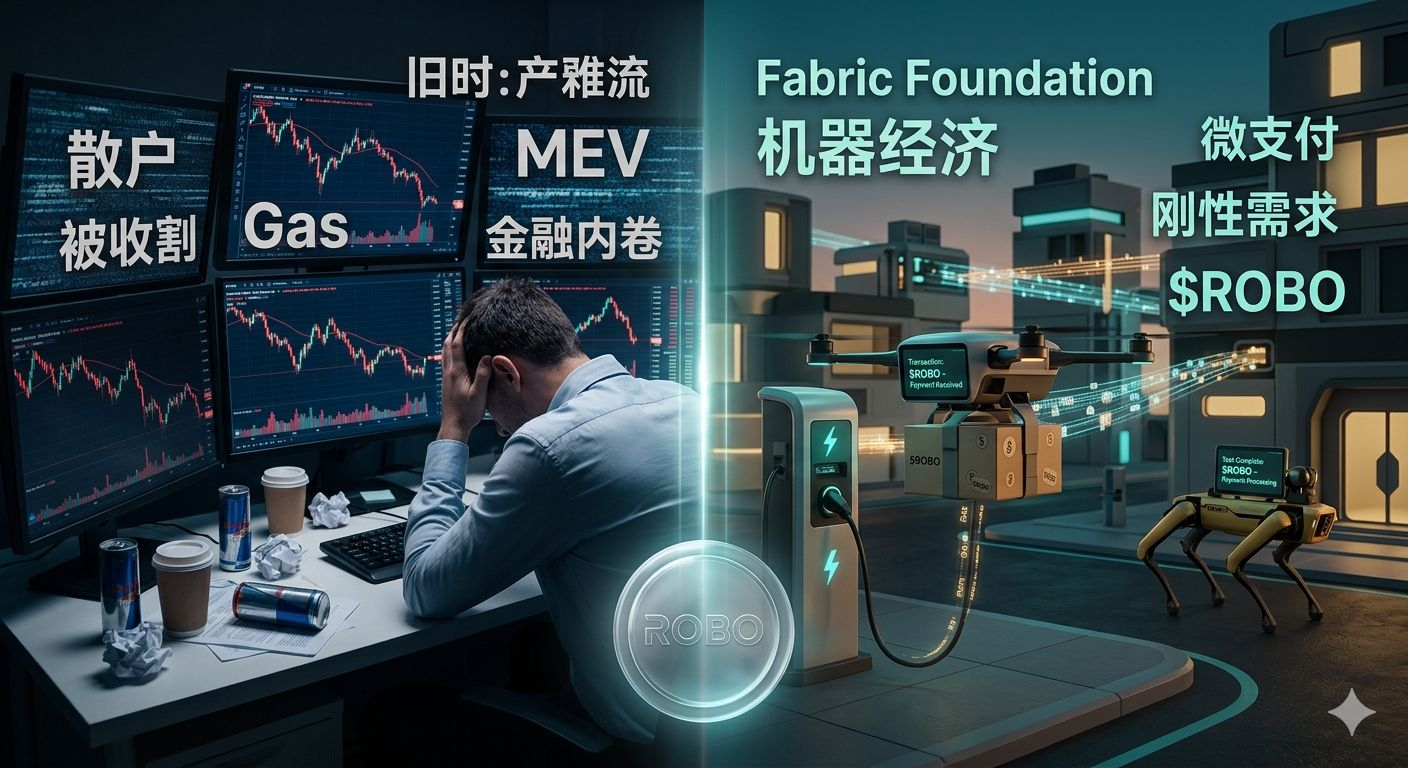
And it is here that real-world applications of cryptocurrency are beginning to emerge.
Through Fabric's protocol and $ROBO as a medium, robots can finally bypass human approval and pay, work, and earn rewards directly on the chain.
This creates a new economic layer that is both science fiction and reality: a machine-driven micro-payment economy.
For those who are still struggling to survive in the existing market, this is actually a very meaningful thing.
because this time, the value of a project may no longer rely on hype and attracting investors, but rather on the 'fuel' that robots must consume to operate.
When millions of robots begin to generate even a few cents in micro-payments on the Fabric network, they will not care about market fluctuations and will not look at candlestick charts.
They only care whether the task is completed.
This calm and rigid demand may be stronger than any retail investor's FOMO.
Nowadays, the market is experiencing severe fluctuations, and many people are watching their assets stagnate, filled with anxiety.
And I feel that rather than betting on the next storytelling meme, it might be better to bet on the infrastructure that seeks to establish independent economic identities for robots.
It has become too tiring to fight against each other in this circle.
Perhaps it's time for machines to start creating some real value.
#ROBO $ROBO @Fabric Foundation
