
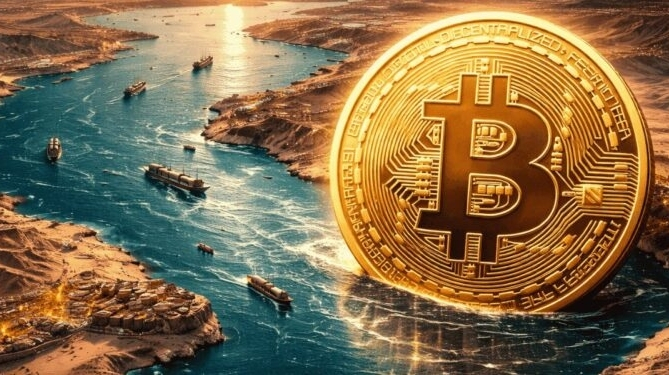
The Strait of Hormuz has once again become one of the most sensitive points in the global economy: the tension in the Middle East has put energy transit through this maritime corridor at risk. Any disruption in its operation has immediate effects on energy markets, inflation, and financial assets, including bitcoin (BTC).
The Strait of Hormuz connects the Persian Gulf with the Gulf of Oman and constitutes one of the most important energy routes on the planet.
Around 20% of the world's oil and a significant proportion of liquefied natural gas circulate through there, making it a strategic point for global energy supply. Since March 3, amid the military escalation between the United States, Israel, and Iran, transit through this route has been partially blocked, a situation that has affected maritime trade and energy exports from the region.
And the impact on the markets was immediate. Oil prices surpassed 100 dollars per barrel for the first time in over three years and approached 120 dollars before moderating some of the gains. At the time of writing this article, March 10, it is trading at 89 dollars.
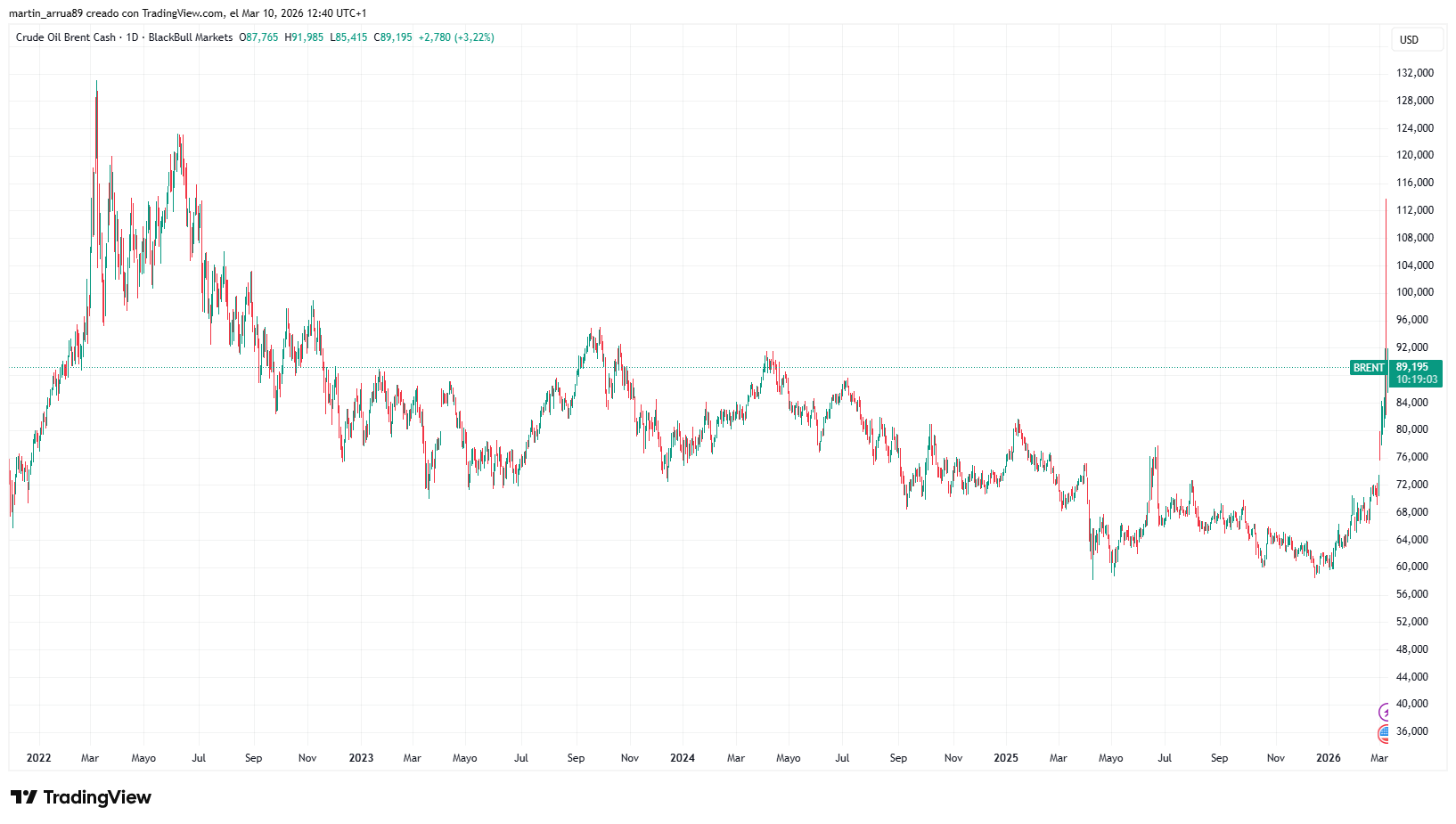
The barrel of crude oil is trading above 89 dollars.
Source: TradingView
The situation is aggravated by the decisions of the main producers in the region. Saudi Aramco, the seventh most valuable company in the world, reduced production in two of its fields, while the United Arab Emirates, Iraq, Kuwait, and Qatar also implemented cuts.
The macroeconomic impact: inflation and monetary policy
The rising cost of oil has direct implications for the global economy. When energy prices rise, the cost of transportation, industrial production, and basic goods also increases, fueling inflationary pressures.
This scenario directly affects monetary policy decisions. Jasper De Maere, strategist and OTC trader at Wintermute, a cryptocurrency trading firm, explained that the surge in oil is altering market expectations about interest rates in the United States.
“Brent oil rose by 26% during the week, driven by fears of long-term energy restrictions,” he noted.
This increase in energy costs complicates the ability of the United States Federal Reserve (FED) to ease monetary policy. “Markets are now only discounting a rate cut in 2026, while two weeks ago the consensus was divided between two and three cuts,” said De Maere.
When interest rates fall, credit becomes cheaper and liquidity increases in the financial system, as explained by CriptoNoticias. This environment usually favors higher-risk assets, such as BTC and cryptocurrencies, as investors tend to seek higher returns.
Bitcoin withstands the turbulence of the conflict
The chart produced by the firm shows the weekly comparison between different asset classes, including stocks, bonds, commodities, and digital assets:
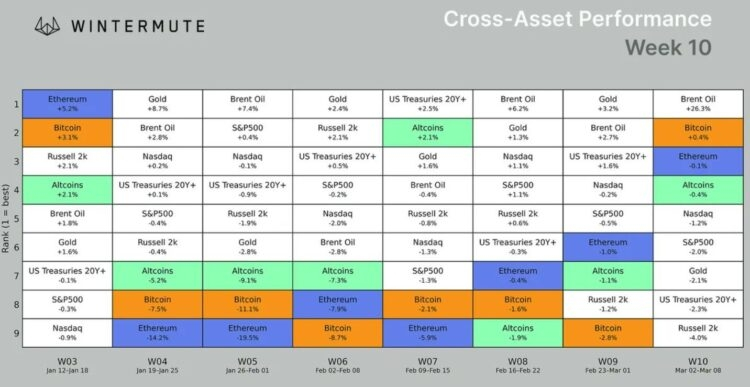
Performance of different assets so far in 2026.
Source: Wintermute.
During the week of March 2 to 8, BTC ranked among the best-performing assets, while much of the financial markets recorded losses.
According to De Maere, this behavior surprised many traders. “What is remarkable is not only the macroeconomic context. Bitcoin remained firm at a time when most traders expected otherwise,” he stated.
Currently, bitcoin is trading near 70,000 dollars, while markets remain attentive to two key factors: the evolution of the conflict in the Middle East and the upcoming meeting of the (FED).
An additional escalation in the region or a more restrictive change in monetary policy could generate volatility in financial markets again. For now, however, BTC shows greater resilience than other assets in the face of uncertainty generated by the energy crisis.
If you wish to verify the source of the information provided here, you can read the full article at the following link:
https://www.criptonoticias.com/mercados/bloqueo-estrecho-ormuz-tiene-en-vilo-bitcoin-mercados/