
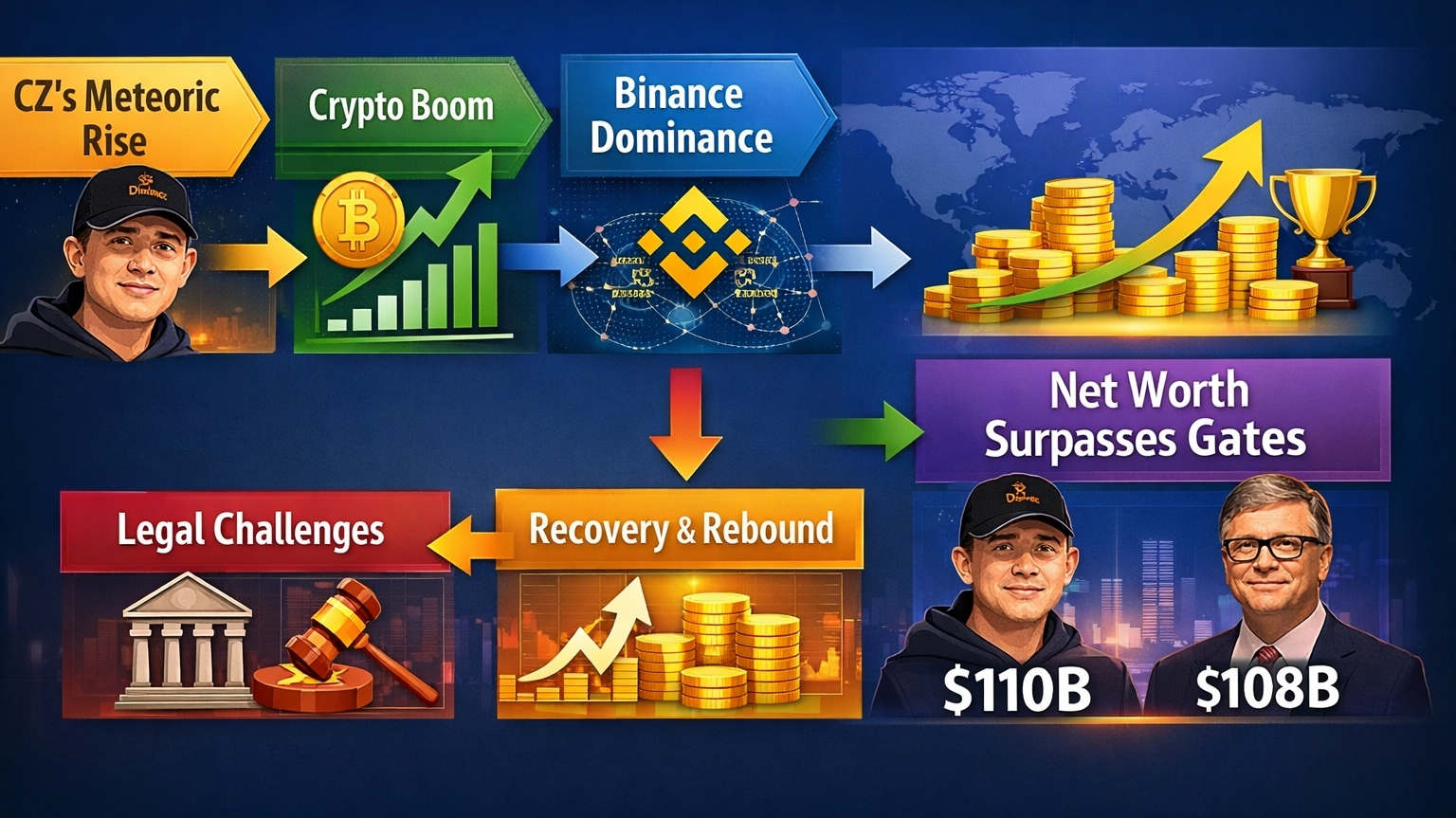


Changpeng Zhao, the founder of Binance and one of the most recognizable names in cryptocurrency, has reached a new milestone that few in finance could have imagined a decade ago. His estimated net worth has climbed to $110 billion, placing him ahead of Bill Gates on the latest global rich list. On paper, it is a simple ranking change. In reality, it reflects a much bigger shift in how wealth is being created in the modern world.
For years, Bill Gates stood as one of the defining symbols of technology wealth. His fortune came from software, personal computing, and the rise of Microsoft into one of the most powerful companies in history. Zhao’s rise comes from a completely different era. His wealth was built in the fast-moving, unpredictable, and often controversial world of digital assets. That contrast alone makes this moment fascinating. A crypto entrepreneur now sits above one of the original titans of the tech age.
What makes @CZ Zhao’s rise even more remarkable is the path he took to get here. This is not a story of smooth, uninterrupted success. Binance has spent years under the spotlight of regulators, governments, and financial authorities. Zhao himself has faced intense scrutiny, legal battles, and a dramatic fall from his position as chief executive. At one point, many assumed his influence and fortune had peaked. Instead, his comeback has been one of the most surprising reversals in recent business history.
Much of Zhao’s wealth is tied to Binance, the crypto exchange he built into a global powerhouse. Even after legal troubles and leadership changes, Binance remains one of the most dominant players in the digital asset industry. Its influence stretches across markets, traders, institutions, and entire ecosystems of coins and tokens. When confidence in crypto strengthens, Binance benefits quickly. And because Zhao’s holdings are so deeply connected to the company, his personal fortune can rise with astonishing speed.
That is exactly what appears to have happened. As the crypto market regained momentum, the estimated value of Binance surged, and Zhao’s net worth rose with it. The jump is not just large — it is massive. A fortune of $110 billion puts him in a class occupied by only a tiny number of people worldwide. It also confirms that crypto wealth, once dismissed by many as temporary or speculative, now sits firmly among the highest levels of global finance.
The comparison with Bill Gates is especially striking because the two fortunes represent very different ideas of wealth. Gates’ fortune, while still enormous, has increasingly become tied to philanthropy and long-term giving. Over the years, he has made it clear that much of his wealth is meant to be distributed, not simply accumulated. Zhao’s fortune, on the other hand, is still defined by ownership, market value, and the continued strength of a business built in one of the newest corners of finance. One man represents the maturing legacy of old-school tech capitalism. The other represents the raw scale and speed of the digital asset era.
There is also something symbolic about Zhao moving past Gates. Bill Gates is not just another billionaire. He is one of the names most people think of when they imagine extreme wealth in technology. To overtake him, even on a fluctuating rankings list, gives Zhao a different level of visibility. It sends a message that crypto is no longer operating on the margins of the financial system. It has produced individuals whose fortunes rival — and now surpass — some of the most iconic business figures of the last half-century.
Still, fortunes connected to crypto always come with a degree of instability. Net worth estimates are exactly that: estimates. They are often based on private company valuations, ownership assumptions, asset prices, and market conditions that can change quickly. A sharp move in crypto markets can erase or add billions in a short period of time. So while Zhao’s current standing is remarkable, it also highlights the uniquely volatile nature of wealth built in this sector.
Yet that volatility should not obscure the bigger reality. Zhao’s position near the top of the world’s richest people shows that crypto has matured from a fringe experiment into a force that can generate and sustain extraordinary value. Even after regulatory crackdowns, public controversy, and repeated predictions of collapse, the industry continues to produce enormous fortunes and powerful institutions. Binance remains central to that story, and Zhao remains one of its clearest beneficiaries.
His rise also says something about the changing face of entrepreneurship. Traditional tech billionaires often built tools, platforms, or operating systems that became part of everyday life. Crypto founders built marketplaces, infrastructure, and networks for a financial system that still feels new to much of the world. Zhao’s wealth is rooted not in consumer hardware or enterprise software, but in the machinery of digital finance — trading, liquidity, exchange services, and the global appetite for alternative assets. That alone shows how much the economic landscape has changed.
Whether Zhao stays ahead of Gates is impossible to predict. Rankings shift. Markets turn. Fortunes expand and contract. But the symbolic importance of this moment is hard to ignore. A man who built his empire in cryptocurrency has now moved beyond one of the most legendary names in technology wealth. That is more than a number on a billionaire list. It is a sign of a changing financial age.
CZ at $110 billion is not just a personal milestone. It is a reflection of how power, wealth, and influence are being reshaped in the 21st century. The old giants of software are still important, but new empires are being built in places that once seemed speculative and unstable. Zhao’s rise above Gates captures that shift in the clearest way possible: the future of wealth no longer looks like the past.