
I keep coming back to one quiet but stubborn idea: most of our economic infrastructure was built on the assumption that a human, a company, or a platform operator would always stand in the middle of the process. That assumption is so deeply embedded that it hardly gets noticed. But the moment I start thinking about machines as participants rather than instruments, the limits of that design begin to show very clearly.
A robot can complete a task. A sensor can validate a condition. An autonomous service can consume resources, generate output, and trigger the next step in a workflow without waiting for a person to intervene. Yet the rails around all of this still tend to assume human-owned accounts, human-paced approvals, and human-readable trust arrangements. To me, that is the real mismatch. It is not just that machines need faster payments. It is that the surrounding logic for identity, execution, settlement, and accountability was not originally shaped for entities that act continuously, programmatically, and at machine speed.
It feels a bit like trying to route industrial freight through a path meant for bicycles.
What usually breaks first is not the transaction itself. The friction begins earlier, at the moment a machine needs a recognized identity, a defined permission set, and a reliable way to prove that it actually performed the work attached to a payment or state change. Traditional systems spread these functions across disconnected institutions and databases. One place holds credentials, another clears payment, another defines access, another keeps logs, and another is expected to resolve disputes afterward. That structure can survive in ordinary commercial settings, but it becomes awkward when participation depends on tight coordination between each layer.
I think that is why so many conversations about machine economies feel incomplete to me. They stay focused on automation at the surface but do not spend enough time on shared state and enforceable coordination underneath. If a machine can accept a task, reserve capacity, spend funds, submit evidence, and trigger settlement, then the surrounding system needs one coherent record of what happened and under what rules. Without that continuity, scale does not produce elegance. It produces a brittle stack of adapters, exceptions, and trusted middle layers.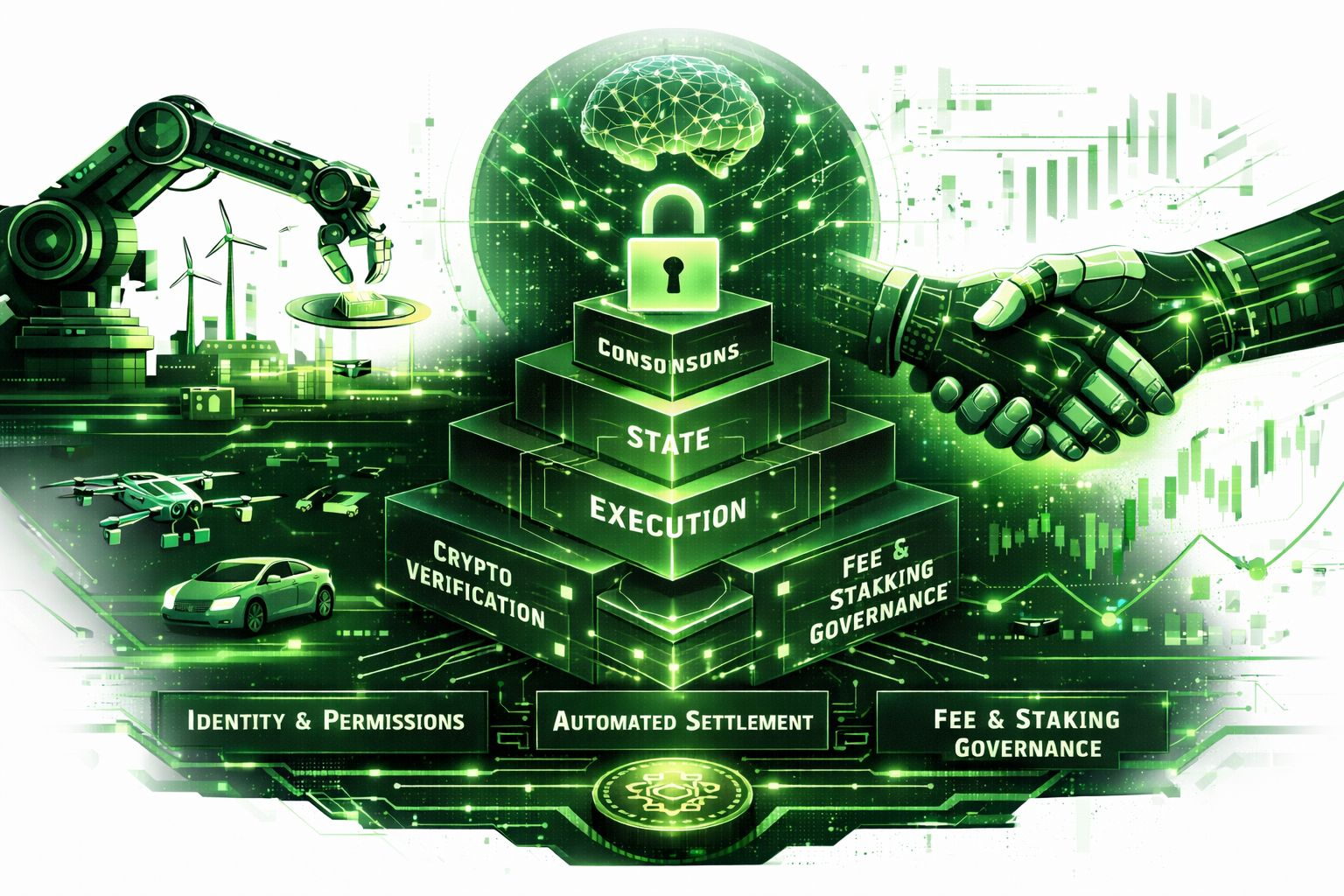
What interests me about Fabric Foundation is that it seems to begin from this structural problem rather than treating machine participation as a branding concept. The important move is not simply putting activity onchain. It is framing the problem as one of economic coordination across identity, validation, execution, and governance, then trying to place those functions inside one consistent environment where they can reinforce one another instead of drifting apart.
At the consensus layer, the core issue is not abstract decentralization language but ordering and finality. A machine-oriented network needs a dependable method for deciding which commitments, proofs, and transactions become canonical, and in what sequence. That matters because conflicting records cannot remain loosely tolerated when autonomous systems are expected to continue acting on the basis of state. Consensus, in that sense, is the discipline that prevents ambiguity from leaking into the rest of the economy.
The state model matters just as much. If the chain is expected to coordinate accounts, identities, task commitments, permissions, escrow status, and proof results, then state cannot be reduced to a simple ledger of balances. It has to express relationships between actors, resources, and actions. In practical terms, that means the system must track not only who controls an asset, but which agent is authorized, which obligation is bonded, which condition has been met, and which settlement path is now valid. That richer state is what makes the chain usable for machine participation instead of merely descriptive.
I also think the execution model deserves more careful attention than it usually gets. In this setting, execution is not valuable just because it allows programmable logic. It matters because it makes rules legible and enforceable. Task conditions, payment release, penalties, access controls, and validation checkpoints all need to be represented in a form that machines and counterparties can rely on without falling back on informal interpretation. A strong execution environment does not just automate; it clarifies.
Then there is the cryptographic flow, which is easy to mention casually and much harder to design coherently. Identity credentials, signed instructions, proof submission, and state transition all need to connect in one verifiable chain. That continuity is what lets the network treat action as provable rather than merely claimed. If an autonomous agent updates a record, commits to a task, or requests settlement, those steps should be anchored in signatures, verifiable messages, and transparent validation paths. Otherwise the system is only simulating trust, not actually producing it.
The economic layer becomes more meaningful once those mechanisms are aligned. Fees are not merely transactional overhead here; they are the pricing function for computation, coordination, and settlement inside the chain. Staking is not useful only as a lockup device; it helps bind participation to responsibility, especially where validation quality and task integrity need weight behind them. Governance also becomes easier to take seriously when it is tied to live system design rather than symbolism, because the network needs a way to adapt admission standards, operating parameters, and incentive logic as machine participation grows more demanding.
What I find most grounded in this model is that utility flows from use rather than narrative. The token is not presented as a detached object floating above the system, but as a mechanism tied to fees, staking, and governance within an operating environment that actually needs those functions. That does not solve every design problem on its own, but it does make the economics feel more anchored to coordination than to attention.
I do not think the deeper lesson is that machines need a copy of human finance. It is that autonomous systems require economic rails built around verification, coherent state, and enforceable logic from the beginning. Fabric Foundation seems most compelling to me when viewed through that lens. The more I think about machine participation in practical terms, the less convincing older economic rails begin to look, not because they failed in their own era, but because they were never really built for this kind of participant in the first place.
@Fabric Foundation $ROBO #ROBO
