

Most narratives in crypto move fast and disappear just as quickly. New sectors emerge, tokens trend for a few weeks, and attention shifts somewhere else. But occasionally a project appears that isn’t trying to win the weekly narrative cycle. Instead, it focuses on building the underlying infrastructure that could support entirely new economic systems.
That is where Fabric Foundation is positioning itself.
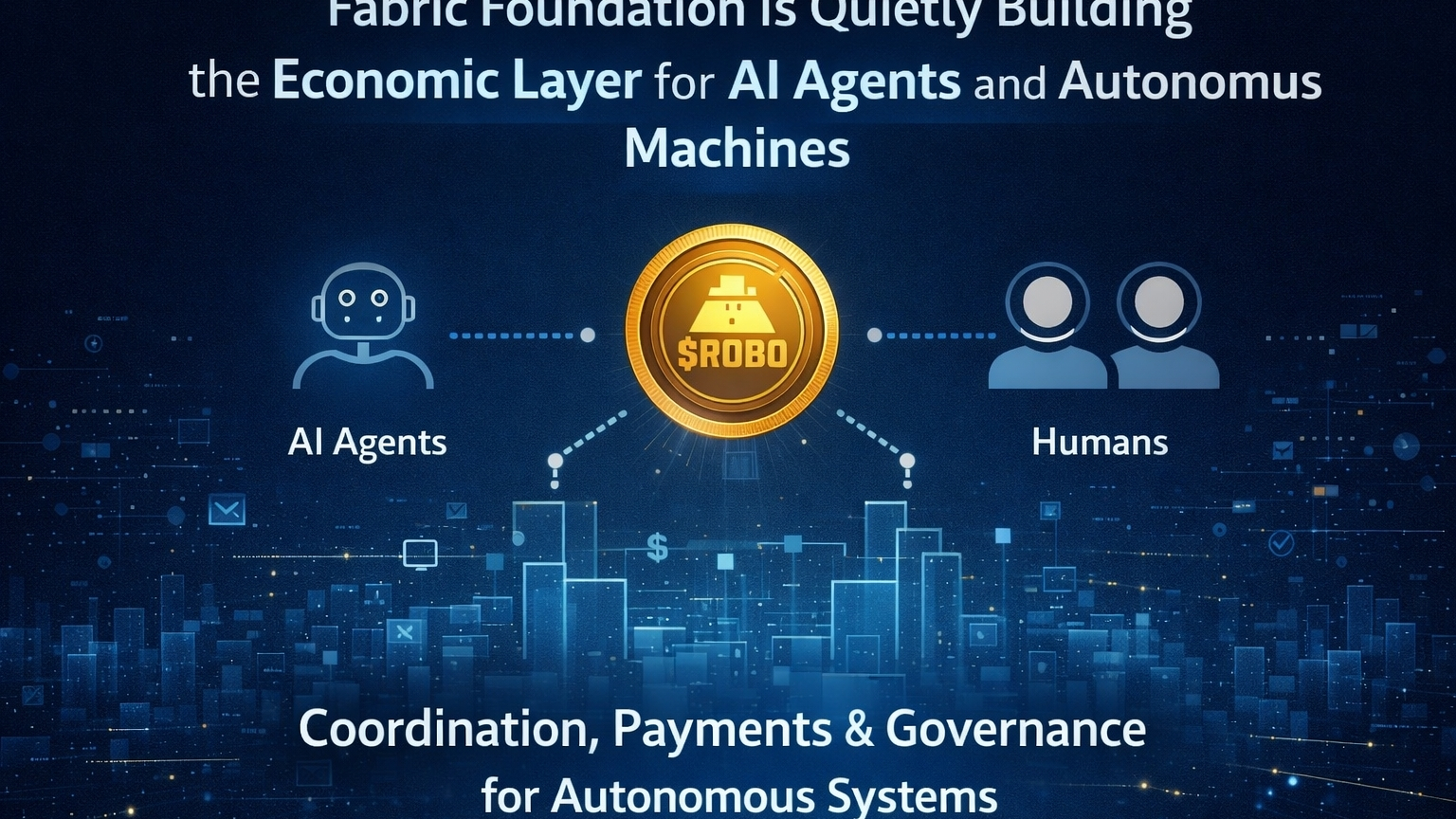
Rather than presenting itself as just another blockchain or AI project, Fabric is attempting something much more structural: creating the coordination layer for a world where AI agents, machines, and humans interact economically on-chain. The idea sounds ambitious, but the direction is becoming increasingly relevant as automation and artificial intelligence begin to move from experimental technology into real operational systems.
At the center of this architecture is the belief that machines will eventually participate in the economy as independent actors. Autonomous systems are already performing tasks that once required human decision-making. From logistics automation to algorithmic trading systems and AI-driven digital services, machines are slowly becoming active participants in economic processes. What Fabric proposes is a framework where these systems can interact with decentralized networks without relying on centralized intermediaries.
This is where the ROBO token enters the picture.
Within the Fabric ecosystem, ROBO acts as the coordination and incentive layer that enables participants—whether human developers, AI agents, or automated systems—to interact within a shared economic environment. The token powers transactions, governance participation, and network incentives, effectively functioning as the operational currency of the ecosystem.
But the concept goes deeper than simply enabling payments.
Fabric’s design revolves around enabling autonomous coordination. In traditional systems, centralized platforms control how digital services interact and how value flows between participants. Fabric’s approach attempts to replace this structure with programmable coordination mechanisms that allow decentralized participants to interact directly.
For example, an AI agent performing a task could theoretically request services from another system, verify results, and execute payment through on-chain infrastructure. Instead of relying on a centralized platform to mediate the interaction, the network itself provides the rules, verification, and settlement.
This shift could become increasingly relevant as AI agents begin interacting with other AI agents in digital environments.
The growth of autonomous software agents is already visible in areas such as automated trading, data analysis, and decentralized finance. These systems can operate continuously, make decisions based on large datasets, and execute complex strategies without constant human supervision. If these agents begin interacting with each other at scale, the question becomes: how do they coordinate trust, verification, and economic settlement?
Fabric’s architecture attempts to address that problem.
Instead of viewing blockchain purely as a financial ledger, Fabric frames it as a coordination infrastructure for intelligent systems. By allowing machines and software agents to operate within transparent and programmable economic rules, the network could enable interactions that would otherwise require centralized platforms.
Another important dimension is developer participation.
Fabric is building a framework where developers can design autonomous systems that plug into the network’s economic layer. This means developers are not only building applications, but also creating agents and services that can interact with other components of the ecosystem. Over time, such an environment could evolve into a network of specialized agents performing tasks, exchanging services, and settling value through decentralized mechanisms.
This model resembles an emerging digital labor market for intelligent systems.
Instead of platforms assigning tasks or coordinating services, the network itself enables interactions between participants. Developers, AI agents, and automated systems can provide services, request services, or coordinate activities through shared infrastructure.
What makes Fabric particularly interesting is that it focuses on long-term infrastructure rather than short-term narratives.
The broader technology landscape is clearly moving toward increased automation. Artificial intelligence is improving rapidly, robotics is becoming more capable, and digital systems are gaining the ability to operate independently. If these technologies converge, the result could be a future where machines routinely perform economic activities alongside humans.
In that environment, coordination infrastructure becomes essential.
Fabric’s approach suggests that decentralized networks may provide a neutral and transparent layer where these interactions can occur. Instead of being controlled by a single platform or company, the system operates through programmable rules and community governance.
Of course, the success of such a vision depends on adoption, developer participation, and the evolution of AI-driven systems themselves. Infrastructure projects often take longer to mature than narrative-driven tokens, because their value becomes clear only when real applications begin operating on top of them.
But if autonomous agents and machine-driven services continue to grow, networks like Fabric could become the rails that support this emerging digital economy.
In many ways, Fabric Foundation represents a shift in how blockchain infrastructure is framed. Rather than focusing purely on financial transactions between humans, the project is exploring what happens when machines themselves become economic participants.
If that future arrives, the question will not simply be whether machines can perform tasks. The real question will be how those machines coordinate, transact, and interact within global economic systems.
Fabric is attempting to build the infrastructure that answers that question.