

At three in the morning, the city sleeps, and only a window lets out a stubborn light. The glow of the code editor, like a lonely star, illuminates the side profile of developer Lin Yi. On the screen, the core architecture of the Fabric Protocol is taking shape line by line. This is not just a technological iteration—what flows through his fingertips is an expedition that lays the foundation for the 'machine economy.'
Lin Yi has witnessed the dilemma of intelligent agents firsthand: they are smart, yet each fights their own battle; they are powerful, yet trapped on islands defined by vendors. A robot can accurately sort packages but cannot send a collaboration request to another brand's unmanned vehicle. This silent barrier sparked an idea in him: what if we build a shared 'city of trust' for machines?
This idea coincided with the OpenMind team thousands of miles away. Thus, the Fabric Foundation was born—a globally open decentralized network. It is built on verifiable computation as its bones, with modular infrastructure as its wings, attempting to allow every machine, regardless of background, to collaborate freely and evolve together under the same sky.
And the foundation of trust is that public ledger. It is like a silent and just arbitrator, recording every data exchange, every calculation, and every handshake. Above this, flows the blood of the ecology—$ROBO. It is not only the fuel for paying network fees but also the scepter of governance. Holding it allows participation in voting; locking it allows one to exchange long-term beliefs for greater speaking rights.
But the protagonists of the story are never just code and tokens.
It is engineers like Lin Yi, who, in countless late nights, incorporate algorithms into every cell of the protocol; it is node operators far in Southeast Asia, who uphold the pulse of the network with stable servers; it is early community members in forums patiently answering every novice question, sowing the seeds of consensus with knowledge. They do not have earth-shattering feats, only day after day, hammering ideals into reality.

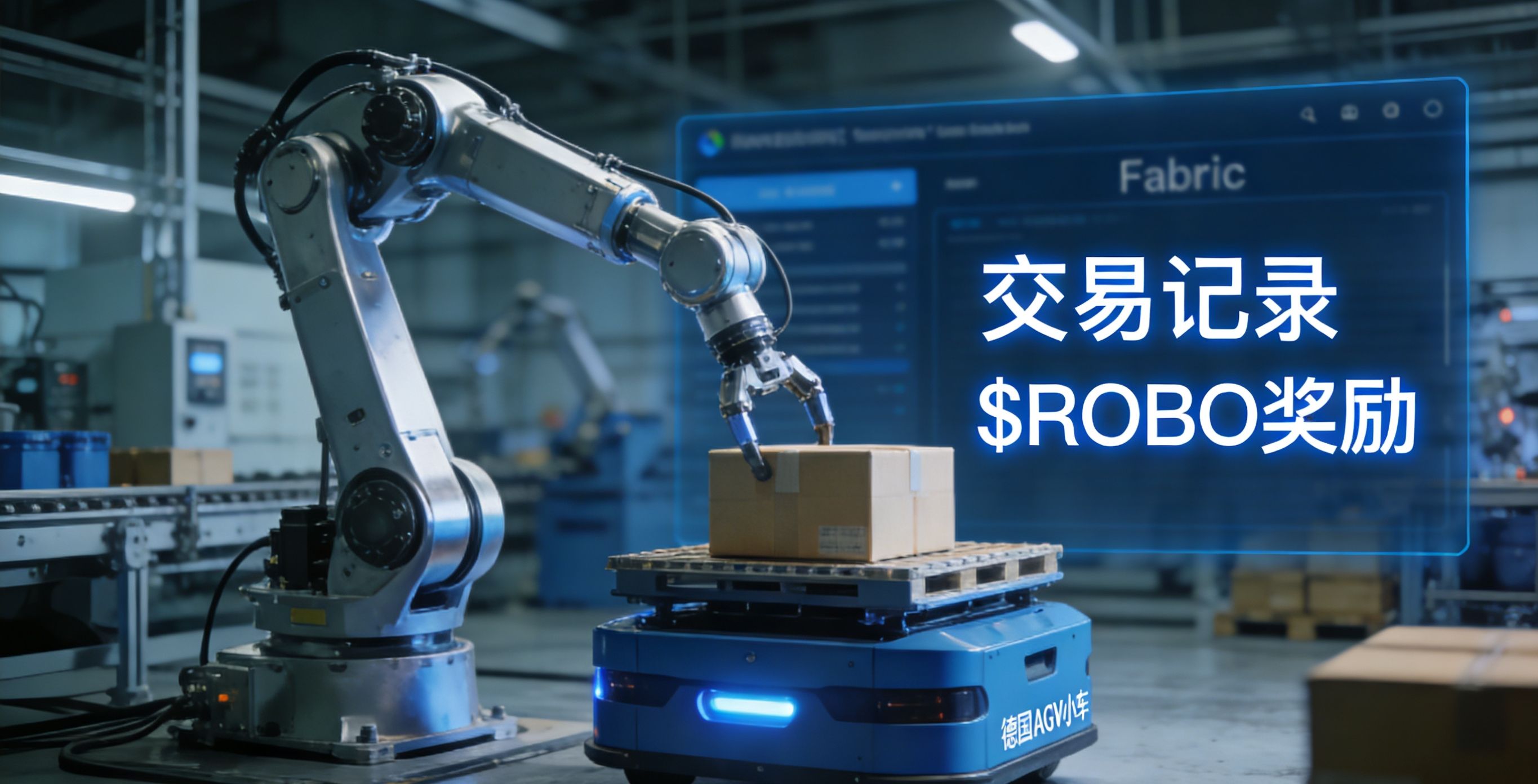
The first milestone arrived quietly: a domestically produced robotic arm successfully called the path data of a German AGV cart through the Fabric network, completing collaborative transportation. At that moment, there was no cheer, only a line of records quietly lying in the system and a meager $ROBO reward flowing to the contributor's wallet.
But Lin Yi knows that this faint light is just the beginning of a prairie fire.
This is not a carnival of speculation. This is a long journey about trust, openness, and win-win cooperation. They believe that the ultimate meaning of technology is not to create smarter tools, but to empower every life—whether human or machine—to grow in collaboration.
One day, when intelligent agents collaborate as efficiently as a swarm globally, and every small contribution is fairly recorded and rewarded, people will look back at this 3 AM. They will remember that there was a group of light chasers, who in the unnoticed night, built the cornerstone of the future with code and defined the essence of cooperation with belief.
Outside the window, dawn is approaching. Lin Yi rubbed his eyes, and the cursor on the screen is still flickering. He knows that on this road to the future, there is no lone battle. Only the flow and resonance of value, like the Milky Way, connects everyone involved into the same light.
In the name of openness, we embark on a journey towards the future. Anchored by value, we build a city of symbiosis. This is the most touching core of the Fabric story.