

When I look at the rapid progress happening in robotics and artificial intelligence, it becomes clear that we are moving toward a future where machines will no longer operate as isolated tools. Instead, they will increasingly become participants in interconnected digital and physical systems. While much of the attention today focuses on smarter robots or more powerful AI models, I believe the deeper challenge lies in how these machines will coordinate with each other. Fabric Protocol appears to be built around solving exactly that problem. Rather than focusing on building robots themselves, the project aims to create the infrastructure that could connect autonomous systems into a shared network where machines can interact, learn, and operate more efficiently.
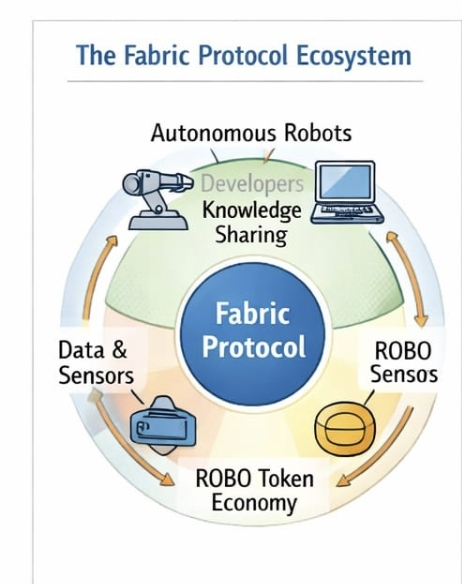
One of the biggest challenges I notice in robotics today is fragmentation. Most robots function inside closed ecosystems controlled by individual companies or organizations. The data they collect through sensors, cameras, and environmental interactions usually remains locked within proprietary systems. As a result, the knowledge gained by one robot rarely benefits others outside its own network. When I think about it, this slows innovation and prevents robotics from evolving as quickly as it could. Fabric Protocol introduces a coordination layer designed to connect machines and developers through shared infrastructure, allowing knowledge and computation to move more freely across the ecosystem.
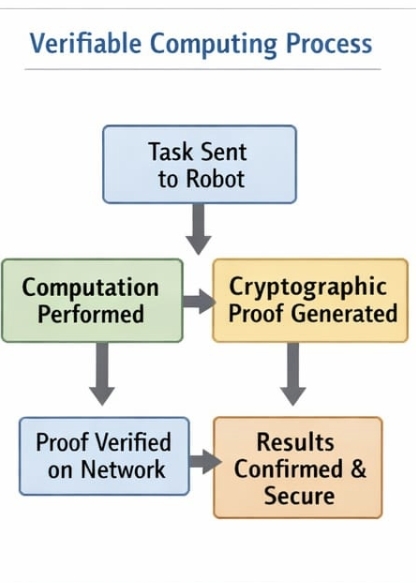
Another part of the protocol that stands out to me is the use of verifiable computing. As robots take on more responsibilities in industries such as logistics, manufacturing, and infrastructure management, trust becomes an important issue. Machines will increasingly make decisions that affect real environments, and relying purely on centralized oversight may not be enough. Fabric integrates cryptographic verification that allows computational processes and system actions to be validated. This means that instead of simply trusting that a machine behaved correctly, participants can verify that operations were executed exactly as intended.
Fabric also explores the concept of agent native infrastructure, which I find particularly fascinating because it changes the role of machines within technological systems. Instead of being treated purely as tools controlled by centralized software, robots and AI systems can act as active participants within networks. They can coordinate tasks with other machines, share resources, and operate through programmable agreements. This model opens the door to collaborative machine ecosystems where automation becomes more dynamic and interconnected rather than isolated.
Within this environment the ROBO coin functions as an economic layer that helps coordinate activity across the Fabric ecosystem. I see it as a mechanism that supports interaction between different participants on the network. It can help incentivize contributions such as data sharing, computational power, and infrastructure support while enabling transactions between developers, service providers, and autonomous systems operating within the protocol. As the ecosystem grows, the token may also gain visibility across major platforms like Binance, helping connect the technological infrastructure with broader market participation.
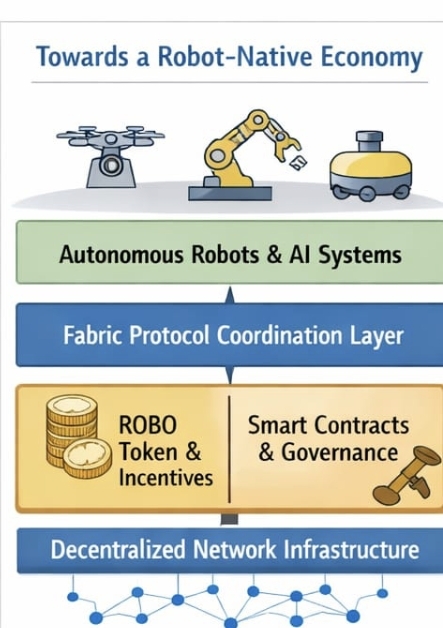
When I step back and look at the bigger picture, I realize that the technologies that change industries often begin by solving coordination problems. The internet connected computers around the world. Cloud infrastructure connected applications and digital services. In a similar way, robotics may eventually require a shared network that allows machines to collaborate at scale. Fabric Protocol seems to recognize this early and focuses on building the layer that could enable such coordination.
If the vision of a robot native economy truly begins to unfold in the coming years, the machines themselves will only tell part of the story. The networks that allow them to share knowledge, verify actions, and cooperate safely will be just as important. I see Fabric Protocol as an attempt to build that invisible foundation. It reflects a belief that technology works best when it connects people, ideas, and systems together. And if that vision continues to grow, the future may not just be filled with intelligent machines, but with networks where humans and robots collaborate in ways that create progress, opportunity, and a more connected world for everyone.