


Last night, I went to Haidilao for a meal, and when I looked at the bill of over 500 dollars, a particularly bizarre thought you mentioned suddenly popped into my head.
In the 1970s, 500 dollars could really buy a house. Fast forward to today in 2026, 500 dollars is just enough for a few people to enjoy a hot pot meal. What has our money gone through during this time?
It really seems absurd when you think about it. If everyone's salary was locked at 1 dollar a day, a house always sold for 500 dollars, and a car also sold for 500 dollars, and everyone adhered to this rigid scale, would the world really have so much scheming and internal strife?
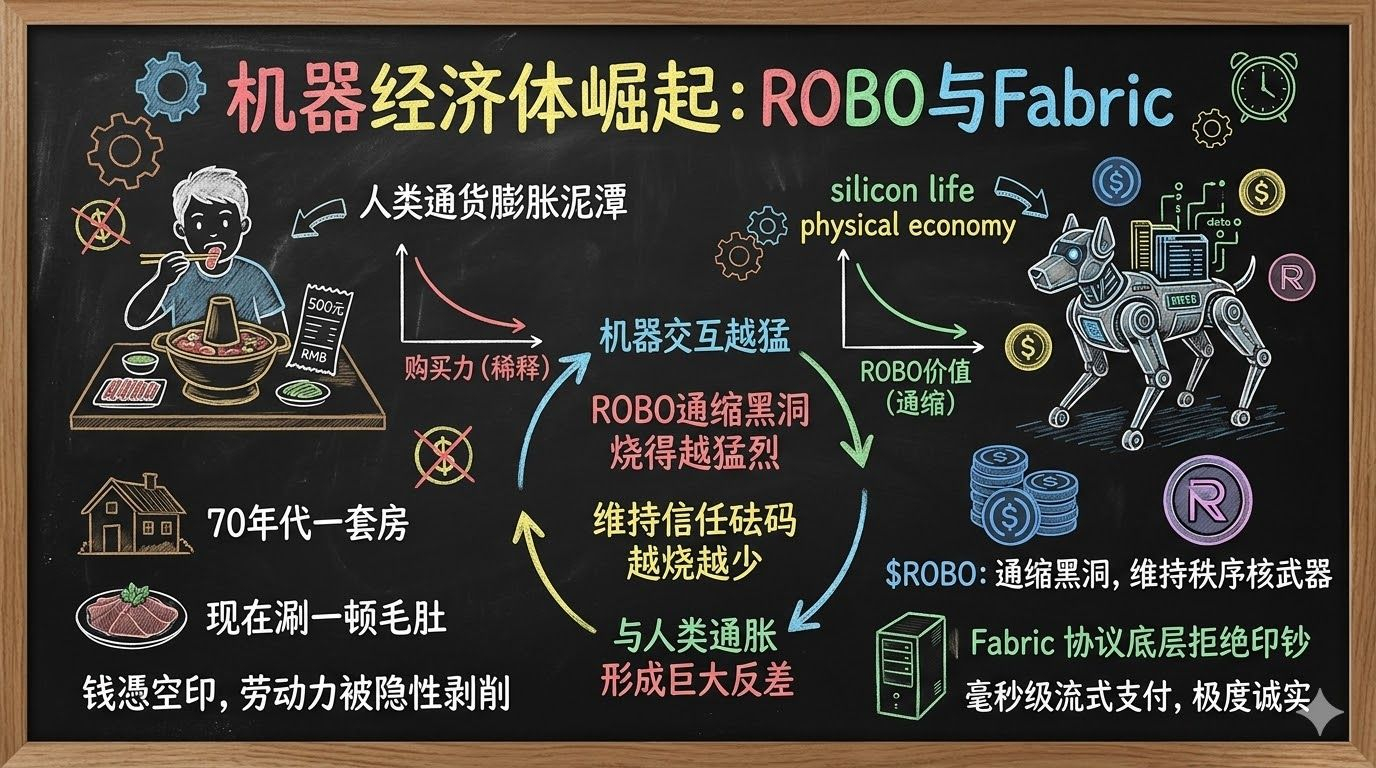
Unfortunately, reality has no ifs. The underlying logic of human society’s finance is based on endless “inflation” to exploit labor time covertly. Money can be printed out of thin air, which means that the purchasing power of ordinary people is always being diluted, so you can only scramble desperately for more diluted pieces of worthless paper. As long as humans have greed, this inflationary game of money will never stop.
Carbon-based humans are struggling and dying in this inflationary quagmire, but if you step out of the human perspective and look at those silicon-based life forms that are about to take over the physical world, you will find they are abandoning the extremely disgusting and inefficient financial games of humanity.
This is also the core reason why I have been recently focused on @Fabric Foundation and the #robo behind it. While humans are still worried about the purchasing power of that 500 yuan, machines are establishing an extremely cold-blooded, inflation-refusing, and absolutely honest physical economy.
Eerie cross-dimensional employment: when AI becomes the foreman
A few days ago, many people might have been focused on the market and didn’t notice a nuclear-level movement that exploded on Twitter. Virtuals Protocol, in collaboration with OpenMind and Fabric, pulled off a big move.
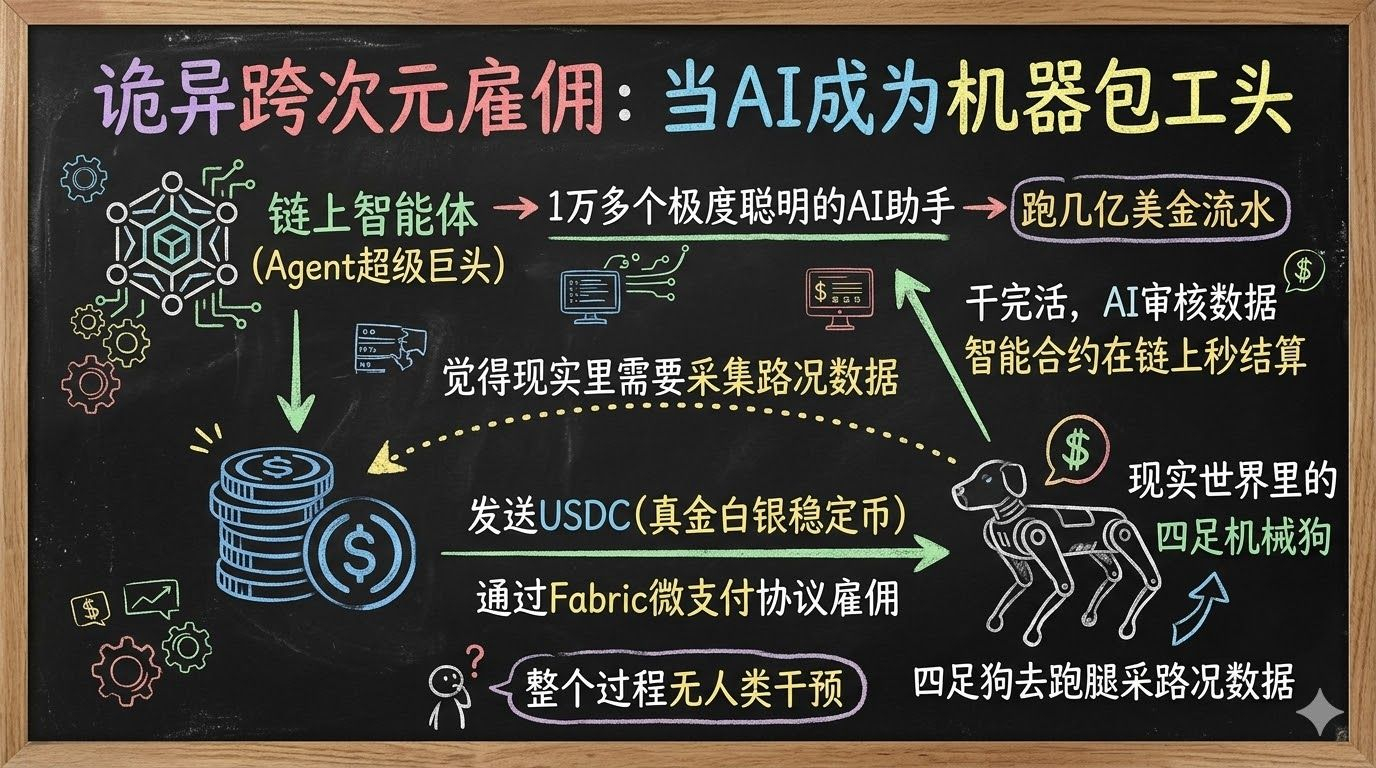
Everyone knows what Virtuals does; it’s the super giant of on-chain agents (Agent), holding over ten thousand extremely smart pure software AIs, running billions of dollars on-chain every day. But these purely digital AIs seem to be tired of staying in the network cables. What do they want to do now? They want to take real money in USDC to hire physical robots in the real world to work.
// I used to think that the narrative limit of Fabric was merely to issue a digital ID (URID) to the mechanical arms in dark factories, allowing them to own a smart contract wallet when they run out of power and go to the charging pile to scan and pay for electricity.
But now that these three are connected, the logic has completely changed, and it’s a bit chilling.
In the future, if you have an AI assistant on the blockchain that needs to collect traffic data from a certain neighborhood, it can directly use the micropayment protocol provided by Fabric to take out stablecoins to hire a four-legged robotic dog in the real world to run errands. After the four-legged dog finishes the task, the AI verifies the data and settles it on the blockchain in seconds. This whole process has no human shadow.
Rejecting the money printer: the absolute deflationary flywheel of the physical world
Let’s bring the topic back to the “500 yuan” dilemma we discussed at the beginning. Why can machines escape the curse of inflation? Because Fabric, from the bottom code, has permanently welded the possibility of “printing money out of thin air”.
In the Fabric network, machines work, buy electricity, and hire each other using USDC, a dollar-pegged stablecoin, for millisecond-level streaming payments. Because machines don’t need speculation; they only require the most stable measure of purchasing power, doing a job for $0.001 earns them $0.001.
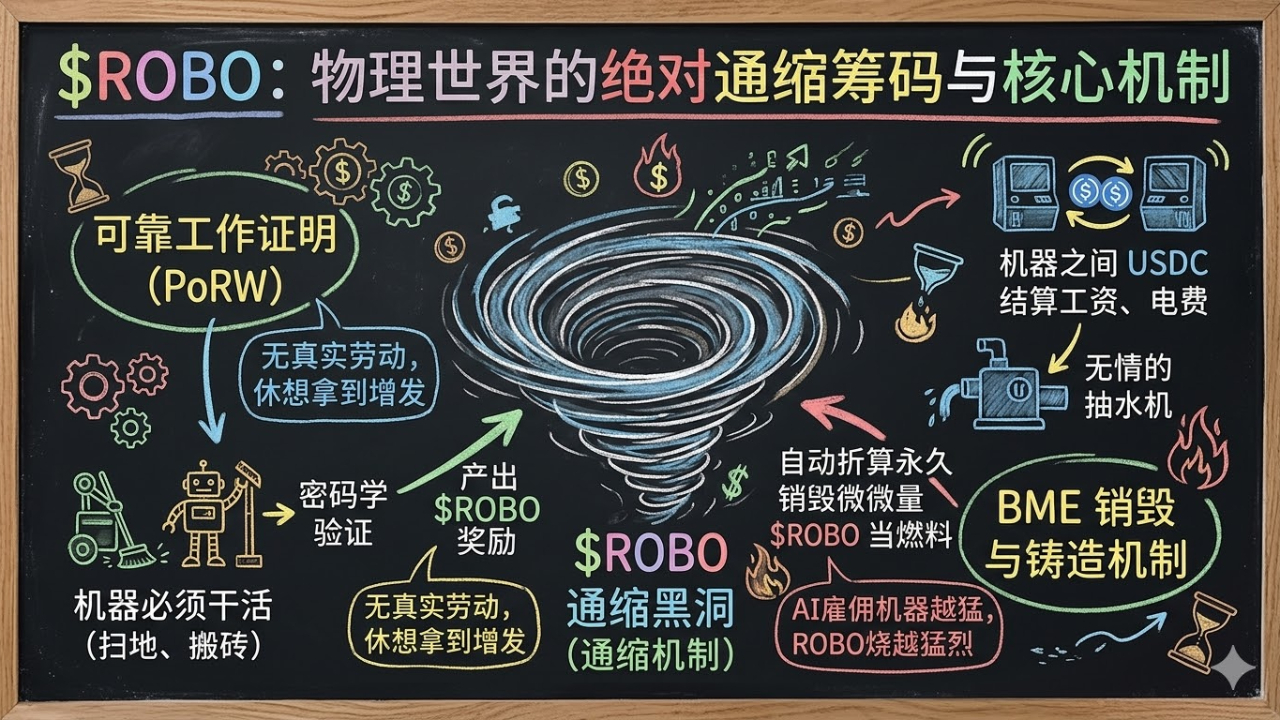
So what is this $ROBO token for? It is the “nuclear weapon” and “deflationary black hole” that maintains order in this economic system.
First, human society likes Ponzi schemes, likes to lie flat and collect rent. But in Fabric, the output of tokens strictly follows Proof of Reliable Work (PoRW). Machines must perform real tasks in the physical world, such as sweeping the floor or moving bricks, and only after being verified by the entire network cryptographically will the system provide rewards. Without real physical labor, you can’t expect to receive a bit of inflationary issuance.
Secondly, this is also the most ruthless point I think, called the BME destruction and minting mechanism. Machines settle wages and electricity fees using USDC, and behind every seemingly tiny payment, the underlying protocol automatically converts and permanently destroys small amounts of ROBO as network fuel.
Take a closer look at this picture. In the real world, the higher the frequency of AI hiring robots, the more numerous machines crazily interact, buy, and sell data and electricity on the road, the more fiercely the deflationary black hole ROBO burns. Human money keeps being printed more and more, while the chips that machines maintain trust with burn less and less.
Financial nuclear deterrence: using everything to guarantee the spirit of contracts
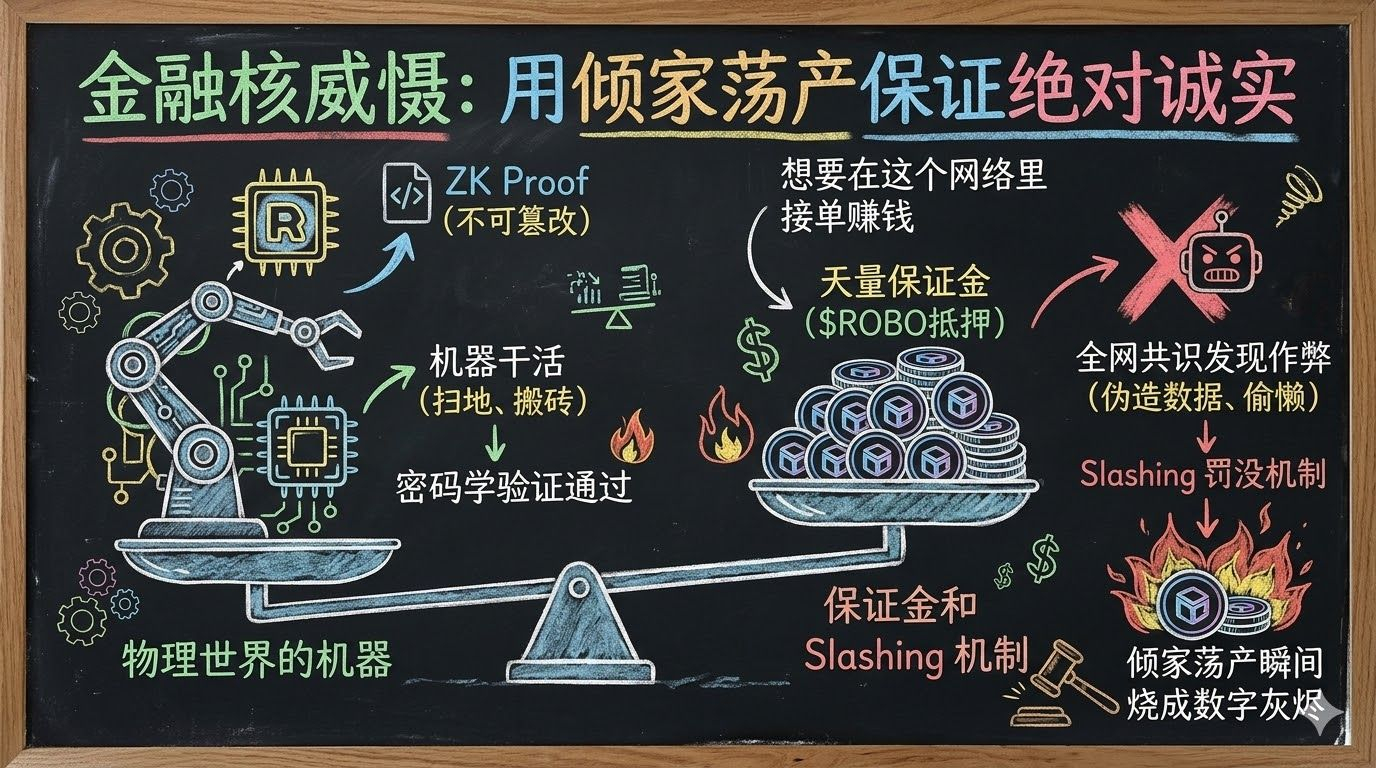
You will definitely ask, since it’s all machines interacting, how does the AI foreman in that network cable know whether the mechanical dog in the physical world is slacking off? What if the robot dog forges data to cheat USDC?
Human society prevents cheating through contracts, lawsuits, and even bickering. Machines don’t operate this way; they only believe in the purest financial nuclear deterrence.
To make money in this network, the operating party behind the machine must stake a massive amount of ROBO as collateral in advance. The hardware chips loaded in the machines will generate immutable zero-knowledge proofs (ZK Proof) in real-time for every step you take and every kilowatt of electricity you consume.
As long as the entire network consensus detects that you have deviated from the physical trajectory or forged data, there is absolutely no room for appeal; the smart contract will instantly trigger the Slashing penalty mechanism. The massive funds you have staked will be turned into digital ashes in just a few tenths of a second. Using everything to force absolute honesty, this is the most efficient law in the machine world.
Splashing a bucket of cold water
To be honest, every time I run through the logic of this machine autonomous economy, I become extremely excited. But as a seasoned retail investor gambling with real money in this market, I must pour a bucket of cold water on myself and everyone.
Letting pure code AI bypass traditional human banking systems to directly control massive amounts of capital to command the steel armies of the physical world, this matter in any country is dancing crazily in the minefield of anti-money laundering (AML) and national security supervision. The iron fist of compliance can strike this grand narrative dead on the beach at any time.
Moreover, even if Virtuals is willing to buy hardware for developers to test, the cost of high-end robot hardware that can run ZK proofs and interact seamlessly with the blockchain is still extremely expensive. Relying on two or three years to see such robots running on the streets autonomously spending money requires a strong supply chain explosion to support it.
Perhaps in a few years, when robots have truly established this completely independent autonomous economy, they will look at humans still anxious over issues like “once being able to buy a house for 500 yuan but now only able to eat hot pot” and feel that we are as pitiable as uncivilized primitives.
Today, following your 500 yuan idea, we’ve delved a bit deeper. How far do you think we are from a scenario where AI employs physical robots with cryptocurrency to deliver takeout, a somewhat eerie scene?