
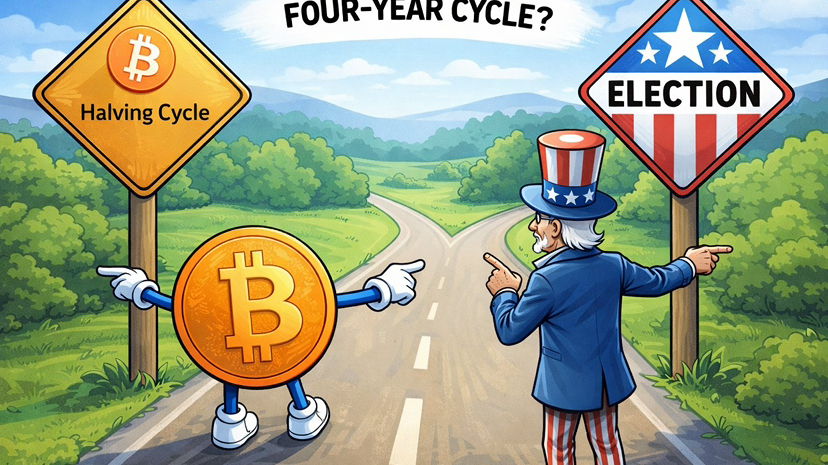

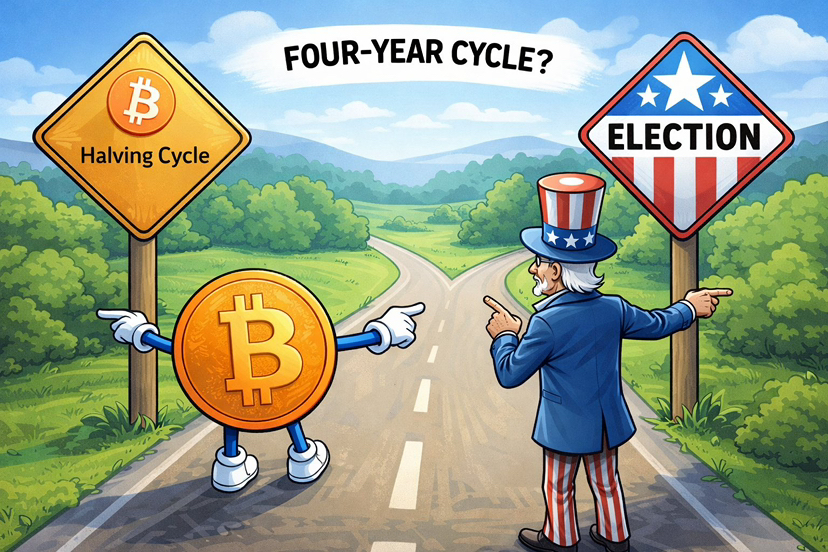
In my personal opinion, the impact of the halving on $BTC is becoming weaker, as the total supply approaches its limit, the anti-dumping effect of each halving is not as strong as it used to be.
Moreover, looking back at the past few cycles, when Bitcoin truly enters a phase of emotional climax, it often overlaps with the U.S. electoral cycle. So my consistent view is that the four-year cycle likely still exists, but it is driven not just by the halving itself, but more like a result of the halving, elections, liquidity expectations, and risk appetite working together.
The national election itself will not directly determine the price of Bitcoin, but elections often influence fiscal policy, regulatory expectations, and the market's imagination about future liquidity, which are precisely the things that risk assets value the most.
Secondly, the lifecycle of BTC is still too short; many combinations of events have never occurred before or have just appeared. For example, this halving cycle corresponding to the Fed's high interest rates and balance sheet reduction is the first time, and Bitcoin has not really faced a long-term economic recession until now.
Therefore, many friends directly apply the experiences from previous cycles to the future, which inherently will have deviations. The past history can only tell us how Bitcoin performs in certain environments, but it cannot prove that the future will follow the same path under completely different macro conditions.
Moreover, the biggest difference between now and the past is not just the decreasing impact of halving, but more importantly, Bitcoin has increasingly deepened its integration into the global financial system. Previously, factors affecting $BTC were more about internal narratives of the crypto world, miners, halving, exchanges, and retail sentiment, but now, ETF, institutional allocation, dollar liquidity, US Treasury yields, Fed path, regulatory attitudes, and even geopolitical conflicts and energy prices will have a more direct impact on Bitcoin.
In simple terms, Bitcoin used to resemble a small market with its own rhythm, but now it’s more like it has been pulled into the global macro asset pricing system, so relying solely on the halving narrative has become very difficult to explain all the issues.
So I think there is a high probability that a four-year cycle still exists, but it does not mean that there will definitely be a major surge every four years. In the future, a more likely scenario is that the election phase will stimulate market sentiment, but if there is no real improvement in liquidity, the market will still fall silent again after the heat passes.
Of course, there is another possibility, which is that as institutions fully enter, Bitcoin gradually resembles gold, no longer strongly dependent on the halving cycle, but rather pricing more in line with global liquidity, interest rates, and risk-averse demand.
Conclusion