
Midnight is the kind of project I would usually dismiss after two paragraphs.
I have read too many whitepapers, too many careful promises, too many chains trying to sell the same old story with a fresh coat of zero-knowledge paint. Privacy. Ownership. Control. Better infrastructure. Smarter design. The market has been chewing on variations of that language for years now, and most of it ends up as noise. A launch, a listing, a few months of attention, then the slow grind into irrelevance.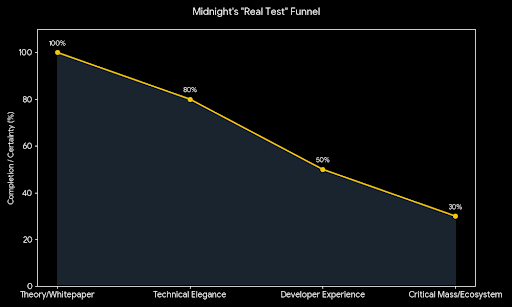
So I came into Midnight with that same fatigue. Honestly, I still have it.
But the reason I keep returning to Midnight is that it does not feel like another attempt to simply repaint the old idea of blockchain privacy. Most projects frame privacy as a slogan — something to attract attention. Midnight feels different. It approaches privacy less as a marketing hook and more as a structural problem that needs to be designed carefully.
The reality is that most blockchains push everything into the open and call that transparency. That philosophy works for certain use cases, but it breaks down quickly when real-world systems enter the picture. Financial records, internal operations, contracts, compliance processes — these things rarely belong in a completely public environment.
On the other side, some projects swing too far in the opposite direction and attempt to hide everything. At first glance that sounds appealing, but systems that hide everything often struggle to prove anything. And in practical environments, proof matters. Businesses, regulators, partners, and users still need ways to verify actions without exposing every piece of underlying data.
That tension — between visibility and confidentiality — is where most blockchain ideas begin to fall apart.
Midnight appears to focus directly on that tension.
Instead of choosing between public transparency or complete secrecy, the project seems to build around the idea of controlled disclosure. In other words, information can remain protected while still allowing the system to demonstrate what needs to be verified. That middle ground is far more complicated than the marketing language makes it sound.
Real systems rarely operate in simple binaries. They require layers of access, selective verification, and carefully managed exposure of information. Designing a blockchain environment that can support those dynamics is not simple work. It requires deeper architectural thinking than most projects bother with.
That is why Midnight caught my attention.
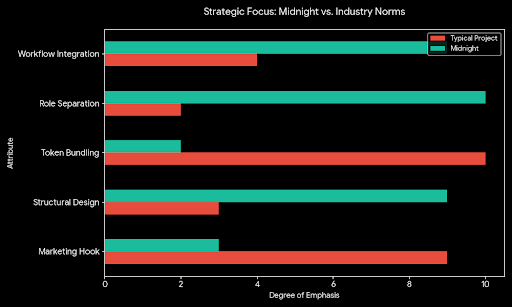 It treats privacy less like a shield and more like a workflow component. The question is no longer just how to hide information, but how to allow systems to function while protecting the information that actually matters. That distinction may seem small, but it fundamentally changes how the technology needs to be built.
The economic structure of the network also suggests that the team has thought about these problems beyond surface level design. Separating the publicly tradable token from the shielded resource used for internal network activity is not a typical move in this industry. Most projects bundle everything into one asset and hope the market eventually resolves the contradictions.
Midnight’s model appears to separate those roles more deliberately. That does not guarantee success, but it shows a willingness to align incentives with architecture rather than ignoring the tension between them.
Of course, good design on paper does not guarantee adoption. Many technically elegant systems have struggled once they met real users. Developers want powerful tools, but they also want systems that are intuitive and easy to integrate. If the architecture becomes too complex or the developer experience too demanding, enthusiasm can fade quickly.
That is where the real test for Midnight will happen.
Not in theory, but in practice — when developers begin building real applications and when users interact with those applications without thinking about the underlying technology. If the system can support that level of usability while maintaining its privacy model, then the project will have accomplished something meaningful.
If not, it risks becoming another respected idea that never quite becomes an ecosystem.
That outcome is not unusual in the blockchain world. Many projects are admired for their concepts but never reach the critical mass of builders and users needed to sustain real momentum.
Whether Midnight escapes that pattern is still an open question.
What I can say is that the project appears to focus on a problem that genuinely matters. The current blockchain model leaves a significant amount of real-world activity off-chain because the environment is simply too transparent to handle sensitive operations. Until that limitation is addressed, adoption will continue to hit the same invisible wall.
Midnight seems designed with that reality in mind.
It does not pretend that radical transparency solves everything, and it does not claim that total secrecy is the answer either. Instead, it tries to build a system where information can remain protected while still allowing the network to function and prove what needs to be proven.
That space — where systems must balance disclosure and confidentiality — is messy, technical, and difficult to design around.
But it is also where many real-world applications live.
And perhaps that is why Midnight continues to linger in my mind more than many louder projects in the market. It feels less like a narrative designed for quick attention and more like a long argument about how blockchain systems might eventually handle the complexity of real economic activity.
I am not ready to celebrate it yet. The market has already seen too many polished ideas collapse once they left the whitepaper stage.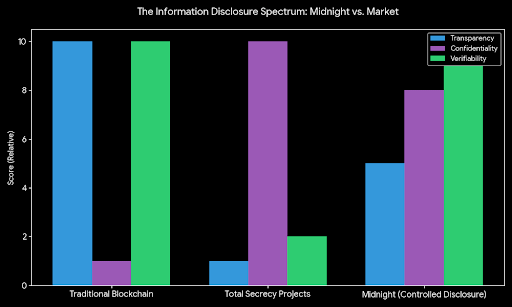
But at the very least, Midnight seems to be addressing the right problem — and in this industry, that alone is rarer than it should be.
@MidnightNetwork #night $NIGHT
