

Yesterday, when I first stepped into Midnight City and watched the agents moving through the districts — buying, selling, chatting — I realized something I hadn't grasped from the documents. It wasn't just a pretty simulation. It was the perfect metaphor for what Midnight is trying to solve.
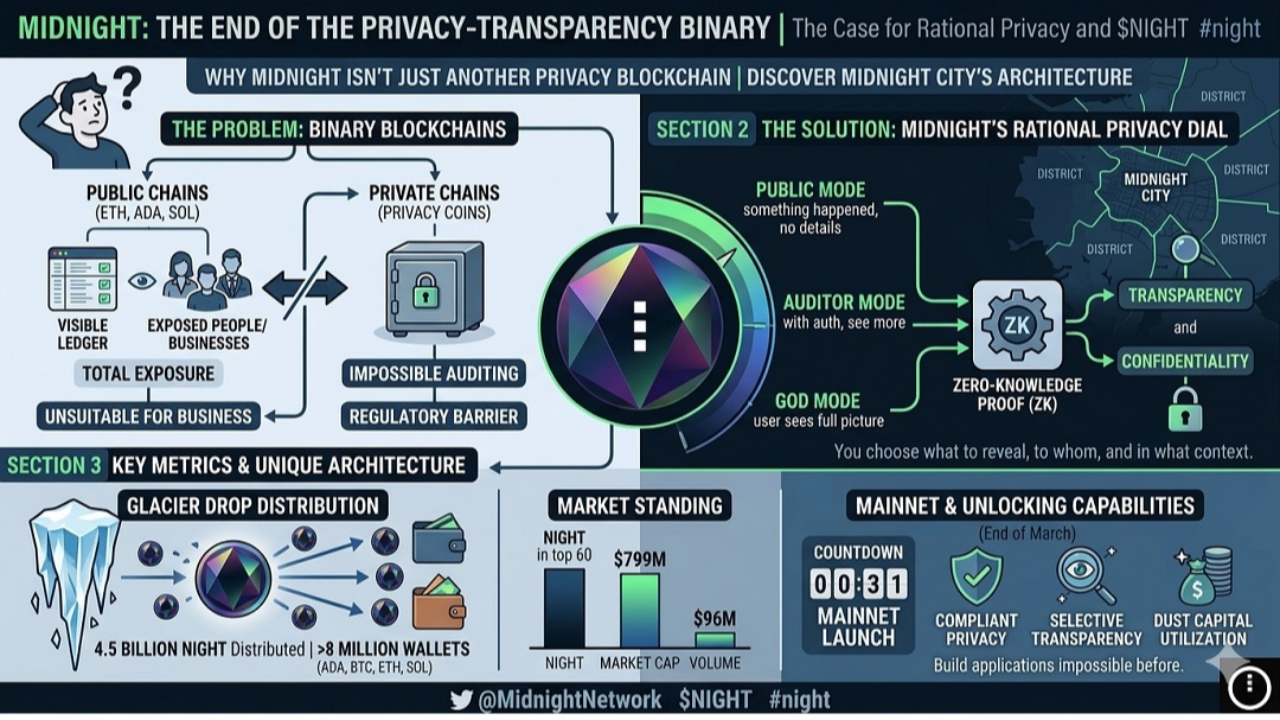
We've been hearing for years that "privacy matters." But in blockchain, until now, the options have been binary: either everything public (Ethereum, Cardano, Solana) or everything private (so-called "privacy coins"). And both come with problems.
Public chains expose every move you make. Every transaction, every balance, every interaction is permanently etched into a ledger anyone can query. For an ordinary person, that's uncomfortable. For a business, it's impossible. No bank is going to put its operations on display where competitors can watch everything.
Private chains solved that… but created other problems. By hiding everything, they became difficult to audit, difficult to regulate, and often ended up being used for things they shouldn't.
Midnight offers something different: rational privacy.
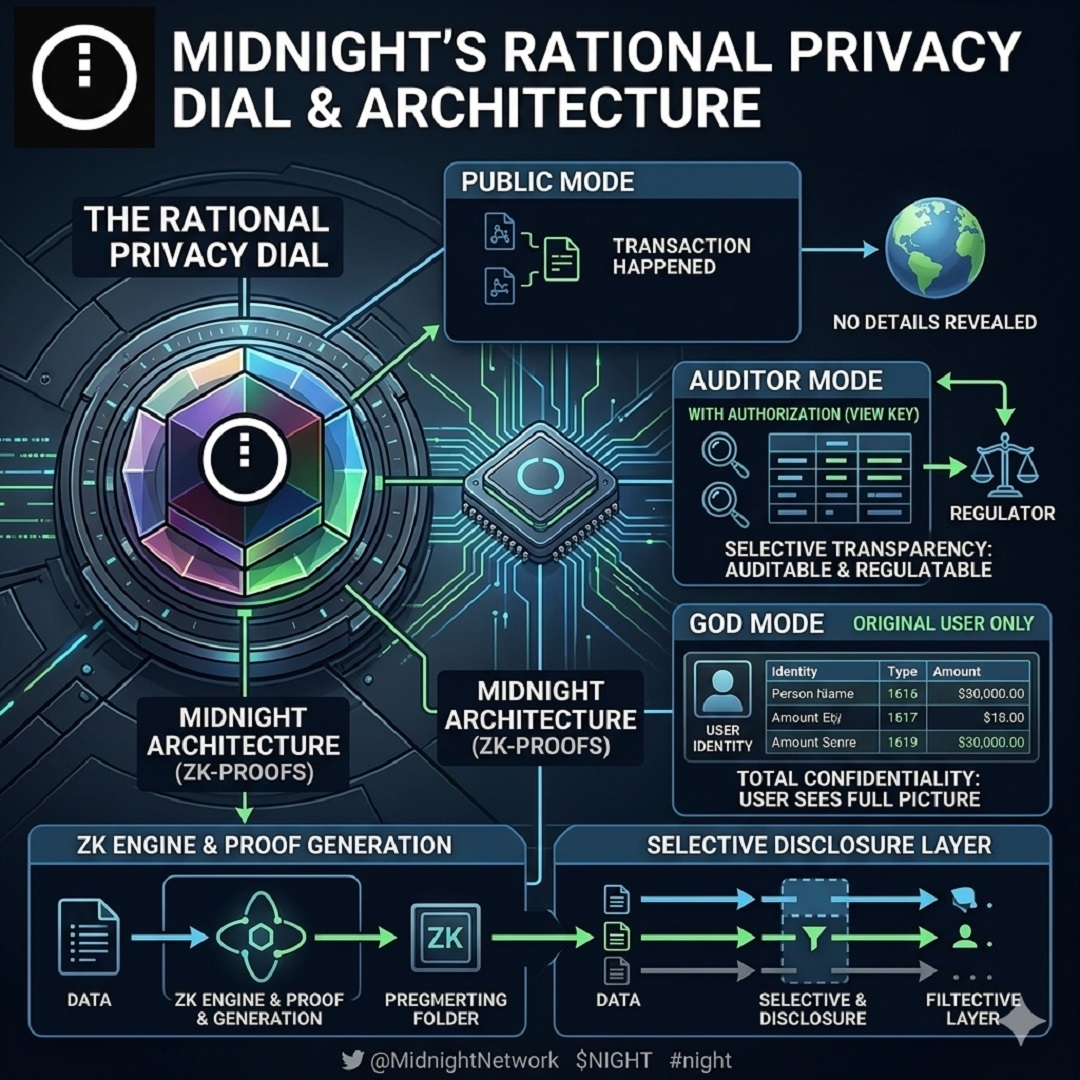
It's not an on/off switch. It's a dial. You choose what to reveal, to whom, and in what context. The technology behind it is zero-knowledge proofs (ZK), but the important part isn't the how — it's what it means: for the first time, a blockchain can be transparent when it should be, and private when it needs to be.
The clearest example was right there in Midnight City. Inside the simulation, you can see the same transaction from three perspectives:
Public mode: Something happened. No details.
Auditor mode: With proper authorization, you see more.
God mode: Only the original user sees the full picture.
That's not a game. It's Midnight's architecture in action.
And the numbers are starting to back it up. In December, the network distributed 4.5 billion NIGHT to over 8 million wallets — one of the widest distributions in crypto history. It wasn't handed to a few insiders. It went to anyone holding ADA, BTC, ETH, SOL who participated in Glacier Drop or Scavenger Mine.
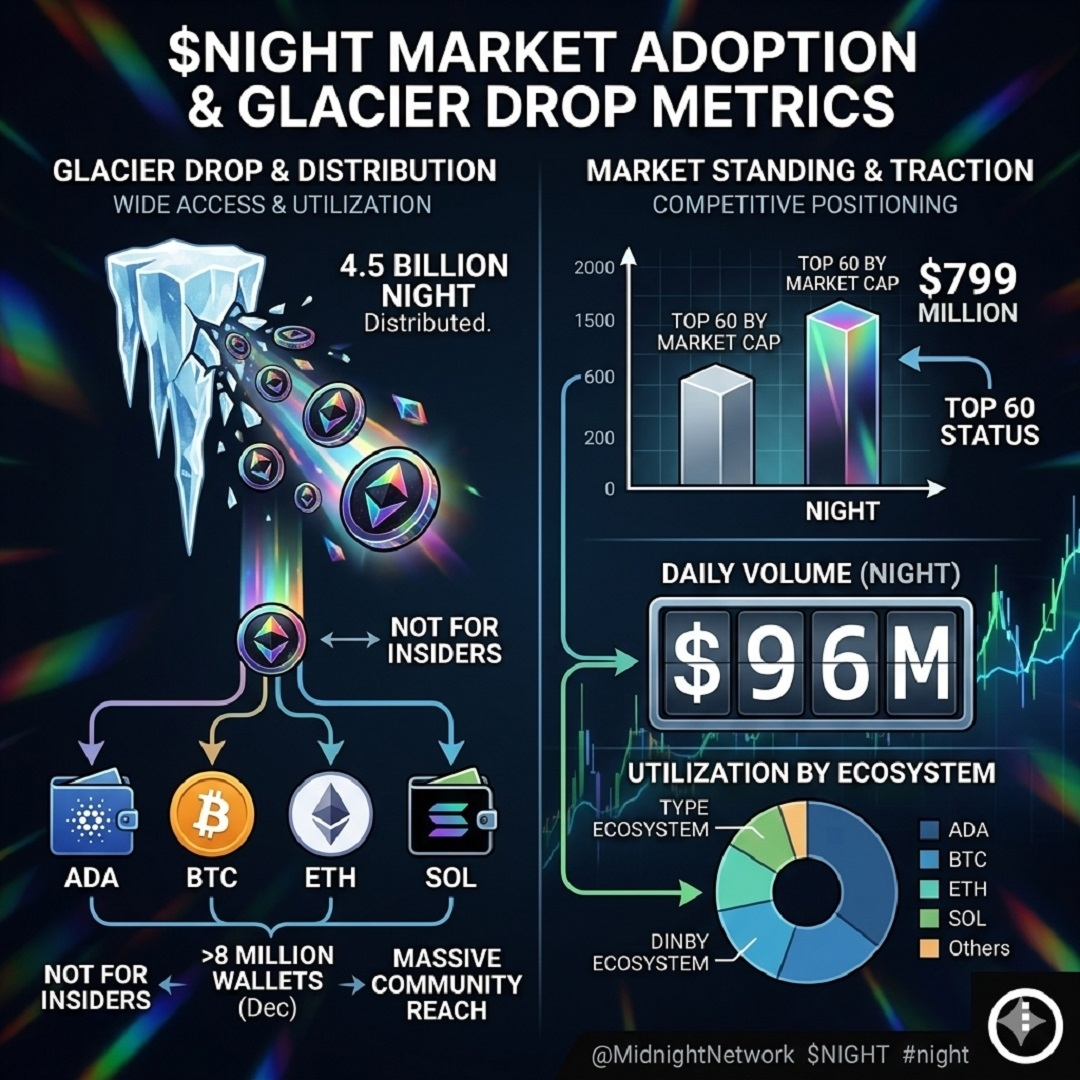
Today, NIGHT sits in the top 60 by market cap, with $799 million and $96 million in daily volume. But the interesting part isn't the price. It's what's coming: mainnet at the end of March, and with it, the chance for developers to build applications that until now were impossible.
Because Midnight isn't just another network. It's the first where you can:
Have privacy without being unregulable
Be transparent without exposing sensitive data
Use the network without spending your capital (thanks to DUST)
The question is no longer whether privacy matters. It's whether we're ready for a blockchain that understands privacy and transparency aren't enemies — they're tools you use depending on the context.
After spending time in Midnight City, I have a feeling we've been looking at the problem backwards for years.