
I have Been watching night closely since morning and 👀 the mechanic that makes Midnight genuinely different from every other L1 isn't the ZK architecture — its the DUST resource design, and specifically what happens when DUST can't be transferred.
Start with the basics. NIGHT generates DUST. You hold NIGHT, designate a recipient address, and DUST accrues linearly with each passing block - up to a cap proportional to your NIGHT balance. When that cap is reached, generation pauses until you spend some. DUST pays for transactions and is burned on use. NIGHT is never spent. This is what the whitepaper calls operational predictability - your transaction costs are decoupled from token price volatility because the fuel regenerates from your holdings.
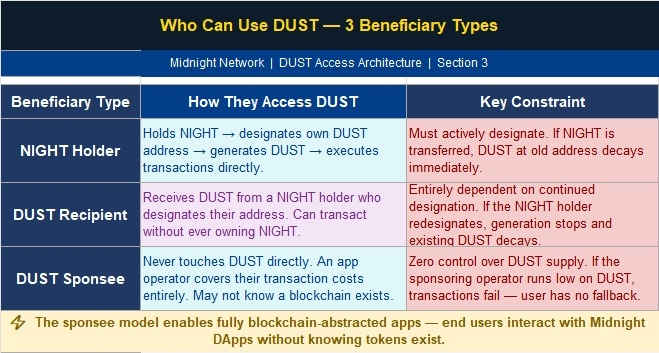
The whitepaper describes three distinct beneficiary types built on this mechanic, and each one reveals something different about what the design enables. NIGHT holders generate and consume their own DUST - standard usage. DUST recipients receive DUST from a NIGHT holder who designates their address, letting them transact without ever owning NIGHT themselves. A non-profit application can run entirely on donated DUST generation. And DUST sponsees don't interact with DUST at all — an app operator covers their transaction costs entirely. The end user may not know a blockchain is involved
That third category is the one worth examining: it's the mechanism that enables fully blockchain-abstracted consumer applications on Midnight.
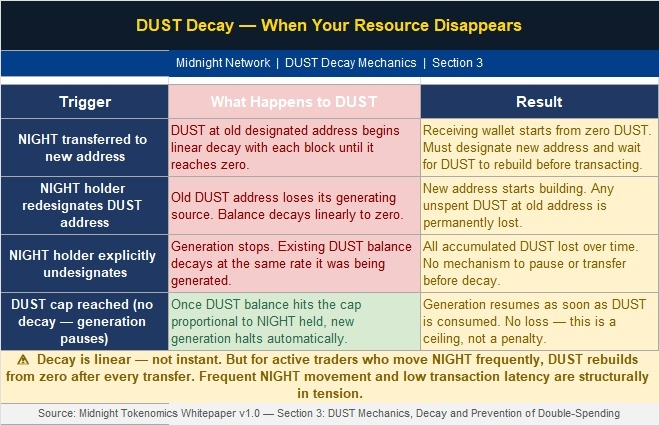
Here's where the design gets interesting and also where I keep coming back to the tension. DUST non-transferability is presented as a feature - and it is, for two distinct reasons. Regulators cannot classify DUST as a tradeable asset because it has no transfer utility and cannot hold value. And it prevents double-spending by making accumulation impossible: the cap is always enforced because generation and decay are symmetric
Elegant design.
But what the whitepaper describes clearly - and doesn't fully resolve - is the active NIGHT trader problem. Every time NIGHT moves to a new address, DUST at the old address starts decaying linearly to zero. The new holder starts rebuilding from scratch. For holders who move NIGHT infrequently, this is a non-issue. For active market participants who trade NIGHT on exchanges or shift between wallets regularly, DUST never fully builds up. The more liquid the NIGHT market becomes, the more fragmented DUST generation across addresses becomes. Builders got the compliance architecture right
What I'd want to see modeled is what average DUST availability looks like across addresses during periods of high NIGHT market activity
because the fee stability premise depends on DUST being sufficiently built up when transactions are actually needed.
The capacity marketplace section hints at solutions — Babel Stations, broker-managed leasing, on-chain DUST exchanges. But those are post-mainnet roadmap items
At launch, your DUST availability is entirely a function of how long you've held NIGHT in one address without moving it. Is that predictability enough for the enterprise-grade operations Midnight is targeting??
@MidnightNetwork #night $NIGHT
