
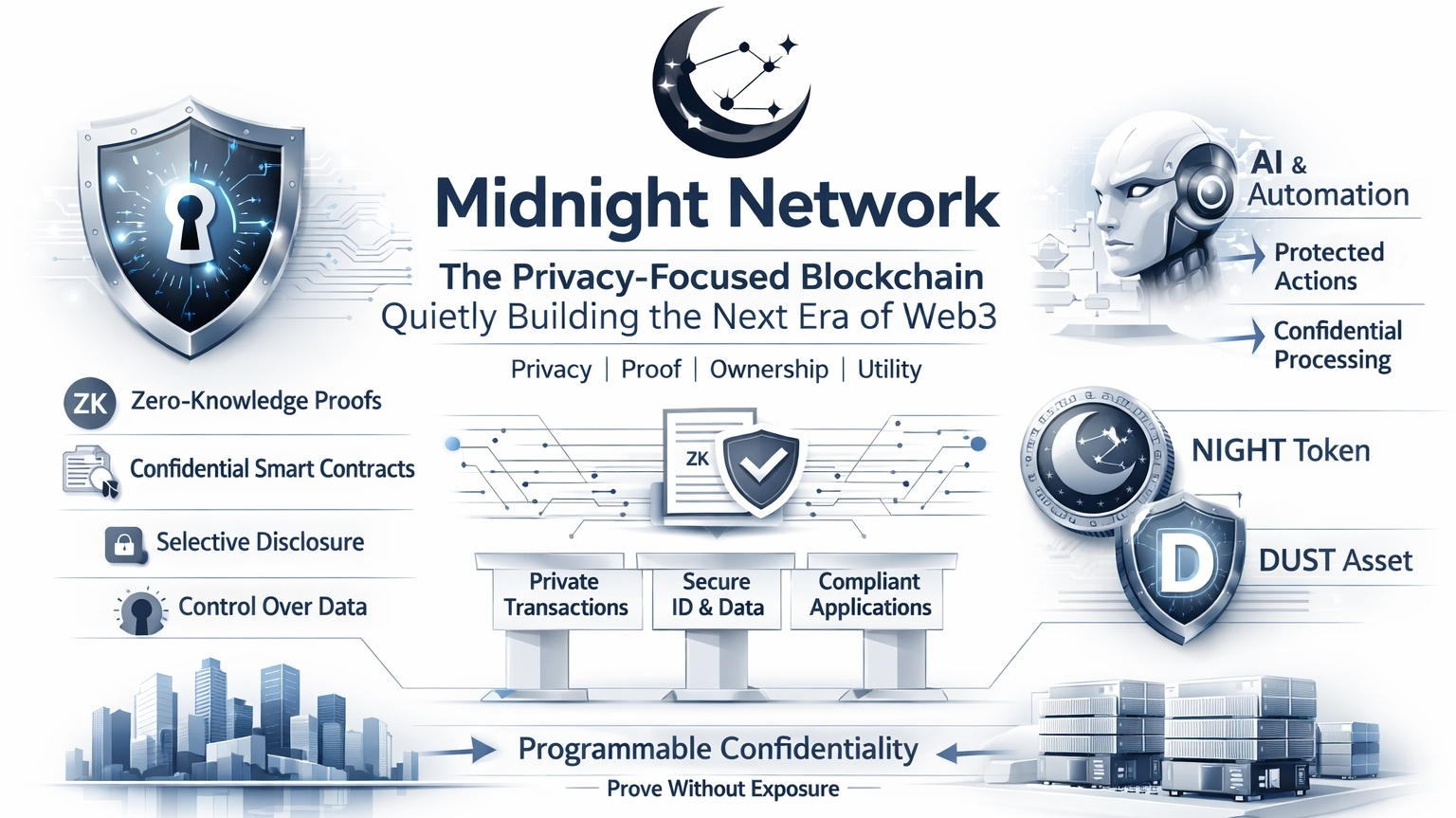


Midnight Network feels different because it is trying to solve a real problem inside blockchain instead of repeating the same old story.
A lot of projects talk about privacy, but most of them frame it in a very basic way. They focus on hiding data and stopping others from seeing what is happening. Midnight takes a much more mature approach. It is building a blockchain that uses zero-knowledge technology to protect information while still allowing people to prove what matters. That idea is important because privacy in Web3 is no longer just about secrecy. It is about control.
That is where Midnight starts to stand out.
The project is built around the belief that users and builders should not have to choose between full transparency and complete darkness. On one side, fully public blockchains expose too much. On the other side, systems that hide everything can become difficult to trust or use in serious environments. Midnight is trying to create balance. It gives people a way to keep sensitive details private while still proving that actions, conditions, or outcomes are valid.
This makes the project feel far more practical than many privacy-focused narratives in crypto.
What Midnight is really doing is turning privacy into something useful. Instead of treating it like a shield that blocks everything, it treats privacy like a tool that can be applied where it is needed most. That changes the type of applications the network can support. Sensitive payments, private identity data, business logic, smart contracts, and on-chain activity do not always belong on a fully public system. Midnight understands that and builds for that reality.
That is why the project has real depth.
Its use of zero-knowledge proofs is not there just to sound advanced. It is there to solve the tension between data protection and blockchain verification. In simple terms, Midnight allows someone to show that something is true without forcing them to reveal all the underlying information. That is a powerful shift. It means ownership, activity, and logic can stay protected while trust is still maintained.
This is one of the strongest ideas behind the whole project.
Midnight is not trying to remove trust from the system. It is trying to improve how trust is created. In many blockchains, trust comes from exposing everything to everyone. Midnight believes trust can also come from proof itself. That creates a much cleaner path for people and developers who want privacy without losing confidence in the network.
Another reason Midnight feels important is because it is being built for the future, not just for the old crypto market.
Blockchain is moving into a phase where more serious applications will need better data handling. It is no longer enough to only support visible transfers and public smart contracts. As the space grows, more users and builders will need systems that can protect sensitive information while still operating on-chain. Midnight fits naturally into that direction. It feels like infrastructure for a more advanced version of Web3, where privacy is not optional but built into the design.
The project also becomes more interesting when looking at how it structures its network economy.
Midnight separates its core token role from the private resource used to power activity on the network. That is a smart move because it makes the system feel more purpose-driven. Instead of turning every part of the network into pure speculation, it creates a model where network use and private execution have their own function. This gives the project a more thoughtful foundation and shows that the team is not only thinking about price or hype. They are thinking about how the chain should actually work in practice.
That matters because the strongest blockchain projects are usually the ones that design around long-term utility, not just short-term attention.
Midnight also gives the impression of a network that wants real builders, not just noise. The way the project has been preparing its ecosystem shows a focus on development, readiness, and actual use. That is a positive sign. A blockchain only becomes valuable when people can build on it, use it, and create something meaningful with it. Midnight seems to understand that clearly.
What makes the project even more compelling is that its core idea is easy to connect with once you strip away the technical language.
People want ownership of their data.
People want privacy without losing access.
People want digital systems that do not expose everything about them.
Builders want tools that protect users without breaking functionality.
Midnight sits directly in that gap.
It is trying to create a blockchain where confidentiality is built into the experience instead of being added later as an extra layer. That gives it a stronger identity than projects that only market privacy as a feature. Midnight feels like it is building an environment where privacy is part of the network’s DNA.
At the same time, the project still has an important journey ahead. Strong ideas alone are never enough. What matters next is execution. Midnight has the concept, the technology, and the direction, but the real test is whether that vision turns into a living ecosystem with real activity and lasting demand. That is the phase where every serious project proves itself.
Still, the reason Midnight keeps attracting attention is clear.
It is not trying to be another chain with a recycled story.
It is trying to build a blockchain where privacy, proof, ownership, and utility can exist together in a way that actually makes sense.
That is a much stronger foundation than hype alone.
Midnight feels like a project built around a real need in crypto. It understands that the future of blockchain cannot rely on full exposure forever. Some information needs protection. Some actions need confidentiality. Some users need control. And some applications simply cannot thrive in an environment where everything is public by default.
That is the gap Midnight is trying to fill.
And if it delivers on that vision, it will not just be seen as a privacy project. It will be seen as a network built for a more usable, more mature, and more realistic version of Web3.