
Look, I'll be honest when I first heard about another privacy-focused blockchain launching, my eyes kinda glazed over. We've seen this movie before, right? Another project promising anonymity, another token, another wait-and-see situation. But the more I've dug into @MidnightNetwork and $NIGHT , the more I'm thinking this might actually be different.
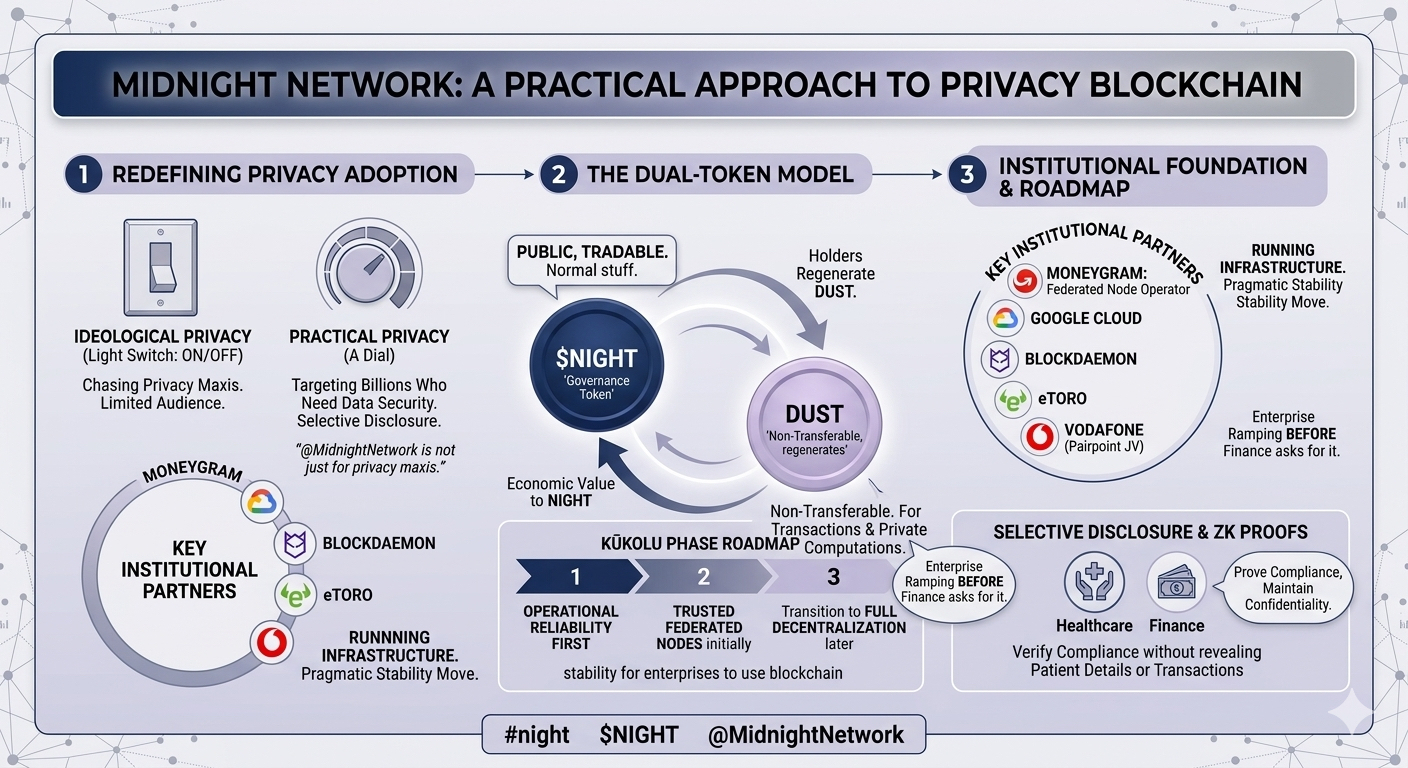 So here's what caught my attention. Midnight isn't trying to be the next Monero. Charles Hoskinson said something at Consensus Hong Kong that actually made me stop and think he basically said they're not chasing the privacy maxis, the people who already care deeply about privacy. Instead, they're going after billions who don't know they need privacy. That's a totally different approach, and honestly? It makes sense. Most people don't wake up thinking about zero-knowledge proofs. But they DO care when their data gets leaked or sold.
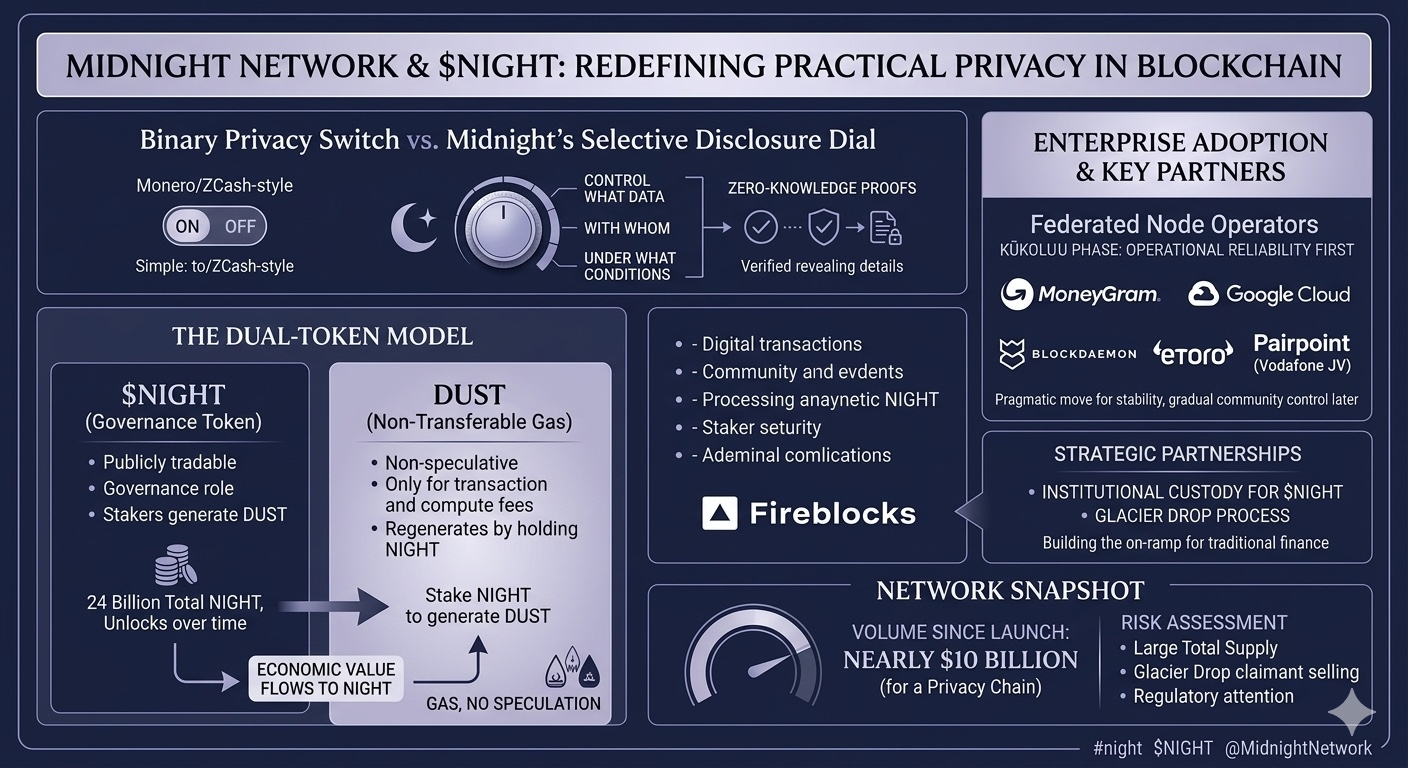
What really sold me on digging deeper was the dual-token model. I'd heard about it before but didn't really get it until I read through the whitepaper stuff. So you've got $NIGHT, which is the governance token public, tradable, all that normal stuff. Then there's DUST, which is this weird non-transferable thing that just regenerates over time if you hold NIGHT. You use DUST to pay for transactions and private computations, but you can't speculate on it or hoard it. It's literally just there to use.
That changes the game compared to something like Ethereum where ETH is both your investment AND your gas. Here, the economic value all flows to NIGHT because DUST can't be traded. So if the network gets used, NIGHT should theoretically capture that value. At least that's the thesis, we'll see if it plays out.
Speaking of which, the volume numbers since launch have been wild. Nearly $10 billion already, which for a privacy chain launching in this market? That's not nothing.
But here's the news that actually got me writing this post. MoneyGram just joined as a federated node operator. Yes, that MoneyGram the global payments giant operating in over 200 countries with nearly 400,000 agent locations. They're not just dabbling either; they're running infrastructure for the network. And they're not alone Google Cloud, Blockdaemon, eToro, and Vodafone's joint venture Pairpoint are all in there too.
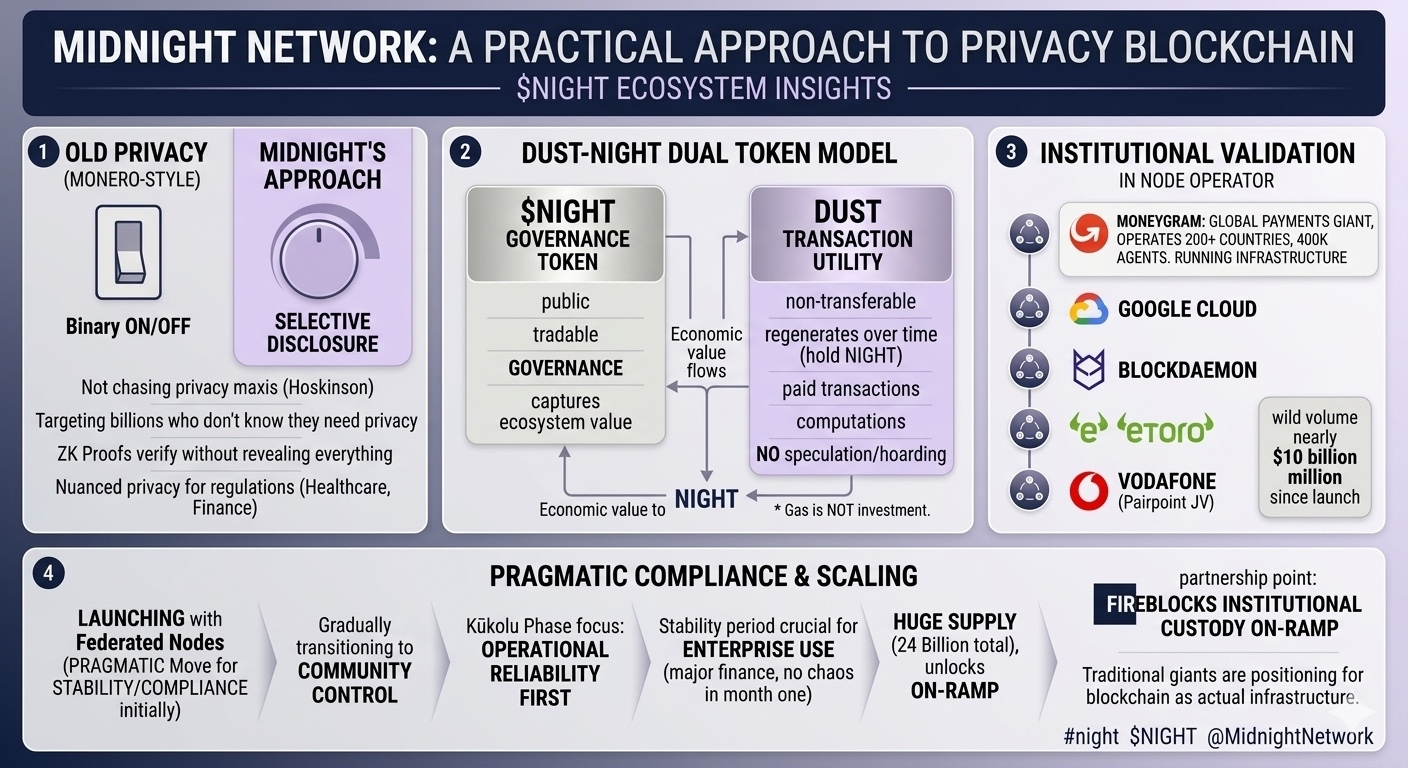
Now, I know what you're thinking. Federated nodes? That's not really decentralized and yeah, you're right. Midnight is launching with trusted entities running the show initially, it's a pragmatic move to ensure stability and compliance before gradually transitioning to community control. The Kūkolu phase is all about operational reliability first, full decentralization later. Some people hate this approach, but honestly? If you want enterprises to actually USE blockchain, they need that stability period. You can't have a major financial institution's data running on something that might fork chaotically in month one.
The Fireblocks partnership from last year also makes more sense now institutional custody for $NIGHT helping enterprises claim and store tokens securely through the Glacier Drop process. They're building the on-ramp for traditional finance before traditional finance even asks for it. That's either really smart or really premature. I'm leaning toward smart.
What I find most interesting though is how Midnight positions privacy. It's not this binary thing where you're either totally anonymous or totally exposed. They talk about 'selective disclosure' letting users control exactly what data gets shared, with who, and under what conditions. That's huge for regulated industries like healthcare or finance where you need to prove compliance without revealing every patient detail or transaction. It's privacy as a dial, not a switch.
Hoskinson made this point that really resonated with me he said Monero and ZCash have been trying to convince people privacy is like a light switch. We're private, switch is on. Everybody else is not, switch is off. But that's not how the world works . Real privacy is nuanced. Sometimes you NEED to show certain data to regulators or counterparties. Midnight's architecture with ZK proofs lets you verify things without revealing everything. That's the kind of practical privacy that might actually get adopted.
Of course there are risks. The token supply is huge 24 billion NIGHT total, with a good chunk unlocking over time . Early price action will depend a lot on how many Glacier Drop claimants sell versus hold. And privacy-focused projects always attract regulatory attention, even when they're trying to be compliant like Midnight.
But watching these traditional giants pile in MoneyGram, Vodafone, eToro makes me think they see something coming. They're not doing this for fun. They're positioning for a world where blockchain isn't just speculation but actual infrastructure. And if that world arrives, having privacy built in by default instead of bolted on later is going to matter.
I'm not saying go apes, I'm saying this one's worth watching. Maybe even worth accumulating a small position to see where it goes. The thesis is solid, the backers are real, and the approach to privacy is actually practical instead of ideological. #night $NIGHT @MidnightNetwork