One thing I have noticed while spending time reading about blockchain infrastructure is that transparency has always been treated as one of crypto’s greatest strengths. Public blockchains allow anyone to verify transactions, audit activity, and observe how systems operate. That level of openness is powerful. At the same time, it creates a challenge that doesn’t get discussed enough.
Many real-world systems simply cannot operate with fully public data.
Financial agreements, identity records, enterprise transactions, and business contracts all involve information that organizations are not comfortable exposing on a public ledger. This tension between transparency and confidentiality has quietly become one of the most important infrastructure questions in Web3.
That’s where Midnight Network starts to look interesting.
Midnight is building what it describes as programmable privacy, a system that allows developers to control what information becomes visible on-chain and what remains confidential. From my view, this approach feels different from many earlier privacy projects that simply focused on hiding transactions.
The goal here isn’t total secrecy. The goal is selective disclosure.
Instead of forcing applications to choose between full transparency or full privacy, Midnight allows developers to design rules around which pieces of information can be verified publicly while keeping sensitive details hidden.
The architecture behind this design is something that stood out to me.
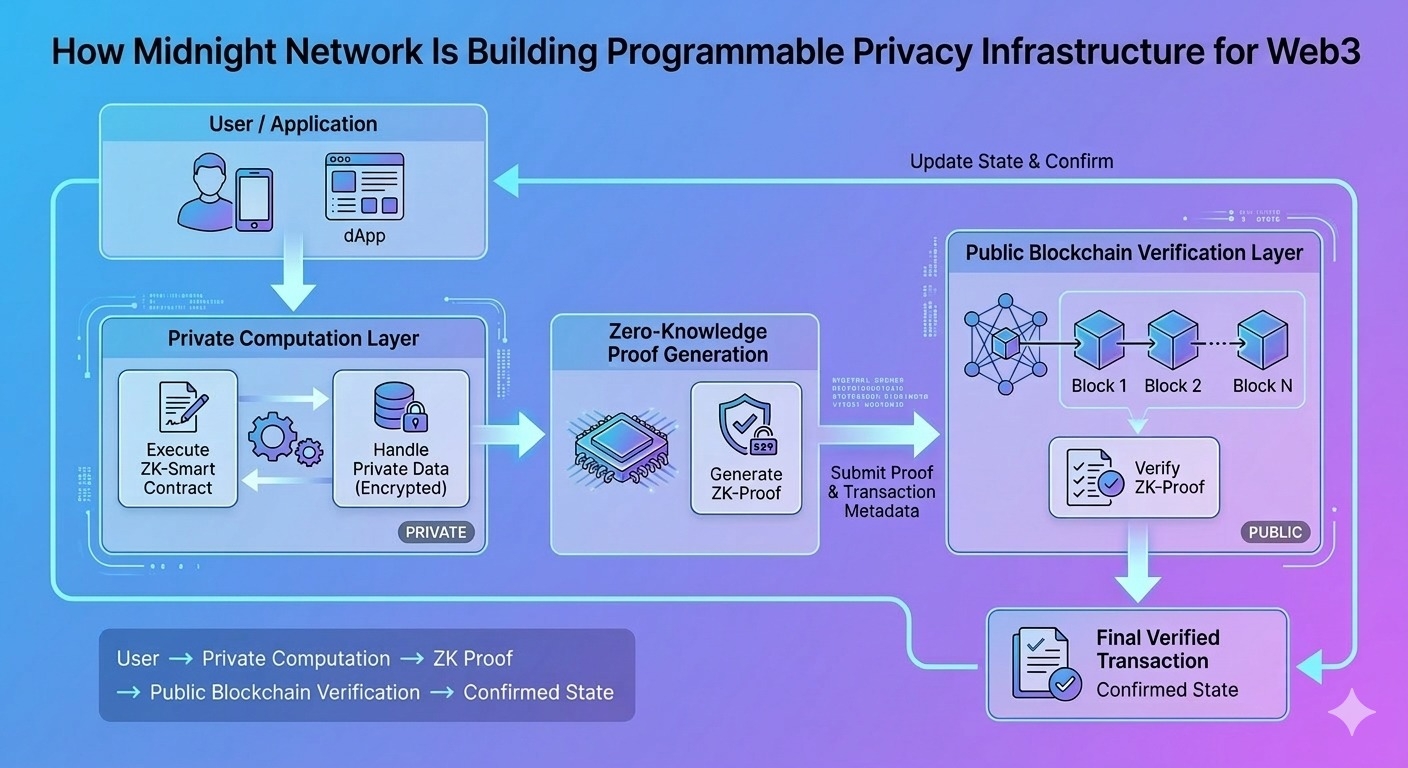
Midnight uses a dual-state model that separates public verification from private computation. The public blockchain layer handles consensus and validation, similar to traditional blockchain networks. Sensitive computations, however, occur in a separate confidential environment.
When an action takes place, the system generates a cryptographic proof confirming that the correct rules were followed. The blockchain verifies that proof without ever seeing the underlying data.
That process relies heavily on zero-knowledge cryptography, a technology that has been gaining a lot of attention across the crypto industry. The idea is fairly simple but powerful. A system can prove that something is true without revealing the data used to prove it.
I’ve been noticing how this concept keeps appearing in discussions about the future of blockchain infrastructure. As networks start moving beyond simple token transfers, the need to verify complex information while protecting sensitive data becomes much more important.
Think about identity verification as an example.
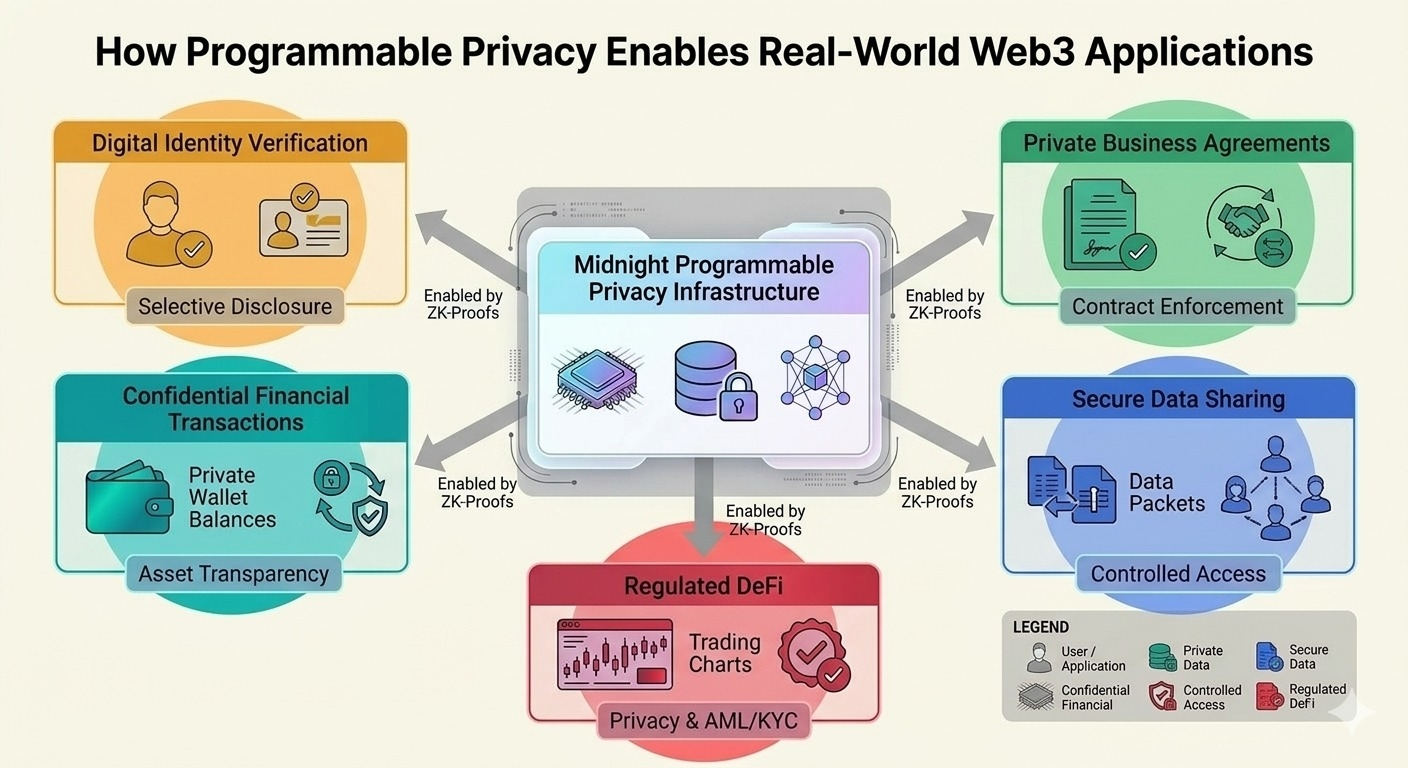
A user might need to prove that they meet certain eligibility conditions, such as being over a certain age or belonging to a particular group. With traditional systems, that often requires revealing personal information. With zero-knowledge systems, the network only verifies that the condition is satisfied.
The underlying data never becomes public.
Another detail I found interesting is how Midnight is thinking about the developer experience. The network introduces tools designed specifically for building confidential smart contracts. Developers can define which variables remain private and which become visible on-chain.
From my perspective, this part might matter more than it seems at first glance. Infrastructure technologies often succeed or fail depending on how easily developers can build with them. If privacy logic becomes easier to implement, developers are far more likely to experiment with new types of applications.
There’s also a broader ecosystem angle worth paying attention to.
Midnight isn’t positioning itself as a standalone isolated chain. Instead, it’s designed to function as a privacy infrastructure layer that can interact with other blockchain ecosystems. As Web3 continues evolving, it’s becoming increasingly clear that the industry may move toward specialized networks that provide different services.
Some chains focus on execution speed. Others focus on data availability or scalability. Midnight appears to be targeting privacy as its core infrastructure role.
That direction aligns with a trend I’ve been seeing across the industry. Rather than one blockchain doing everything, the ecosystem is gradually turning into a layered system where different networks specialize in different tasks.
If that structure continues developing, privacy infrastructure could become a core layer in the Web3 stack.
One perspective that keeps standing out to me is how Midnight frames privacy differently from many earlier crypto discussions. A lot of people associate privacy in blockchain with anonymity or hidden transactions.
Midnight seems to approach privacy more as programmable confidentiality.
That distinction is important because most institutions aren’t looking for complete anonymity. They want controlled disclosure. They want to prove that rules are followed while protecting sensitive data.
That’s a very different problem to solve.
If programmable privacy becomes practical at scale, it could open the door for blockchain applications that currently struggle with regulatory or data-protection concerns. Industries like healthcare, supply chains, digital identity, and enterprise finance all rely on systems where verification and confidentiality need to exist at the same time.
Public blockchains solved the verification side of the equation. Privacy infrastructure could be the missing piece that allows more complex real-world systems to move on-chain.
From my view, the real test for Midnight won’t be short-term attention. Infrastructure projects usually take time before their impact becomes visible. What matters more is whether developers begin experimenting with the tools and whether ecosystems start integrating programmable privacy into their applications.
If that happens, networks like Midnight could quietly become an important part of the foundation that Web3 applications rely on.
The bigger question that comes to mind is this: if programmable privacy becomes standard blockchain infrastructure, how many industries that currently avoid public ledgers might finally start building on them?
@MidnightNetwork $NIGHT #night #Night