A strange thing happens the first time you seriously try to trace a wallet on a public blockchain. At the beginning it feels almost magical. You paste an address into a block explorer and suddenly an entire financial history opens in front of you. Transfers, contract calls, token swaps. Everything sitting there like a public diary that nobody bothered to lock.
The longer you stare at it though, the more uncomfortable it becomes. Patterns appear. You start guessing who might be behind the wallet. When large funds move, people notice. Traders speculate. Analysts write threads. And slowly it becomes clear that transparency in crypto is not just a technical feature. It changes behavior.
For a long time the industry treated radical transparency as a kind of moral victory. Bitcoin proved that a financial system could run without trusting institutions because every transaction could be inspected by anyone. Ethereum followed the same philosophy. The ledger stayed open. The assumption was simple: if everything is visible, manipulation becomes harder.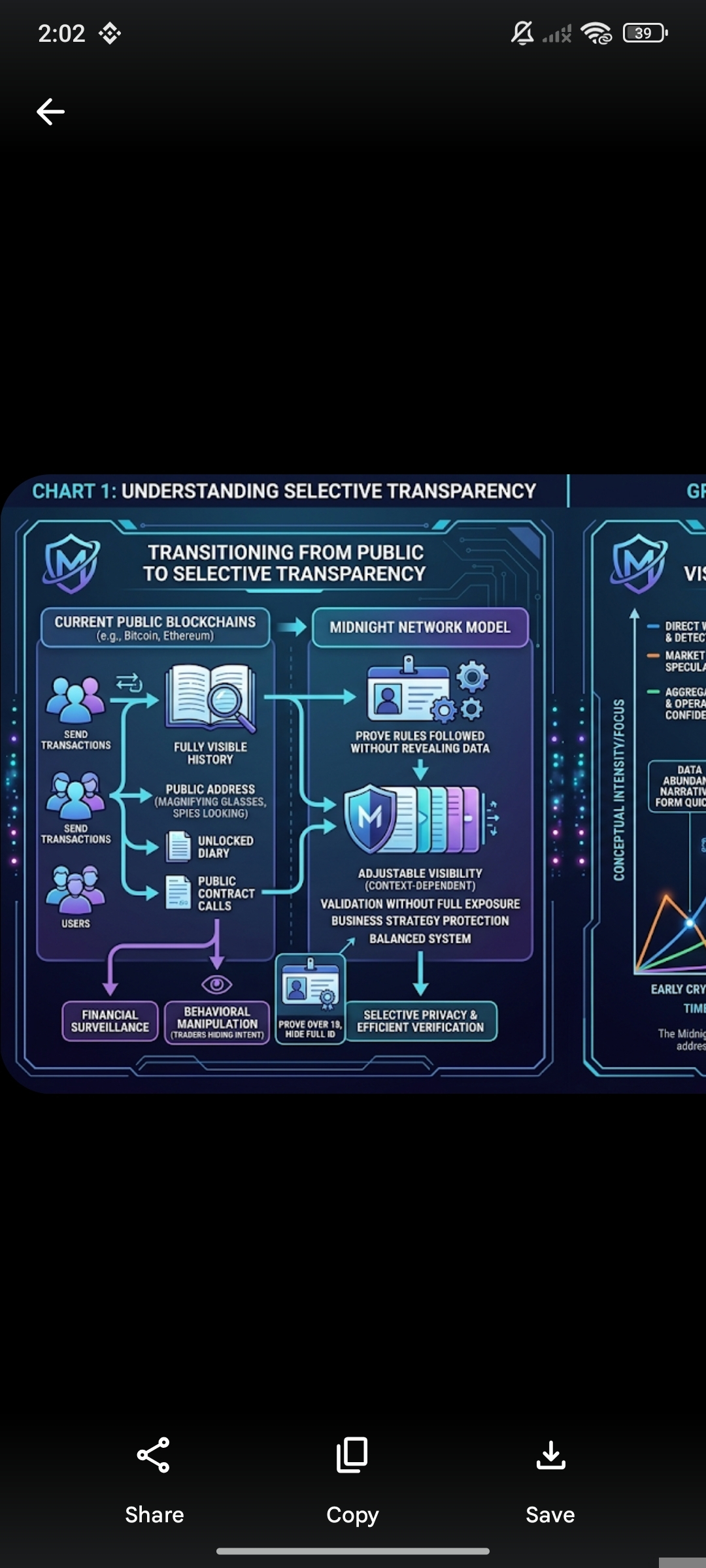
But markets have a way of revealing the side effects of any design choice. Total visibility can also create strange incentives. Traders sometimes move funds through multiple wallets just to avoid attention. Funds split transactions into smaller pieces to hide intent. Analysts watch whale wallets the way stock traders once watched central bank statements.
This is where the conversation around Midnight Network starts to get interesting. Not because it promises secrecy. A lot of projects promise privacy. What caught my attention is that Midnight approaches the problem from a different direction. It is not trying to remove transparency completely. Instead it asks a quieter question: what if transparency itself should be adjustable?
That idea is called selective transparency. The phrase sounds technical, but the intuition behind it is almost ordinary. In daily life information is rarely either fully public or fully private. Your bank knows your transaction history. Regulators might access certain records. But random strangers cannot inspect your payments over breakfast. Visibility depends on the context.
Public blockchains erased those layers. Everything became public by default. It worked well for verification, yet it also created a system where financial activity sometimes feels closer to surveillance than transparency.
Midnight attempts to soften that extreme without breaking the core property of blockchain verification. The network relies heavily on zero-knowledge proofs. In plain terms, a zero-knowledge proof allows a system to confirm that a rule was followed without revealing the underlying data.
Imagine proving that you are over eighteen without showing your full identification card. The verification happens, but unnecessary details remain hidden. That is essentially the logic behind the technology.
I remember the first time I tried explaining this idea to someone who wasn’t deep in crypto. Their immediate response was simple: “Wait, so the network knows the transaction is valid but it doesn’t need to see everything?” Exactly. That small distinction changes a lot about how systems can be designed.
For developers, selective transparency opens doors that were awkward before. Think about businesses exploring blockchain infrastructure. Many companies hesitate to use fully transparent ledgers because competitors could analyze their payment flows. Even ordinary operational details might reveal strategy. Privacy is not always about hiding wrongdoing. Sometimes it is just about keeping routine information routine.
The more I watch these discussions on platforms like Binance Square, the more I notice how visibility shapes perception. Writers compete on ranking dashboards. Engagement metrics quietly decide which analysis gains attention. When data is abundant and easy to trace, narratives form quickly. A wallet move becomes a signal. A contract interaction becomes speculation.
Now imagine a system where parts of those signals remain hidden unless they actually matter. Analysts would have to rely less on direct wallet tracking and more on broader network indicators. AI-driven analytics might aggregate behavior patterns without exposing individual participants. The research style changes.
That shift is subtle but important. Crypto analysis today often behaves like open-source detective work. Everything is visible, so everyone tries to interpret it. Selective transparency might move analysis slightly away from raw surveillance toward structured interpretation.
Still, the idea is not without risk. One advantage of open ledgers is simplicity. Anyone can verify transactions themselves. When privacy layers appear, observers must trust the mathematics behind them. Zero-knowledge proofs are strong cryptographic tools, but they also introduce complexity. Complexity can create hesitation.
There is also a cultural factor. Crypto grew out of communities that valued radical openness. Many early participants believed that transparency itself protected the systems to from the corruption. Introducing privacy to even limited privacy that can feel like stepping away from that philosophy.
And yet the world outside crypto rarely operates with perfect transparency. Businesses protect internal data. Individuals expect financial privacy. Even governments manage layers of access. The blockchain ecosystem may simply be moving closer to how information already works in practice.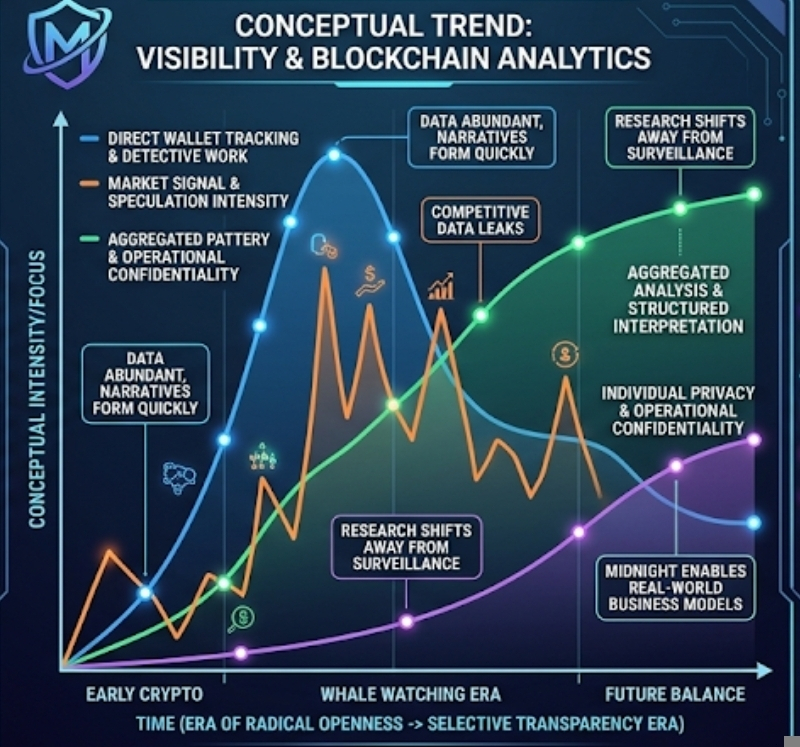
Another thought keeps returning to me while watching this shift unfold. Early crypto culture often framed transparency as the opposite of trust. If the ledger is visible, trust becomes unnecessary. But real systems are rarely that clean. Trust still exists. It just moves to different places.
Selective transparency does not remove verification. Instead it asks whether verification always requires full exposure. Maybe proving correctness is enough. Maybe the system only needs to show what matters.
Whether Midnight succeeds technically is something the market will decide over time. Infrastructure projects tend to evolve slowly. They are rarely priced by narratives alone. What matters more is whether developers actually build applications that depend on these privacy mechanics.
But stepping back from the technology for a moment, the broader pattern feels familiar. Crypto started with a bold experiment in radical openness. It solved real problems, yet it also revealed new ones. Now the ecosystem is exploring something more balanced.
Not secrecy. Not total visibility either. Something in between.
And in a strange way, that middle ground may end up looking a lot like the real world after all.

Article
Midnight Network and the Quiet Rise of Selective Transparency in Crypto Markets
Disclaimer: Includes third-party opinions. No financial advice. May include sponsored content. See T&Cs.