
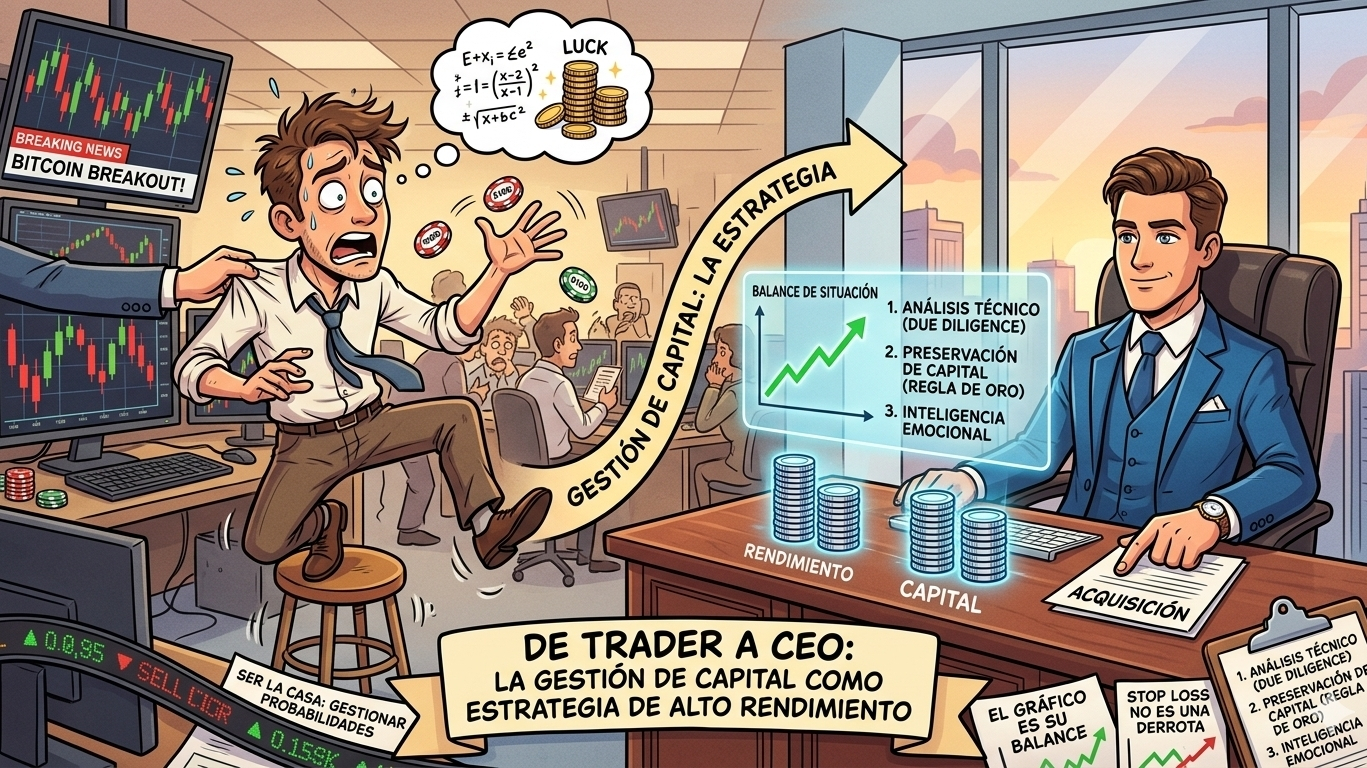
Operating in financial markets is not very different from running a high-level corporation or playing a final poker table: success does not depend on luck, but on the impeccable execution of a business model. That break we saw in Bitcoin was not a stroke of chance; it was the validation of a well-structured investment thesis.
For a CEO, the graph is not just a line; it is their balance sheet.
1. Technical Analysis as Due Diligence 📈
A CEO does not invest in a project just because it "looks good". They conduct a deep audit.
The Candles are your Performance Indicators (KPIs): Just as a CEO waits for the quarterly report to act, a professional trader waits for high probability setups, like a bullish wedge or respect for the EMA(99).
Opportunity Cost: The beginner's mistake is "overtrading" (trading for the sake of trading). In the executive world, this is equivalent to poorly diversifying resources. If the signal is not clear, the best investment is to maintain liquidity. No deal, no bet.
2. Capital Preservation: The Golden Rule of the Chief Financial Officer 🪙🏅
In poker, the bankroll is your ability to keep sitting. In business, it is your cash flow.
Risk Management: A CEO never compromises the solvency of the company on a single product. The Stop Loss is not a defeat; it is an executive exit decision to protect net worth. "Folding" a losing hand is what allows capital for the next big acquisition.
3. Emotional Intelligence and Control of Corporate "Tilt"
The biggest enemy of a CEO is decision-making based on ego or desperation after a negative quarter.
Shielding Against Volatility: The market has no memory or loyalty. If a trade hits the Stop Loss, the executive response is to analyze the process, not to "take revenge" on the market by increasing leverage. "Revenge" in trading is the fastest route to technical bankruptcy.
Risk Analysis: The Reality of Asset Management ⚠️
Managing your own capital comes with responsibilities that can affect the health of the organization (you):
Decision Fatigue: Constant exposure to the market's dopamine can cloud long-term judgment.
Risk of Ruin: Unlike a traditional corporate structure, here the execution error translates into direct personal capital loss. There are no external rescues.
The Survivor Bias: An accidental victory can create a false sense of mastery. A CEO knows that a good result does not always justify a bad process.
The Casino Owner's Mindset 🎰🎲
The goal is not to win a hand, but to be the house. The casino does not play; it manages statistical probabilities. As the CEO of your own capital, your competitive advantage is your trading system and your discipline. If the process is solid, quarterly profits will come as a result.
Continue supporting us by sharing or leaving a tip, thank you! 🥺💪🏻
