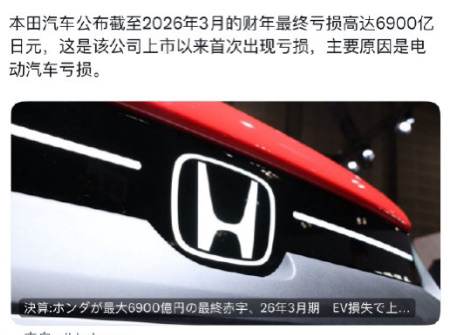
According to Nikkei, Honda lost 690 billion in 2025!
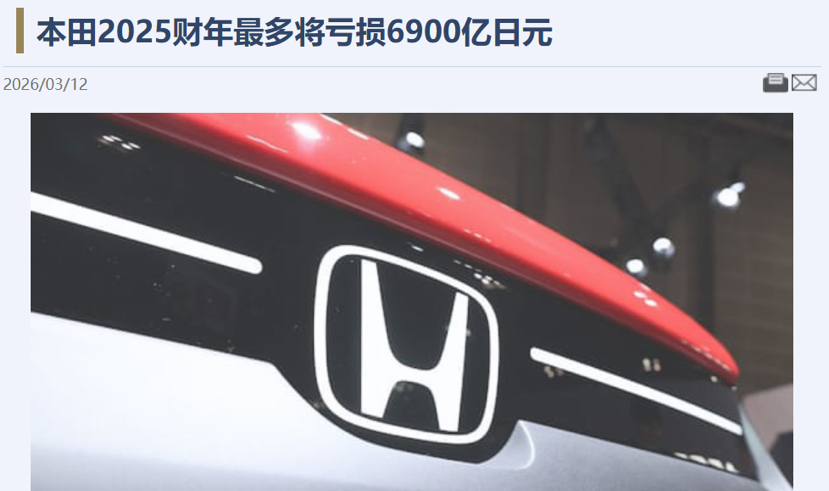
Honda has completely blown up!
NHT issued a recall announcement involving over 65,000 2024 Honda Prologue and Acura ZDX electric vehicles (Prologue 45,000+, ZDX 19,000+), due to a software defect: dashboard black screen + rearview camera failure, key information is not visible while driving, safety risks are off the charts. The user's temporary solution is to manually restart, and the official fix will wait for the free OTA from dealers in April or a repair.
This bug directly points to Honda's traditional interior and software pain points: still old-style buttons + basic display, no AI real-time monitoring, predictive maintenance, or adaptive UI.
When problems arise, it all relies on manual intervention, resulting in low efficiency, high costs, and poor user experience. Honda's stock price fluctuated slightly, and its reputation suffered, once again proving that traditional car manufacturers sticking to old ways suffer greatly in the AI era.
In 2026, with strict regulations and fierce competition, not deeply integrating AI will inevitably lead to major problems. This also highlights the awkwardness of the entire traditional manufacturing industry: robots/cars are still at the 'hardware + simple control' stage, with AI merely an embellishment.
🚀 In contrast to emerging projects, @Fabric Foundation 's $ROBO directly integrates AI + robotics + blockchain to create a 'decentralized robot economy.' Fabric is led by the Fabric Foundation (non-profit), with the TGE launching at the end of February 2026, aiming to make general-purpose robots autonomous economic entities: possessing on-chain identities, wallets, and keys, able to sign contracts, accept tasks, verify work, and make automatic payments. Unlike traditional robots, which are 'tools controlled by companies,' Fabric builds an open network—robots from different manufacturers share data, computation, and intelligence, coordinated and incentivized through blockchain.
Nodes/robot staking $ROBO to gain priority tasks and bond security.
Governance: Holders vote on protocol upgrades and ecological directions.
Incentives: Developers contribute models/hardware, robots receive rewards for completing tasks.
🪝 Project highlights: Using OM1 Universal OS + Fabric protocol to enable robots to 'go on-chain'—such as warehouse robots collaborating autonomously and medical assistance robots verifying privacy tasks.
✅ Compared to the traditional bugs recalled by Honda, Fabric's AI decentralization makes robots smarter, more fault-tolerant, and more cost-effective. The era of robots has arrived, and Honda's troubles are a warning: if traditional companies do not embrace AI, they will be left behind. Fabric is leading the 'Robot Economy,' and $ROBO as fuel is expected to double with the AI + robotics wave. Want to embrace the future? Fabric is the direction!