
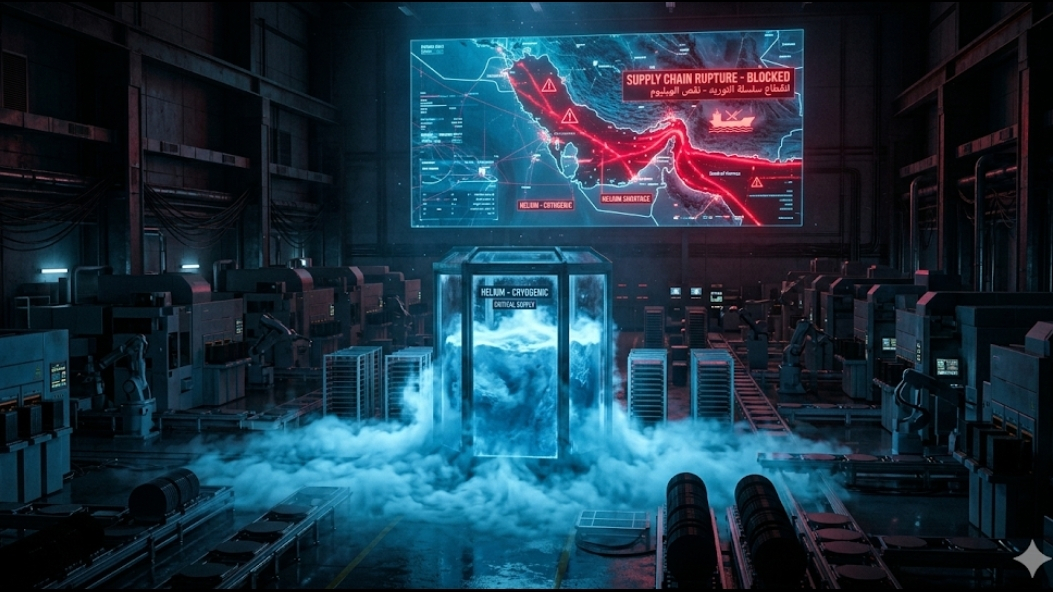
Logistical paralysis on Gulf routes has cut off the supply of essential helium for semiconductors, jeopardizing global memory chip production and threatening the physical infrastructure that supports Ethereum, Solana, and AI data centers.
A Noble Gas Vulnerability
While crypto focuses on consensus algorithms and Layer 2 scalability, the material reality has dealt a blow of authority. Helium, a non-renewable resource with no synthetic substitute, is the critical coolant for the lithography machines that manufacture DRAM and NAND memory chips.
With the disruption of maritime traffic in the Gulf, giants like Samsung and SK Hynix, which control about 70% of the global memory market, have entered a state of maximum alert. Unlike the semiconductor crisis of 2021, caused by bottlenecks in demand, we are facing a raw material supply shock. Without helium, the vacuum chambers where integrated circuits are printed simply cannot operate without destroying the components due to excess heat.
From the Cloud to the Node
The impact on the crypto sector is direct and profound, affecting three fundamental pillars:
Node Infrastructure: The Ethereum network and other PoS chains rely on cloud services (AWS, Google Cloud) that use high-performance servers. If hardware replenishment stops, network capacity expansion freezes.
Zero-Knowledge (ZK) Mining: Zero-knowledge proofs require massive computational power. The shortage of Nvidia memory chips and next-generation GPUs will slow the adoption of privacy and scalability solutions.
Network Security: A lower availability of new hardware raises the entry costs for new validators, potentially centralizing computational power among those who already own physical infrastructure.
From a technical perspective, Moore's Law faces a thermodynamic and logistical barrier. We cannot scale software if the hardware running it cannot be cooled during its manufacturing.
Towards Hardware Sovereignty
In the next 2 to 5 years, this incident will force a restructuring of the investment thesis in digital infrastructure. We expect to see:
Geographical Diversification: A massive investment in helium capture plants in politically stable regions like the U.S., Qatar (via alternative land routes), and Algeria.
Data Efficiency: The development of "lightweight" blockchain protocols that require fewer memory resources, in light of the prospect of hardware becoming a luxury asset.
Sovereign Hardware: The rise of open-source hardware initiatives and optimized ASICs that use manufacturing processes less dependent on rare gases.
Mass adoption will no longer only depend on user interface (UX), but on the resilience of the physical supply chain. Decentralization must start at the mine and the port, not just in the code.
Key Data
Critical Dependency: South Korea supplies 60% of the world's memory chips; a 15-day pause in helium supply could reduce its annual production by 10%.
Impact on AI: Training large language models (LLMs) could become 25% more expensive due to rising replacement costs for GPUs and servers.
Logistical Risk: 30% of global helium transits or originates near currently blocked conflict zones in the Gulf.
Are we facing the end of the era of cheap and abundant hardware, or can innovation in materials save decentralization before data centers exhaust their memory reserves?