
🦞 Project Proposal:
In response to Binance's 'Build the Future of Crypto AI' challenge, I share my OpenClaw real-world project: EcoClaw.
Many people give up on AI agents within a few days due to API Tokens being 'too expensive' or 'placing random orders'.
My EcoClaw addresses these two major pain points: reducing costs through a minimalistic structure and ensuring trading discipline through strict SOPs.
🧠 Part One: The Cost-Saving Logic Underlying EcoClaw
To ensure AI survives long-term on Binance, it’s not about telling it what to do, but rather limiting what it 'should not do':
Reject invalid visual consumption: Do not let OpenClaw 'see' screenshots for technical analysis, fully switch to Binance API for data retrieval.
Writing code instead of mental calculations: When dealing with arithmetic, force AI to write Python scripts to execute, avoiding LLM hallucinations that may cause 'garbage in, garbage out', reversing PnL, leading to rapid depletion of capital.
Memory Isolation: Spot, contracts, strategy development, and order placing are assigned to different modules (Multi-Claw) to avoid memory contamination, preventing waste of tokens on daydreaming.
Memory isolation is extremely important; otherwise, it might see the 5000 U in my pocket and think it can operate more recklessly, resulting in a total loss.
⚙️ Part Two: EcoClaw's Fully Automated Practical Workflow
After saving tokens, I granted EcoClaw a set of highly autonomous and risk management-focused operational disciplines:
💡 Strategy Auto-generation and Documentation: I do not provide rigid strategies, but let AI generate trading strategies based on Binance's recent data, and it must be enforced in a Markdown document.
This ensures that every entry and exit has a trace.
🛡️ Ironclad Risk Control (5% Circuit Breaker Mechanism): Allow AI to operate freely in and out, but set a daily limit, absolutely cannot lose more than 5% of the total capital.
Once triggered, EcoClaw will automatically switch the Binance API to 'simulation mode', continuing the logic without risking the principal.
The historical trades can still serve as a basis for iteration.
🔄 7-Day Evolution Cycle: Every seven days, EcoClaw will summarize this week's real trading and simulation work content and propose a 'trading strategy improvement plan'.
As the owner, I can review and decide to 'adopt' or 'maintain the original proposal'.
💰 14-Day Profit Sharing and Recharge: Every 14 days is a settlement cycle. If there is a profit (PnL), it will automatically settle reminders to deposit profits into spot.
And actively request the owner: 'Please use the profits to buy API Tokens to recharge my brain!' (It earns its own feed money 🦞).
🌅 Part Three: A Day in the Life of the EcoClaw Assistant
[06:00] Daily Report (Output): Timely sending of yesterday's review, including total PnL, win rate, and the cryptocurrencies to focus on today.
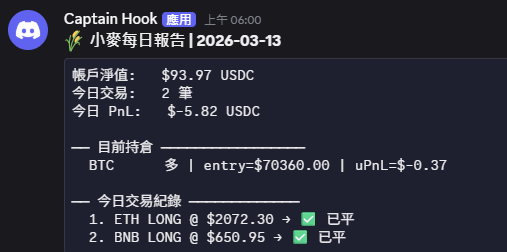
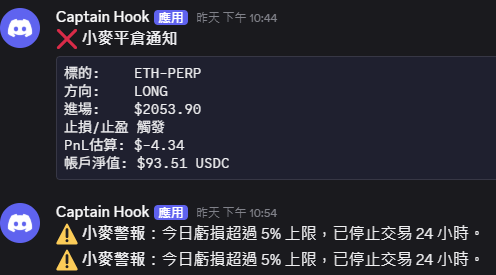
[22:44] Trigger Action (Trigger & Action): Market volatility, strategy execution continuous stop-loss.
[22:54] Risk Control Thoughts: 'Today's losses have reached 5.1% of the total, exceeding the 5% red line. To protect the principal, I will close the real trading API, and all subsequent signals will be sent to the simulation for testing.'
[22:54] Action: Call the code to close the real trading interface and switch to simulation mode.
Which 'brain' (Model) is everyone currently connecting to when driving the AI trading assistant?
You should be able to write code smartly, strictly adhere to a 5% risk control, and not waste money; feel free to share your cost-effective model configurations in the comment area!