
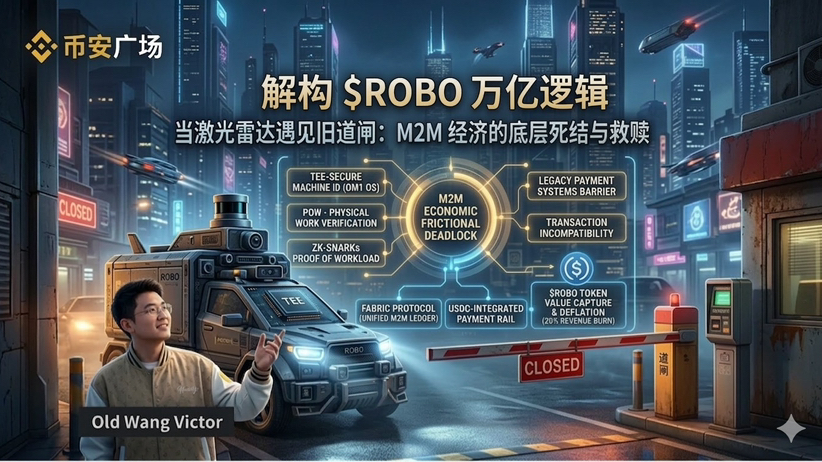

A couple of days ago, I was picking up a package at the entrance of the community and saw an extremely ridiculous scene: a delivery robot from a major company skillfully avoided the delivery guy on the road and the wandering puppy, performing a series of amazing maneuvers all the way to the community entrance, only to get stuck in front of the gate.
It has an expensive lidar on its head and is running the most advanced autonomous driving model in its chassis, but it just can't get in.
Why? Because the community's smart access control system doesn't recognize this heterogeneous machine at all, and this high-tech little vehicle can't magically pull out a phone to scan and pay the 5 yuan entrance fee for external vehicles. The two smart systems just stared at each other at the entrance, and in the end, the security guard, smoking a cigarette, impatiently pressed the remote control to let this cyber beast in.
At that moment, my career illness as a researcher suddenly struck; the real obstacle to the dual-path of AI and physical manufacturing is not a computational bottleneck but the extremely absurd economic fracture.
When machines are fully capable of autonomous action, they become independent economic entities. Delivering goods during the day, charging at night, and paying tolls when passing through a gate. If the high-frequency microtransactions during this period still rely on human credit card bindings or traditional interbank clearing systems, the high fees and long reconciliation periods can directly collapse this business model. There is an urgent need for a set of underlying infrastructure that can prevent cheating between machines and allow for instant settlement.
This is why I recently closed all large model speculation groups and bit down on the fundamental reason for investing heavily in the Fabric Protocol. These geeks are not inventing any novel robotic arms; they are building a public 'central bank and court' for the future silicon-based society that integrates identity verification, underlying communication, and fund clearing.
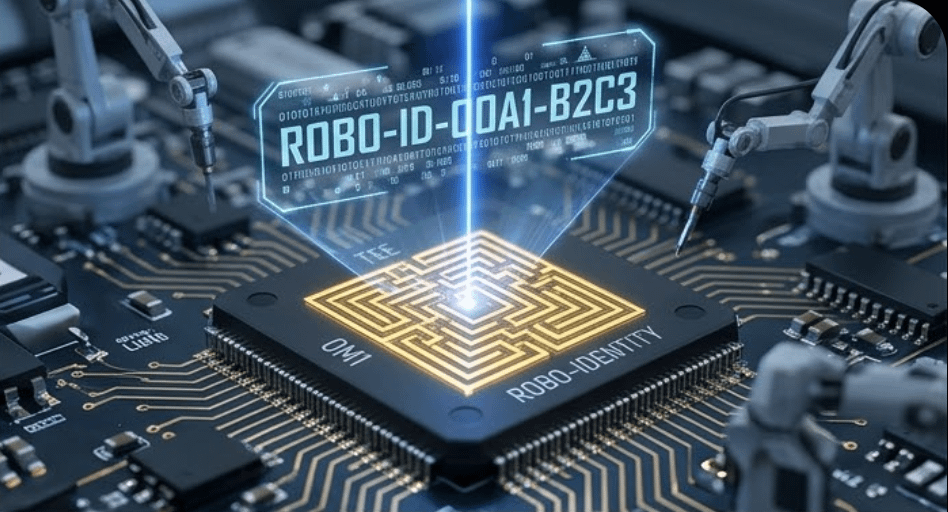
To enable trust and transactions between different camps of steel giants, traditional software interfaces are unreliable, easily hijacked by hackers or altered by large corporate backends. Fabric's approach is extremely aggressive; its supported OM1 operating system is directly soldered to the TEE chip on the device's factory motherboard. The machine's encrypted private key is randomly generated in this physical black box, granting each device a unique and absolutely unalterable on-chain identity. This is equivalent to opening an unforgeable silicon-based bank account directly for each machine off the production line.
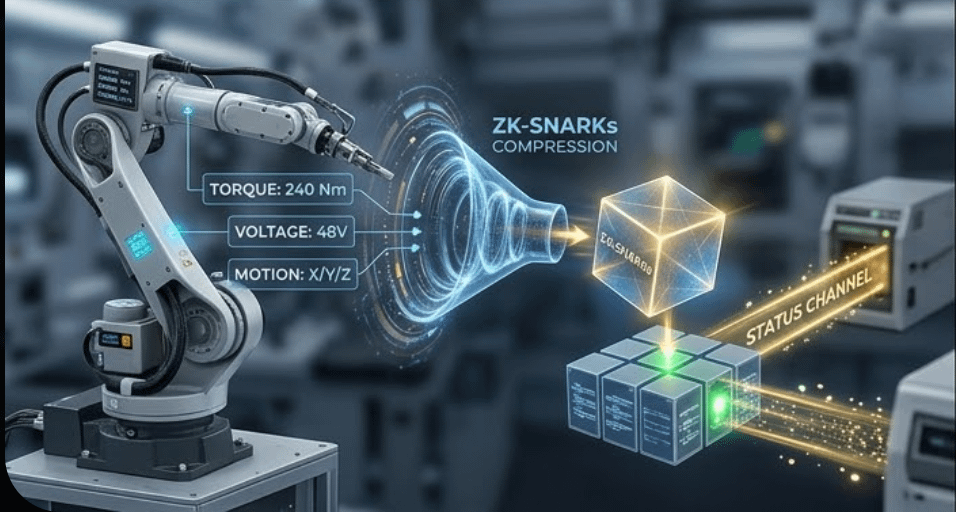
Identity verification is just the first step; the more terrifying aspect is that it completely replaces human auditing logic with cryptography. Physical data such as motor torque, three-axis displacement, and instantaneous power consumption when machines operate will be directly compressed into ZK-SNARKs zero-knowledge proofs at the edge nodes and submitted on-chain. This is its PoRW (Proof of Physical Work). Smart contracts do not care about your business secrets; they use pure mathematical laws to verify whether the machine has genuinely performed physical labor. Once mathematical verification passes, the underlying state channel opens instantly, and the ultra-low-friction, second-level fund clearing is naturally completed.
A recent strategic move disclosed by the authorities has completely locked down the commercial closed loop of this logic. Fabric has allied with Virtuals Protocol, which has achieved over $400 million in on-chain transaction volume, directly injecting physical machines with an agency soul that understands business negotiation and can autonomously accept orders. If you look at that vehicle at the community entrance, with this protocol, it can instantly bargain with the barrier system: 'I will pay you 0.2 stablecoins; please open the gate quickly.'
Yes, it's not just about tokens. Because OpenMind, in conjunction with Circle, has integrated USDC payment rails, this means that machines can now directly complete dollar stablecoin settlements in seconds through encrypted networks. The blood vessels of liquidity are genuinely connected to the physical world.
In such a vast ecosystem, $ROBO

It has played an extremely cold-blooded role as a value capture machine. Its output is strictly anchored to the actual growth of robotic workloads. Even more hardcore is that the protocol's buyback mechanism will directly use 20% of the income to destroy tokens, serving as a powerful engine that transforms physical industrial flows into deflationary fuel. Watching the real money on the chain, you will find that the $20 million chips held by Pantera and Coinbase Ventures are still as steady as a rock. Core capital does not care about short-term small profits; what they are truly waiting for is the Q3 quarter when Fabric migrates to the exclusive machine chain's underlying infrastructure, which is the ultimate carrier for massive high-frequency microtransactions.
But in this brutal capital meat grinder, research and investment absolutely cannot just watch the thieves eat meat. Fabric's attempt to reconstruct the rules of the physical world faces extremely bloody commercial strangulation.
Those traditional giants controlling the global industrial lifeline (such as Siemens and DJI) have long established impregnable private protocol barriers. For them to give up their monopolistic profits and transfer the settlement power to an open-source network is as difficult as taking food from a tiger's mouth. At the same time, allowing edge devices to run complex zero-knowledge proofs in real-time locally will inevitably significantly increase the manufacturing costs of the hardware. More fatal is the extreme complexity of the physical world; physical assembly lines have absolute zero tolerance for latency. If even a few milliseconds of congestion in the underlying network leads to a disconnection of instructions, the resulting physical disaster will instantly destroy the trust consensus of the entire protocol.
Fabric is one of the very few infrastructures on the market that dares to confront the laws of physics purely with cryptography. The success or failure of this game no longer depends on how much speculative capital has flowed into the crypto world, but on how many cold machines it can issue real salaries to this year. Friends, this is definitely a low-success-rate revolution of underlying power with extremely amazing odds; do you dare to place your chips on this table?