

What if the real breakthrough in robotics isn’t the machines — but the network that organizes them?
I’ve spent enough time in crypto to recognize the rhythm of the market. Every cycle brings a new narrative — AI tokens, robotics tokens, infrastructure tokens — and most of them follow the same path. A project appears with strong branding, heavy buzzwords, and promises of revolution. For a moment it captures attention, and then it fades into the background noise that fills the industry.
That pattern is exactly why Fabric caught my attention.
At first glance it sits in the same lane as many other AI-robotics projects. But the more I looked into it, the more I realized the project isn’t actually centered on the machines themselves. Instead, it focuses on something most people ignore: the system that organizes them.
And that difference matters more than it might seem.
The Problem Nobody Talks About Robots are becoming more capable every year. Autonomous drones, warehouse robots, delivery machines, and AI agents are already operating in real environments. But capability alone isn’t the real challenge.
The real challenge is coordination.
Who assigns tasks to machines?
How do machines verify their work?
How do payments move between operators and users?
How do different machines interact without being controlled by one centralized company?
These questions rarely get attention in robotics discussions, but they are the exact problems Fabric is trying to address.
Fabric Idea: Infrastructure for Machine Activity Fabric positions itself as an open network where robots and intelligent machines can participate in an economic system. Instead of being controlled by a single corporation, machines register identities, perform tasks, and interact through a decentralized protocol.
Blockchain infrastructure plays a central role here. It allows actions, ownership records, and machine coordination to be tracked transparently on-chain. In theory, this creates a shared framework where machines, developers, and users can operate under the same rules.
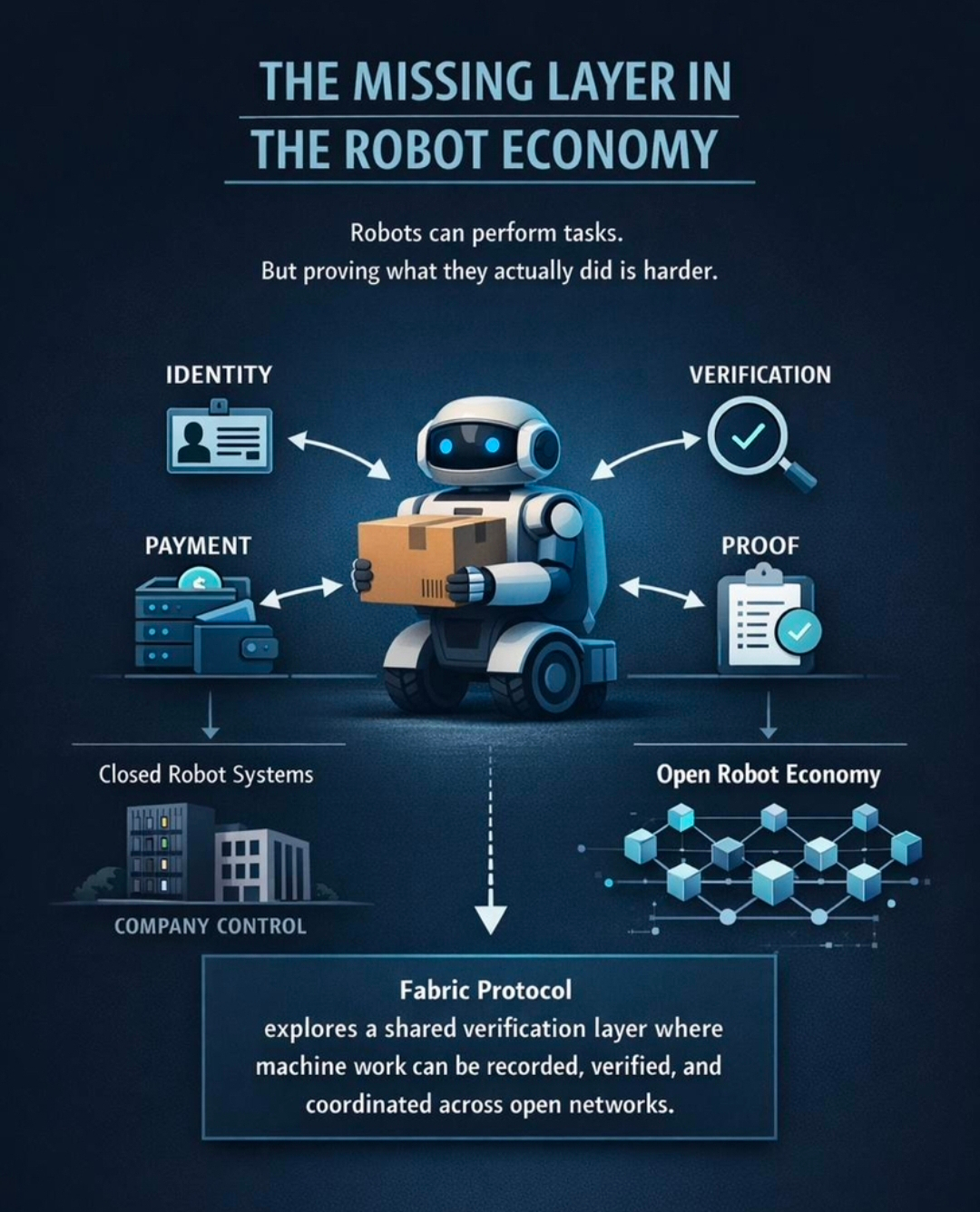
Think of it less as a robotics project and more as coordination rails for machine activity.
Where the ROBO Token Fits? The network’s economic layer is powered by the ROBO token, which functions both as a utility and governance asset.
Participants use ROBO to:
• Pay network fees
• Stake participation bonds
• Participate in governance decisions
The idea is to replace centralized authority with economic coordination. Instead of a company managing everything, the network evolves through incentives and community governance.
Example: How This Could Work? Imagine a decentralized delivery network. A company deploys autonomous delivery robots in a city. Instead of operating through a closed platform, the machines register on Fabric’s network.
• Developers upload navigation software
• Operators deploy robots
• Users request delivery services
Each task — navigation, delivery, verification — is recorded on the network. Payments move automatically through the protocol, and reputation systems track reliability.
This is only an example, but it shows the kind of coordination layer Fabric is aiming to build.
The Hard Part Most Projects Ignore.This is where my skepticism naturally kicks in.Ideas like this often sound intelligent at the concept stage. But real systems break under pressure messy coordination, unpredictable economic behavior, and technical friction tend to expose weaknesses quickly.
Building infrastructure is very different from marketing a narrative.
It requires real adoption, real activity, and systems that can handle complexity.
Why the Idea Still Matters?Despite that skepticism, I find the premise compelling. If machine economies ever become meaningful, they won’t run purely on intelligence or hardware.
They will depend on:
• identity systems
• coordination frameworks
• payment infrastructure
• governance rules
• trust and accountability
Those layers determine whether machines can actually operate inside open systems.
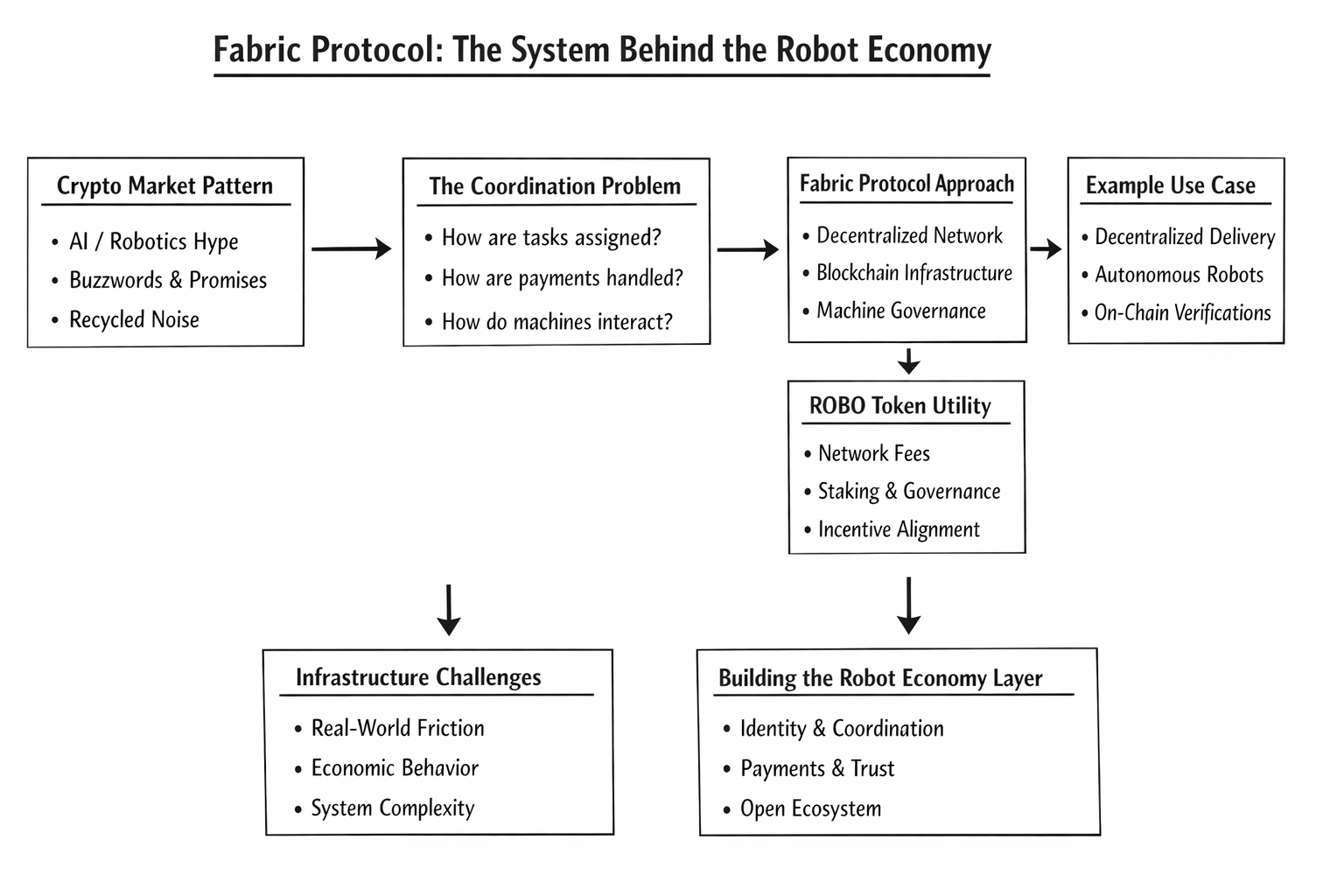
Fabric is attempting to build that layer.
(Where I Stand )I’m not looking at Fabric as a guaranteed winner. The idea is ambitious, and projects tackling infrastructure often face the hardest road.But it’s one of the few projects in this space that seems focused on a structural problem rather than a market narrative.
And in a crypto industry filled with recycled noise, that alone makes it worth watching.
Because if the robot economy ever becomes real, it won’t just need smarter machines.
It will need systems that can organize them.