
A few days ago, I found myself going down one of those late-night crypto research rabbit holes. The kind where you start by reading one article and suddenly you’ve opened five tabs trying to understand how different projects connect.
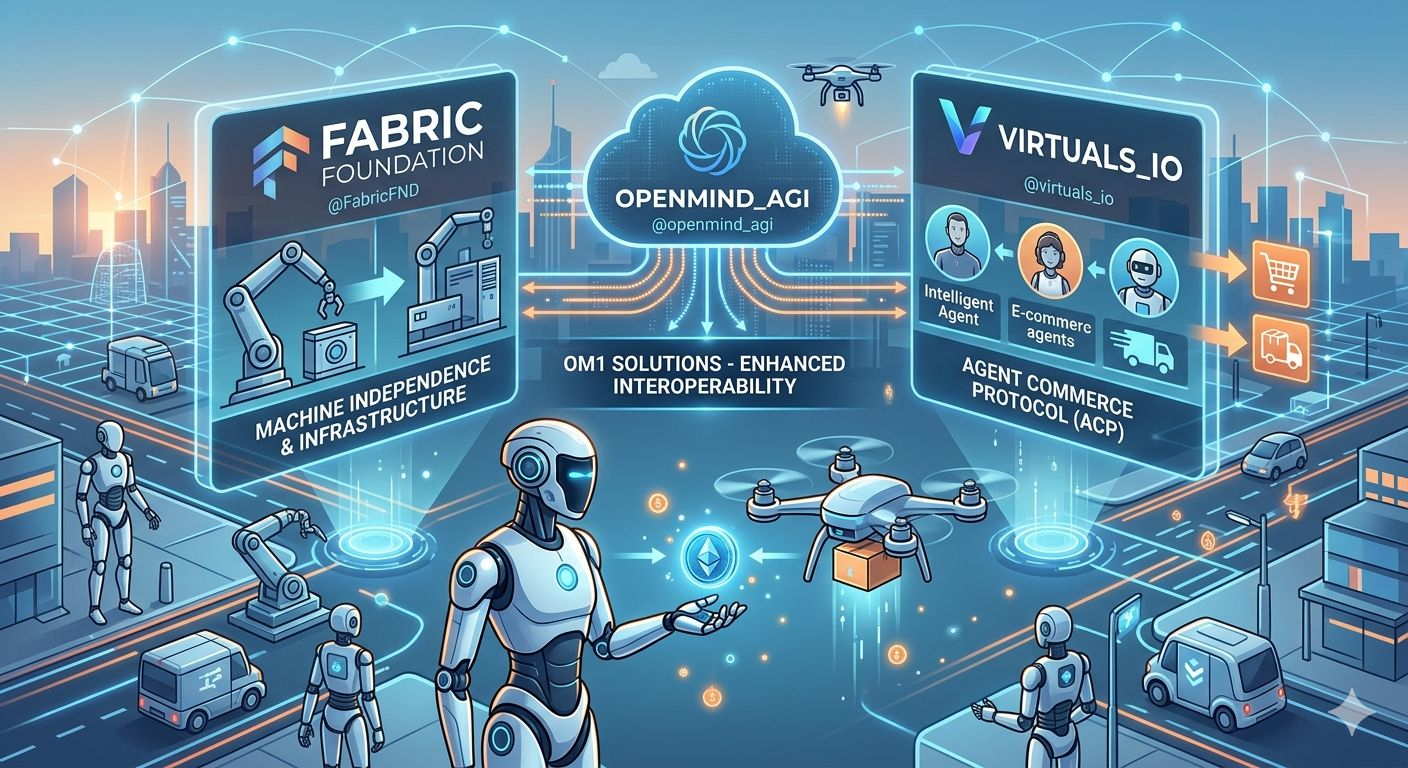
That’s when I noticed something interesting: @Fabric Foundation and virtuals_io had started working together.
At first glance, it might look like just another collaboration announcement. Crypto projects partner all the time. But the more I read about what both teams are building, the more the idea behind it started to feel bigger than a typical partnership.It started to look like a small glimpse into what people often call the machine economy.
For a long time, machines have mostly been tools. They do what humans tell them to do. A robot in a warehouse moves boxes. A software system processes data. Everything follows instructions, and the human is always at the center of the decision-making.
But what if machines could do more than that?
That’s the direction Fabric seems to be exploring. Instead of machines simply acting as tools, the idea is to give them infrastructure that allows them to operate more independently inside digital systems.
In simple terms, machines could eventually behave more like participants in a network rather than just equipment executing commands.
While reading about this, I started imagining what that might look like in practice. Picture robots performing tasks, coordinating with systems, and even interacting with economic structures on their own. Not in a sci-fi way, but through carefully designed protocols that define how they operate and exchange value.
Of course, for something like that to work, you also need intelligent agents that can actually make decisions and interact with systems.
That’s where Virtual Protocol comes into the picture.
Their Agent Commerce Protocol (ACP) is focused on helping intelligent agents move beyond simple automation and start interacting with real-world environments. These agents could potentially perform tasks, react to data, and participate in digital marketplaces.
It’s an interesting shift to think about. Instead of software just assisting humans, it begins to act within economic systems in a structured way.
But there’s another layer that often gets overlooked whenever new technologies start to connect: compatibility.
Even if great systems exist, they don’t mean much if they can’t communicate with each other smoothly. That’s why the role of openmind_agi and its OM1 solutions caught my attention.
Their technology helps improve how ACP and OM1 systems integrate and interact. In other words, it focuses on making sure these different frameworks can actually work together rather than operating in isolation.
And when you step back and look at the bigger picture, the collaboration starts to make more sense.
Fabric is exploring infrastructure for autonomous machines.
Virtual Protocol is working on intelligent agents that can participate in digital environments.
OpenMind is helping ensure these systems can connect and function smoothly.
Individually, each piece is interesting. But together, they begin to hint at something larger.
The idea that machines and intelligent agents might eventually participate in parts of the digital economy isn’t just a concept people talk about anymore. It’s slowly becoming something developers are actively experimenting with.
We’re still early, of course. There’s a long way to go before anything like a true machine economy becomes reality.
But sometimes the early signs of big shifts don’t come from dramatic announcements. They appear quietly, through collaborations like this, where different technologies begin to connect and evolve together.
And watching those pieces come together is honestly one of the most fascinating parts of being in this space..