

On-chain privacy and security is a complex and evolving field.
Although blockchain is known for its 'transparency', this transparency itself is a double-edged sword for privacy.
What practical issues might arise?
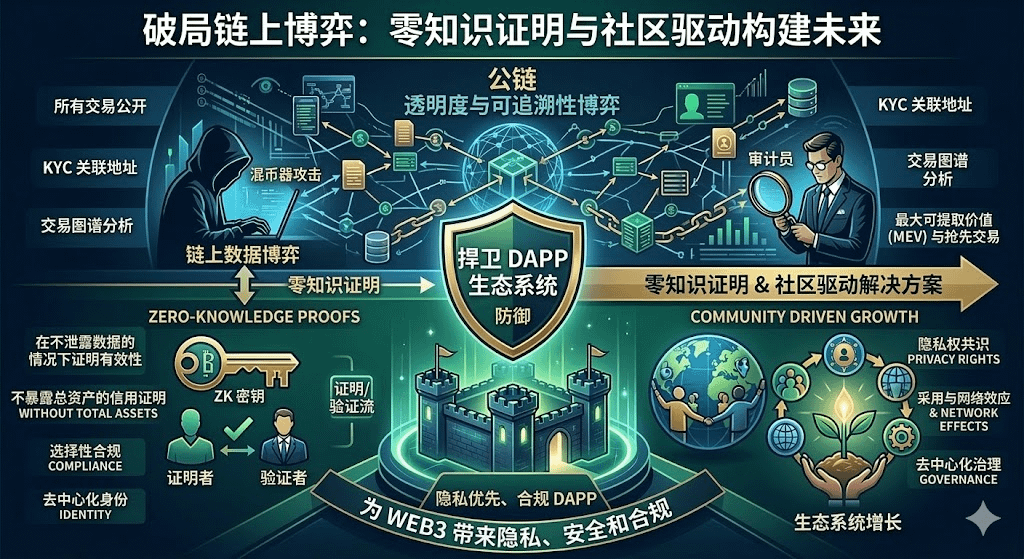
1. Pseudonymization is not anonymization
2. Transaction Map Analysis
3. MEV and Front-Running
4. Smart Contract Vulnerabilities and Privacy Computing Risks
5. Side Channels and Metadata Leakage
6. The Conflict between Compliance and Privacy
In summary: the security issues of on-chain privacy are essentially a game between 'transparency' and 'traceability'.
The emergence of @MidnightNetwork can perfectly solve this problem.
To break this deadlock, Zero-Knowledge Proofs (ZKP) have become the most crucial antidote.
It is like a 'gatekeeper of data sovereignty,' allowing sensitive data to securely sleep in the dark, only illuminating the verification light precisely under compliant touch.
Through ZKP, developers can create dApps that prioritize privacy while also being compliant.
Users can prove their credit without exposing the full picture of their assets, and protocols can complete risk control without retrieving personal privacy.
This proves that privacy and compliance have never been a relationship of choosing between one or the other; they can run in parallel as dual tracks.
However, technological breakthroughs are just the skeleton; community-driven growth is the flowing blood.
Privacy should not be an island, and compliance should not be a shackle.
When community members realize that protecting privacy is a fundamental right, and compliance is the cornerstone of long-term development, a strong network effect will emerge.


