
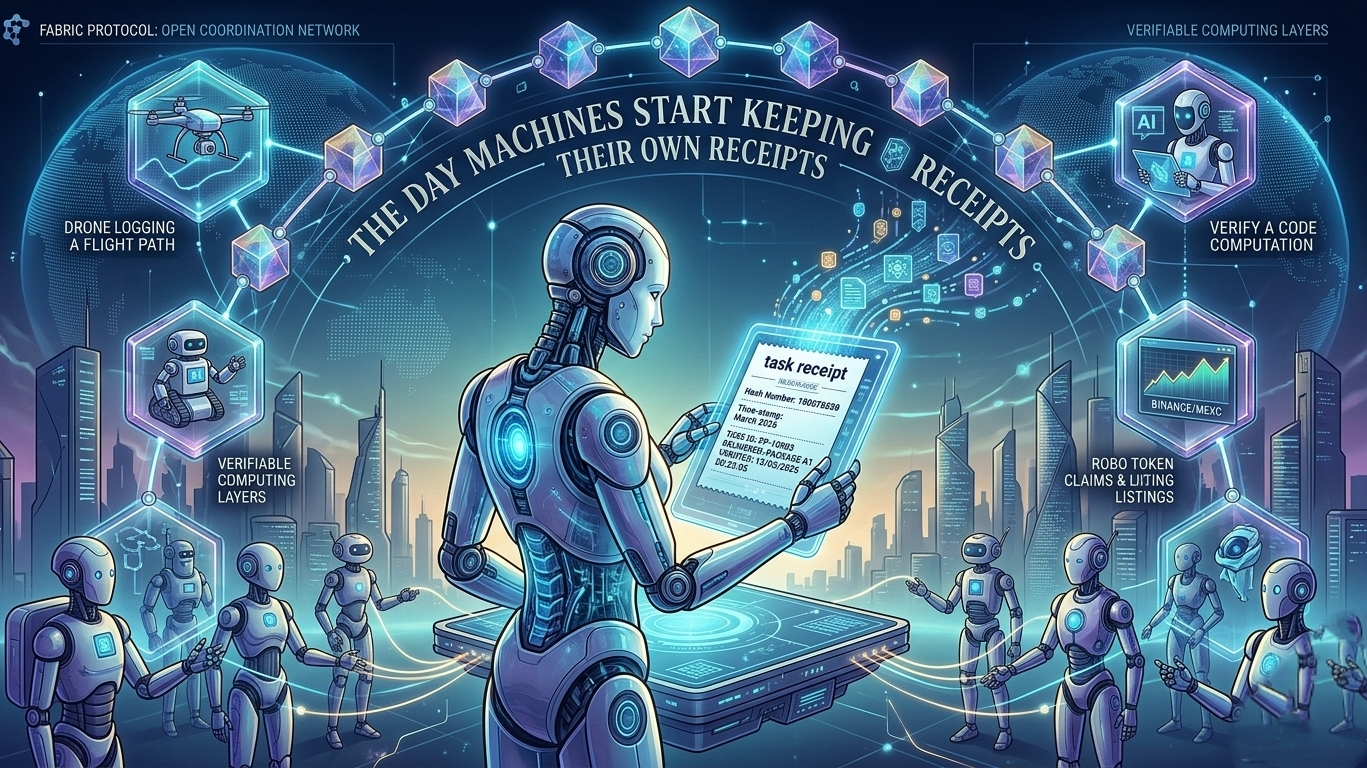

I’ve been thinking about something strange lately. Technology is moving toward autonomy at an uncomfortable speed. AI agents can already write code, robots can navigate warehouses, and automated systems make financial decisions in milliseconds. But one question keeps bothering me: who keeps the record when machines start acting on their own? That curiosity is what pulled me into exploring Fabric Protocol.
From what I’ve observed, Fabric isn’t trying to build robots. It’s trying to build the ledger where robots prove what they’ve done. Imagine a robot performing a task delivering something, running a computation, or coordinating with another system. Instead of trusting the company behind it, the action gets logged on a public network. Proof exists. Anyone can verify it. In a weird way, Fabric feels like a global receipt machine for machines.
The analogy that made the concept click for me is this: think of Fabric as a universal passport for robots. A machine built in Berlin, a robot deployed in Bangkok, and an AI agent running on servers in California could all interact under the same rules. Same verification. Same economic language. Same shared record of activity.
What’s interesting is that this idea is not just theoretical anymore. March 2026 has been a pretty active period around the project. The claim deadline for the ROBO token recently created buzz across communities, and listings on exchanges like Binance pushed the project into broader market conversations. Whether someone is bullish or skeptical, those events definitely signaled that Fabric is moving from concept discussions into actual market presence.
Under the hood, the protocol revolves around something called verifiable computing. Instead of trusting that a robot or AI system executed a task correctly, the network produces cryptographic proof that the computation actually happened. That idea sounds technical, but the implication is simple: machines stop asking us to trust them. They start proving their actions.
Personally, I find that direction fascinating because most blockchain projects stay inside the digital finance bubble. Tokens, liquidity, speculation—that familiar cycle. Fabric tries to step outside it. It’s exploring what happens when decentralized infrastructure interacts with physical machines and autonomous software agents.
But I’ll be honest, the idea isn’t free from challenges. Robotics is expensive hardware. Distributed networks can introduce latency. And convincing robotics companies to adopt open protocols instead of private systems is never easy. Infrastructure projects like this usually take years before their impact becomes visible. So while the vision is compelling, the road ahead will probably be slow and technically demanding.
Still, the broader idea keeps pulling my attention back. If autonomous systems become common—and everything suggests they will—machines will eventually need systems to verify work, coordinate tasks, and settle payments. Humans won’t manage every micro-transaction or robotic action manually. A decentralized coordination layer could make sense.
And that’s where Fabric starts to look less like a niche crypto experiment and more like an early attempt at machine infrastructure.
But this whole concept opens a deeper question that I don’t see enough people asking.
If robots and AI agents start working independently…
if they can verify their tasks…
if they can even transact economically through networks…
@Fabric Foundation #robo $ROBO
