
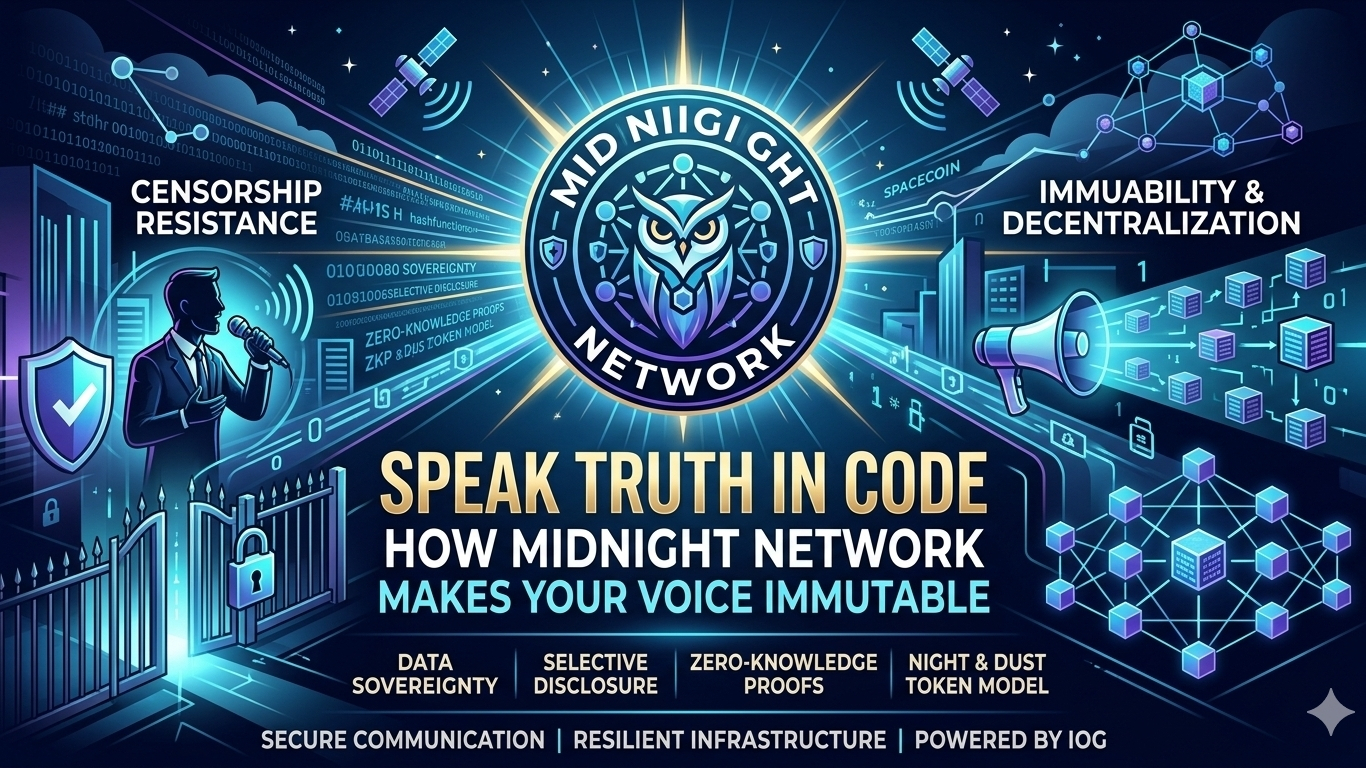
In the digital era, the phrase "reedom of expression has shifted from a legal concept to a technological challenge. While constitutions may protect a citizen's right to speak, the infrastructure of the modern internet dominated by centralized servers and data hungry platforms often acts as an invisible filter. The ability to speak is increasingly contingent on the whims of private entities or the shifting tides of geopolitical regulation. In this landscape, the Midnight Network emerges not just as a blockchain project, but as a critical piece of cryptographic infrastructure designed to restore the fundamental right to private, resilient, and unhampered expression.
📍The Crisis of Digital Expression
For decades, the internet was hailed as the ultimate democratizing force. However, the architecture of Web2 has inadvertently created a "Panopticon" of speech. Every word published, every "like" registered, and every transaction made leaves a digital footprint that is harvested, analyzed, and stored. This metadata the who, when, and where of communication is often more dangerous than the content itself.
Censorship in the 21st century rarely starts with a direct ban. It begins with surveillance, leading to chilling effects where individuals self-censor to avoid social, professional, or legal repercussions. When a centralized authority controls the off switch, freedom of expression becomes a privilege rather than a right. This is where the intersection of cryptography and blockchain technology, exemplified by the Midnight Network, provides a revolutionary alternative.
📍Cryptography: The Modern Printing Press
If the printing press broke the monopoly on information in the 15th century, cryptography is breaking the monopoly on data control in the 21st. At the heart of this shift is a technology known as Zero-Knowledge Proofs (ZKPs).
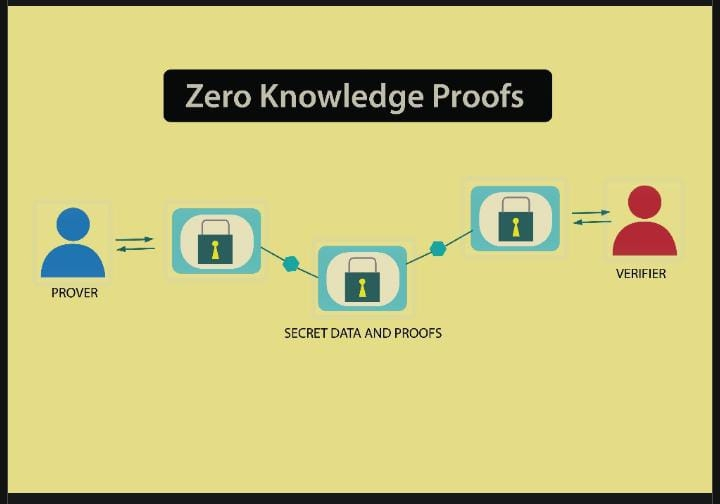
ZKPs allow one party to prove to another that a statement is true without revealing any information beyond the validity of the statement itself. In the context of free expression, this is a game changer. Imagine being able to prove you are a certified journalist, a resident of a specific city, or a member of a whistleblowing collective without ever revealing your name, IP address, or physical location. Midnight leverages this technology to decouple identity from activity, ensuring that the act of expression does not create a permanent, exploitable trail of personal data.
📍 Midnight Network: Delivering Rational Privacy
Developed by Input Output Global (IOG) as a partner chain to Cardano, Midnight is built on the philosophy of rational privacy. Most privacy focused technologies fall into two extremes: total transparency (which invites surveillance) or total anonymity (which can invite illicit activity and regulatory pushback). Midnight finds the middle ground through Selective Disclosure.
Midnight’s architecture allows users to keep their data private by default while programmatically defining who can see what. This programmable privacy is the bedrock of censorship resistance. It allows for the creation of decentralized applications (dApps) where the rules of engagement are written in code, not enforced by a centralized moderator.
📍The Dual-Token Model: $NIGHT and DUST
To sustain this ecosystem of private expression, Midnight utilizes a sophisticated dual token system. NIGHT serves as the utility and governance token, providing the economic energy and security for the network. It allows stakeholders to participate in the direction of the protocol, ensuring that the infrastructure remains a public good rather than a corporate asset.
DUST, on the other hand, is the engine of privacy. It is a shielded capacity resource generated by holding #night . When a user wants to perform a private transaction or publish a piece of data without revealing metadata, they use DUST. This separation ensures that the cost of privacy is decoupled from the volatility of the market, making it accessible for activists and citizens who need predictable, low cost tools for secure communication.
📍 Censorship Resistance in Action: From Messaging to Media
The theoretical benefits of Midnight translate into tangible protections for free speech. Consider the partnership between Midnight and Spacecoin, which aims to secure online conversations against censorship and surveillance using satellite technology. By combining cryptographic privacy with decentralized hardware, the collaboration creates a communication stack that does not rely on traditional, easily monitored internet infrastructure.
Another example is Dawn, a censorship resistant media platform built on Midnight. Dawn allows users to publish reports anonymously while maintaining verifiable authenticity. In a world of deepfakes and misinformation, Dawn uses ZK-proofs to verify that an author has the credentials to speak on a topic (e.g., I am a verified doctor in this hospital) without revealing the author’s name. Once published, the data is permanent and immutable. No government or corporation can delete the report because there is no central server to seize.
📍 Breaking the Metadata Trap
Most private messaging apps today protect the content of the message but fail to protect the metadata. Governments can still see who you are talking to and how often. @MidnightNetwork addresses this metadata trap by shielding the transactional details of the network. Because Midnight is a fourth generation blockchain, it focuses on protecting the logic of the interaction.
When a user interacts with a dApp on Midnight, the computation happens locally on the user's device. The network only sees a mathematical proof that the computation was done correctly. This off-chain computation, on-chain verification model means that the network nodes the entities processing the data never actually see the data itself. If the processors can’t see the data, they can’t censor it.
📍 The Developer’s Mandate: Compact and Accessibility
For censorship resistance to be effective, it must be easy to deploy. Historically, writing zero-knowledge smart contracts required a PhD in mathematics. Midnight lowers this barrier with Compact, a smart contract language based on TypeScript.
By making privacy preserving tools accessible to millions of mainstream developers, Midnight ensures that the next generation of social media, voting platforms, and financial tools will have censorship resistance baked in from day one. When privacy becomes a standard engineering resource rather than a niche specialty, the entire digital ecosystem becomes more resilient against overreach.
📍 Conclusion: The Future of the Open Web
The struggle for freedom of expression has moved from the town square to the digital packet. As centralized platforms become increasingly restrictive, the need for decentralized, cryptographically secured infrastructure becomes existential.
The Midnight Network offers a blueprint for this future. By utilizing zero-knowledge proofs and selective disclosure, it provides the tools necessary to speak truth to power without the fear of deplatforming or surveillance. It recognizes that true freedom of expression requires the freedom to be private. In the end, censorship resistance is not just about the right to speak; it is about the right to own the infrastructure of your own voice. Through Midnight, that voice is finally being given a permanent, unshakeable home on the blockchain.