
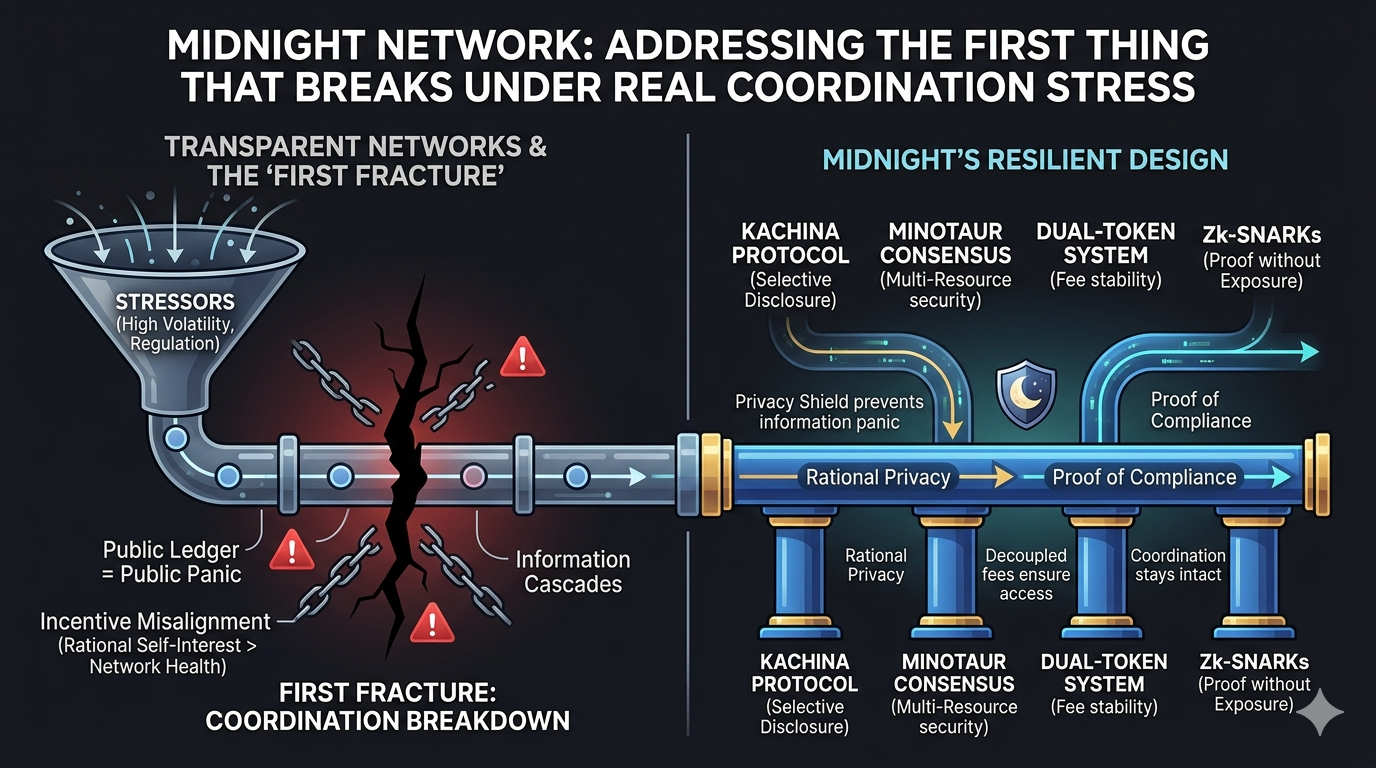
I spend most of my time watching where liquidity hesitates. Not where it flows easily, but where it stalls. Coordination systems only reveal their real structure when capital begins to doubt them. Until then, everything looks coherent. Midnight sits in an interesting position inside that observation. It is built around zero-knowledge verification and selective disclosure, where the network agrees on the validity of proofs rather than the underlying data itself. That architectural decision creates a very particular kind of coordination environment. It assumes participants can trust outcomes without seeing the underlying state. Most of the time that assumption feels elegant. Under economic stress, it becomes something else entirely.
What I tend to watch first in systems like this is not the cryptography but the latency between belief and verification. Midnight’s model splits public consensus from private computation, allowing data to remain hidden while proofs validate the outcome. The idea works perfectly in an environment where actors behave predictably and verification costs remain low relative to the value of participation. But coordination under stress is rarely about whether proofs are valid. It becomes about whether participants can afford to wait for certainty. When volatility rises, markets stop optimizing for correctness and start optimizing for speed. That shift quietly pressures any architecture where trust depends on proof generation, proof propagation, and proof verification happening in sequence.
The first structural pressure point appears here: verification latency colliding with market reflexes. In calm conditions, zero-knowledge systems feel instantaneous because the delay between action and confirmation is small compared to the pace of economic decision making. But stress compresses time. Capital moves faster than validation cycles. Participants begin acting on expectations of proofs before proofs actually settle. I have watched this pattern repeat across multiple systems that rely on cryptographic attestations. The technology remains correct, but the coordination layer begins drifting ahead of it. At that moment, the network is no longer synchronizing behavior; it is chasing it.
Midnight’s architecture deepens this tension because the system intentionally separates visible economic infrastructure from the private data that drives it. The public token layer functions as coordination infrastructure while the underlying data remains shielded through ZK circuits and selective disclosure. That separation is powerful from a privacy perspective. But it creates a behavioral asymmetry during stress events. Markets can price the token instantly, while the private information that actually justifies that price remains invisible. Price discovery becomes detached from informational discovery. In quiet markets this is merely theoretical. Under stress it becomes structural.
This leads to the second pressure point: incentive opacity. Midnight assumes actors will submit truthful proofs because the system only accepts mathematically valid state transitions. But incentives are not about validity; they are about timing. A participant does not need to falsify a proof to exploit a coordination gap. They only need to understand when other actors cannot see the same underlying conditions. Privacy preserves data ownership, which is the point of the system, but it also concentrates informational asymmetry in ways that markets historically struggle to price correctly.
I have seen similar dynamics play out in less sophisticated environments. The moment some actors realize they are operating with hidden state while others are trading against public signals, the coordination equilibrium begins to shift. Midnight’s privacy guarantees make that asymmetry structurally embedded. Participants are not observing the same information surface. They are coordinating through proofs that confirm rules were followed, not through shared visibility of the environment those rules operate within.
This produces a trade-off that is easy to miss when reading architectural diagrams. Privacy increases composability across industries like identity, governance, and finance because sensitive data never needs to appear on chain. But the same property reduces the ability of markets to collectively interpret risk in real time. A system that hides the informational substrate while exposing the economic layer inevitably asks participants to price something they cannot directly observe. The proofs say the rules were followed. They do not say whether the incentives behind those rules are stable.
I find the token design interesting in this context. Midnight separates capital from execution by allowing the native asset to generate a separate network resource used for transactions and computation. From an engineering perspective, this isolates governance and long-term stake from operational costs. But coordination is rarely that clean. Markets treat tokens as both infrastructure and signal simultaneously. When the price moves, it sends behavioral cues about the health of the entire system. If those cues diverge from the hidden operational layer, participants begin coordinating around the signal rather than the underlying mechanism.
That is the uncomfortable question I keep returning to when I watch systems like this: what happens when the market begins reacting to the token faster than the network can demonstrate that the private state behind it is still coherent? The cryptography will still be correct. The proofs will still verify. But coordination might already be happening somewhere else.
The strange thing about decentralized coordination is that it does not collapse when technology fails. It collapses when participants stop waiting for it. Midnight attempts to solve trust by replacing visibility with verification. Mathematically that works. Behaviorally it assumes actors will continue respecting the verification cycle even when capital starts moving faster than it.
I am not sure that assumption survives the first real liquidity shock.
#night @MidnightNetwork $NIGHT
