
I found myself thinking about @MidnightNetwork today in a strange, unstructured way. Not like researching a project or studying a chart, but more like the way a thought quietly lingers after reading something late at night. Midnight is one of those ideas that doesn’t demand attention loudly, yet somehow it stays in the background of your mind
On the surface, the concept is simple: a blockchain built around zero-knowledge proofs, designed to let people use and verify data without exposing the data itself. It sounds elegant—almost suspiciously elegant.
But the more I think about it, the more I realize that Midnight is trying to solve a tension that has been at the center of blockchain since the beginning.
For years the rule has been simple:
“Transparency creates trust.”
Public blockchains operate on this principle. Every transaction, wallet address, balance, and interaction is visible on-chain. Anyone can verify everything. That openness is what makes decentralized systems possible.
But it also creates a strange paradox.
Because transparency doesn’t always feel like freedom.
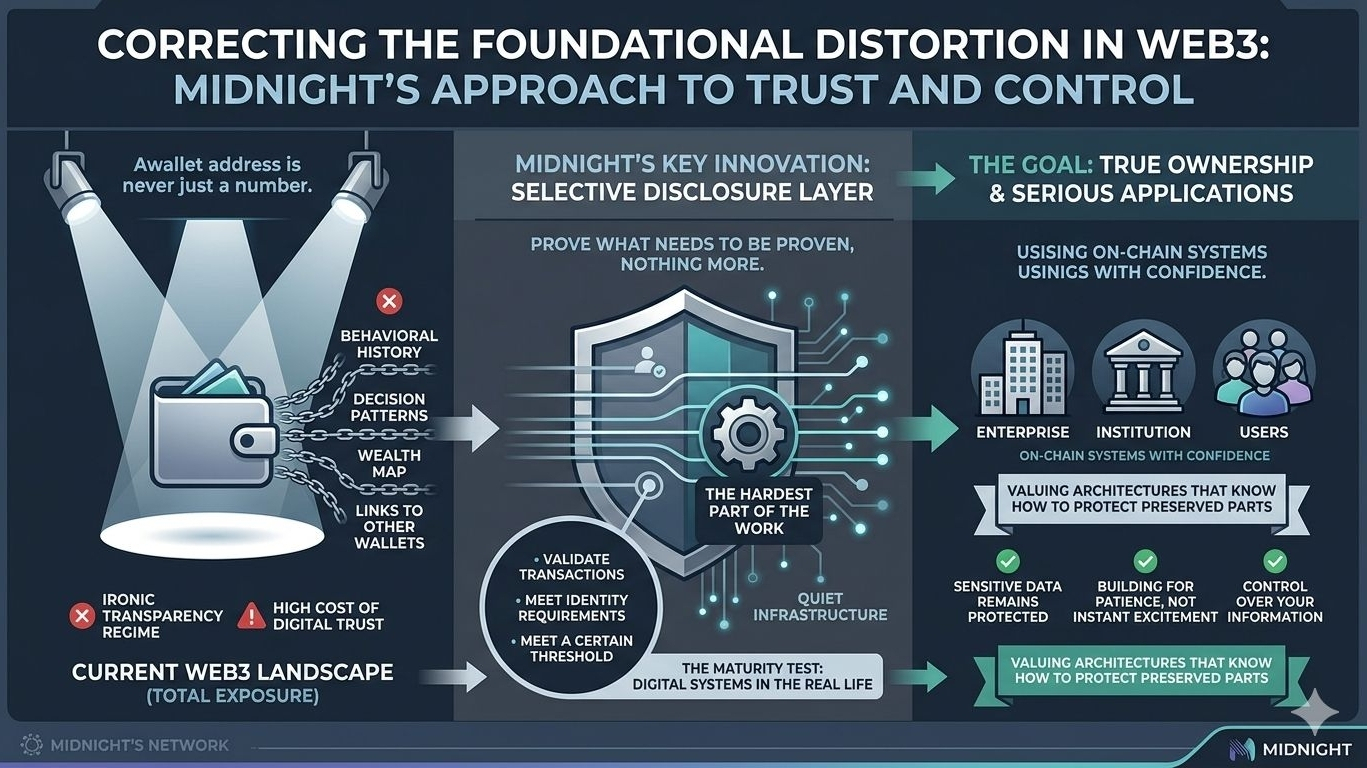
A wallet address may look anonymous, but over time it becomes a trail of behavior. Transaction history reveals patterns. Patterns reveal relationships. And relationships slowly reveal identity.
So the system that promised financial independence sometimes ends up creating permanent financial visibility.
That’s where Midnight introduces a different idea.
Instead of assuming that trust requires exposure, it asks a quieter question:
“What if you could prove something is true without revealing the data behind it?”
This is the strange beauty of zero-knowledge proofs.
Mathematically, the concept is straightforward. You can demonstrate that a statement is correct without revealing the underlying information that proves it. But when you sit with the idea long enough, it starts to feel almost philosophical.
It’s like whispering a secret into a locked room and somehow the room nods back in agreement.
Midnight builds an entire system around that principle.
Rather than forcing a choice between completely public systems and completely hidden ones, the network aims for something in between—selective visibility. You reveal exactly what needs to be proven and nothing more.
In everyday life this logic already exists.
When you prove your age somewhere, you don’t hand over your entire identity history. When a company verifies compliance, it doesn’t necessarily need to reveal all internal records publicly.
Yet blockchain systems often demand that level of exposure.
Midnight seems to be asking whether that exposure was ever necessary in the first place.
Of course, ideas that elegant always come with questions.
Technology often assumes rational behavior, but humans rarely behave rationally. Systems designed around mathematical trust may work perfectly at the cryptographic level, yet still feel unfamiliar psychologically.
For centuries people have associated visibility with legitimacy. Courts require evidence. Auditors require records. Regulators want traceable information.
Midnight doesn’t remove those mechanisms, but it changes how they work. Instead of showing the data itself, the system shows cryptographic proof that the data meets specific conditions.
Technically, that works beautifully
Culturally, it requires a shift in how people think about truth.
Another part of Midnight that keeps my attention is its economic structure. Instead of a single token trying to do everything, the system separates roles. The $NIGHT token participates in governance and network activity, while another internal resource quietly powers private computation inside the network.
At first that design feels unusual. Crypto ecosystems usually prefer simplicity: one token, one narrative, one economy.
But Midnight treats computation more like energy.
Energy isn’t meant to be hoarded forever—it exists to enable activity.
That perspective actually makes a surprising amount of sense.
Still, systems like this always face the same human questions that every blockchain eventually encounters: coordination, governance, and incentives. Technology can distribute power, but communities still have to decide how decisions are made.
And when privacy becomes a central feature, governance becomes even more interesting.
“Where does privacy end and accountability begin?”
That’s not a question unique to Midnight, but the project brings it into sharper focus.
Sometimes I imagine what kinds of applications might quietly emerge if networks like this succeed. Identity systems where eligibility can be verified without revealing personal data. Financial platforms where compliance checks happen without exposing entire transaction histories. Voting systems where participation can be proven without revealing individual choices.
Those possibilities feel powerful.
But real life tends to complicate clean ideas. Institutions move slowly. Regulations evolve cautiously. And whenever money enters the equation, incentives reshape behavior in unpredictable ways.
Midnight can provide the infrastructure for rational privacy, but it cannot force the world to use it rationally.
And maybe that’s why the project keeps lingering in my thoughts.Because in the end, Midnight isn’t just experimenting with cryptography.
It’s experimenting with trust itself.instead of trusting institutions to guard data, the system asks us to trust mathematical guarantees. Instead of trusting visibility, it asks us to trust proof.
That shift might be small in code, but enormous in culture.
When I step back and look at the broader evolution of blockchain, Midnight feels like part of a deeper transition. Early networks focused on transferring value. Later ones focused on programmable applications.
Now a new layer is emerging—one focused on how information behaves inside decentralized systems.
Maybe that’s exactly what @MidnightNetwork and $NIGHT are trying to