
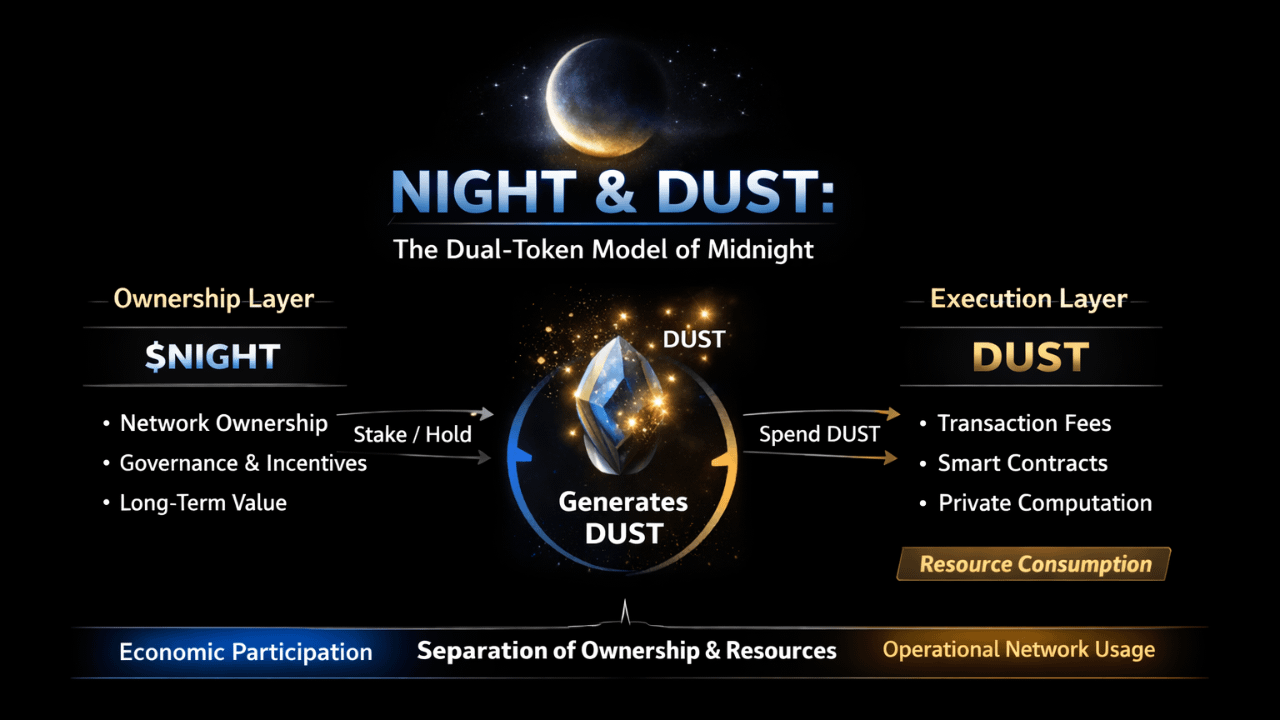

One design choice in Midnight Network kept catching my attention while studying its architecture: the network does not use the same token for ownership and transactions.
Instead, Midnight introduces a dual-token structure built around $NIGHT and a resource called DUST. From my view, this isn’t just a token design decision. It’s a way to rethink how blockchain infrastructure should price computation especially when privacy features are involved.
The Foundation of Midnight
Midnight is being developed as a privacy-focused blockchain designed for programmable data protection. The goal is to allow developers to build applications where sensitive information can remain private while still benefiting from blockchain verification.
Privacy systems often require heavier cryptographic computation than simple transfers. What stood out to me is that Midnight’s token architecture seems designed with that reality in mind.
Instead of letting speculation directly influence network usability, the protocol separates economic ownership from computational resources.
Ownership Layer NIGHT
NIGHT represents the economic foundation of the network. It is connected to the long-term structure of the ecosystem rather than everyday transaction activity. In practice, this means NIGHT aligns participants with the growth of the infrastructure itself.
This layer supports several roles inside the ecosystem:
• Network ownership — participants holding NIGHT share exposure to the development of the protocol.
• Governance alignment — stakeholders can influence how the network evolves.
• Ecosystem incentives — developers, builders, and infrastructure contributors are tied to the network’s long-term value.
What stands out to me is that NIGHT haves more like the economic backbone of the network rather than a simple gas token.
Execution Resource DUST
Where NIGHT represents ownership, DUST acts as the operational resource that powers activity on the network.
DUST is consumed whenever computation happens inside the system, including:
• Executing transactions
• Running smart contracts
• Performing privacy-preserving computations
• Interacting with decentralized applications
From my perspective, DUST behaves less like a tradable token and more like computational fuel. It reflects how much processing power the network actually uses.
That distinction becomes important for privacy infrastructure, where transaction complexity can vary significantly depending on the application.
How DUST Is Generated and Used
The relationship between $NIGHT and DUST follows a resource-generation model.
Instead of buying gas tokens for every interaction, DUST is generated through holding or allocating NIGHT.
The mechanism works like this:
• Holding or allocating NIGHT nerates DUST over time
• Applications and users spend DUST when performing network actions
• Consumed DUST represents real computational work occurring on the network
I noticed this creates a system where resource consumption is directly tied to infrastructure participation.
It also mirrors how many real-world systems operate. For example, cloud infrastructure separates ownership of computing resources from usage of those resources.
Midnight appears to bring that same logic into blockchain design.
Why Midnight Separates Ownership From Transaction Resources
Many blockchain networks rely on one token to perform multiple roles. That often creates friction.
If the token price moves dramatically, transaction fees move with it—even when the actual computational cost of running the network hasn’t changed.
Midnight’s dual-token architecture divides responsibilities:
• NIGHT → ownership and long-term value capture
• DUST → computational resource used for execution
From my view, this separation is particularly important for developers building real applications. Privacy-focused smart contracts may involve complex computations, so predictable execution costs matter.
Without that predictability, building large-scale privacy applications becomes much harder.
Why This Model Can Stabilize Transaction Costs
Because DUST is generated from NIGHT rather than constantly purchased on the market, the cost of using the network becomes less dependent on token speculation.
That creates several practical advantages:
• Developers can estimate operational costs more reliably
• Users face fewer sudden spikes in transaction expenses
• Network activity reflects actual computational demand, not market volatility
What stands out to me is how this design treats blockchain activity more like a resource economy than a speculative fee market.
Instead of gas prices being dictated by token trading, they are linked to how much computation the network performs.
A Different Direction for Blockchain Economics
The deeper insight here is that Midnight is experimenting with separating value from usage.
In this system:
• NIGHT captures the long-term economic value of the network
• DUST represents the computational energy required to operate it
From my perspective, this approach may become increasingly relevant as decentralized applications grow more complex—especially in areas like privacy, identity, and data protection.
If Midnight succeeds in building a strong ecosystem around privacy-preserving applications, this dual-token structure could quietly influence how future blockchain networks design their economic models.
The bigger question I keep thinking about is this: as Web3 infrastructure matures, will more networks begin separating ownership from computational resources the way Midnight does?
@MidnightNetwork $NIGHT #night #NİGHT
