
Public blockchains log everything — wallet addresses, amounts, counterparties — on a ledger anyone with a browser can read. That was a deliberate design choice in the early days of crypto. Openness was the proposed answer to the opacity of traditional finance.
Transparency without control is a liability. The openness that signals accountability becomes a tool for surveillance, front-running, and exposure.
A business settling payments on a public chain hands its suppliers a real-time view of every outflow. Someone entering a position risks being front-run by anyone reading the mempool. Users sending funds expose their full financial history to whoever looks up their address. The data is open, but the consent was never there.
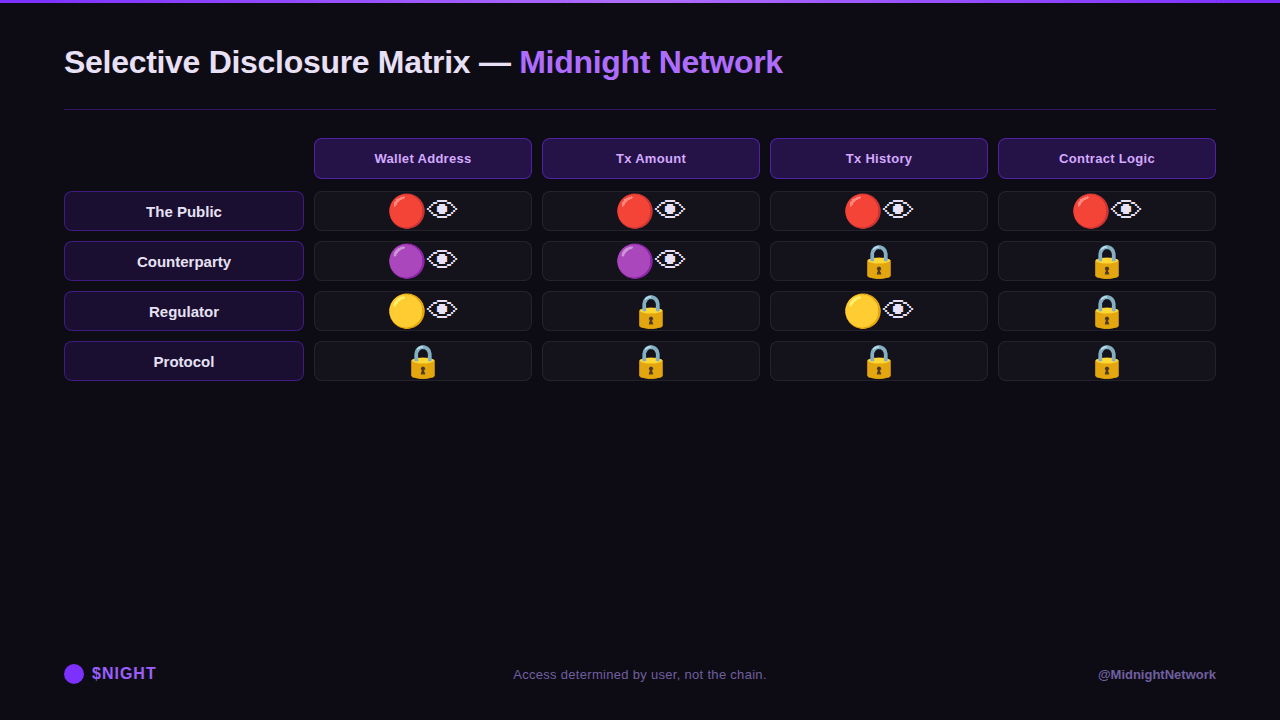
@MidnightNetwork approaches this differently. What users control — what gets disclosed and to whom — is the actual question. $NIGHT powers a network built on that principle. Financial activity on Midnight stays between the parties involved unless one of them chooses to share it. ZK-proofs handle verification, so the network confirms a transaction is valid without reading its contents.
$
Compliance fits into this model cleanly. Regulators need to verify specific things — not audit everything. Midnight lets a business prove solvency or confirm payments without opening its books to the network. Users decide what gets shared, and the protocol enforces that boundary.
Selective disclosure reframes what privacy in finance actually means. The user holds the key. That is the shift night is building toward.