

The first time I tried to explain privacy on a blockchain to someone outside crypto, I realised something strange.
Transparency is easy to demonstrate.
You open a block explorer, paste a transaction hash, and suddenly everything appears. Wallet addresses, transaction flows, contract interactions. The system proves itself simply by showing you the data.
Privacy doesn’t work that way.
If a system is protecting data correctly, there is nothing to point at. Nothing visible. No obvious proof sitting on the screen.
That is the strange paradox of privacy infrastructure. When it works, it disappears.
For a long time that made privacy-first blockchain projects difficult to evaluate. Whitepapers could describe the cryptography. Documentation could explain how proofs were generated. But reading about privacy is not the same thing as seeing how a system behaves when people actually start using it.
That question stayed in the back of my mind until Midnight launched the City Simulation.
At first glance it looks almost playful — a virtual city divided into districts, populated by autonomous agents that run businesses, negotiate services, and interact with each other as if they were part of a real economy.
But the longer you watch it, the more the purpose becomes clear.
The city isn’t the product. The transactions are.
Every interaction between those agents generates activity on the Midnight network. Purchases, contracts, negotiations, and service exchanges are all processed through the protocol’s privacy architecture.
And what you see from the outside is strangely incomplete.
You can see that activity is happening. Transactions appear. The network records the results. But the underlying data — the context that normally becomes visible on public chains — simply never appears.
At first that absence feels unusual. Years of watching transparent blockchains trains you to expect that information should be there.
Then you realize that the absence is the demonstration.
The simulation is not trying to show you the data. It is showing you that the system works without revealing it.
Watching the agents interact inside the city feels less like observing a game and more like watching a stress test. Their behavior is unpredictable. They start businesses, change strategies, form relationships, and create transaction patterns that look surprisingly similar to what happens in real economies.
The network processes all of it continuously.
That unpredictability is what makes the simulation interesting. Controlled benchmarks can always make a system look good. Real usage rarely behaves in such orderly ways.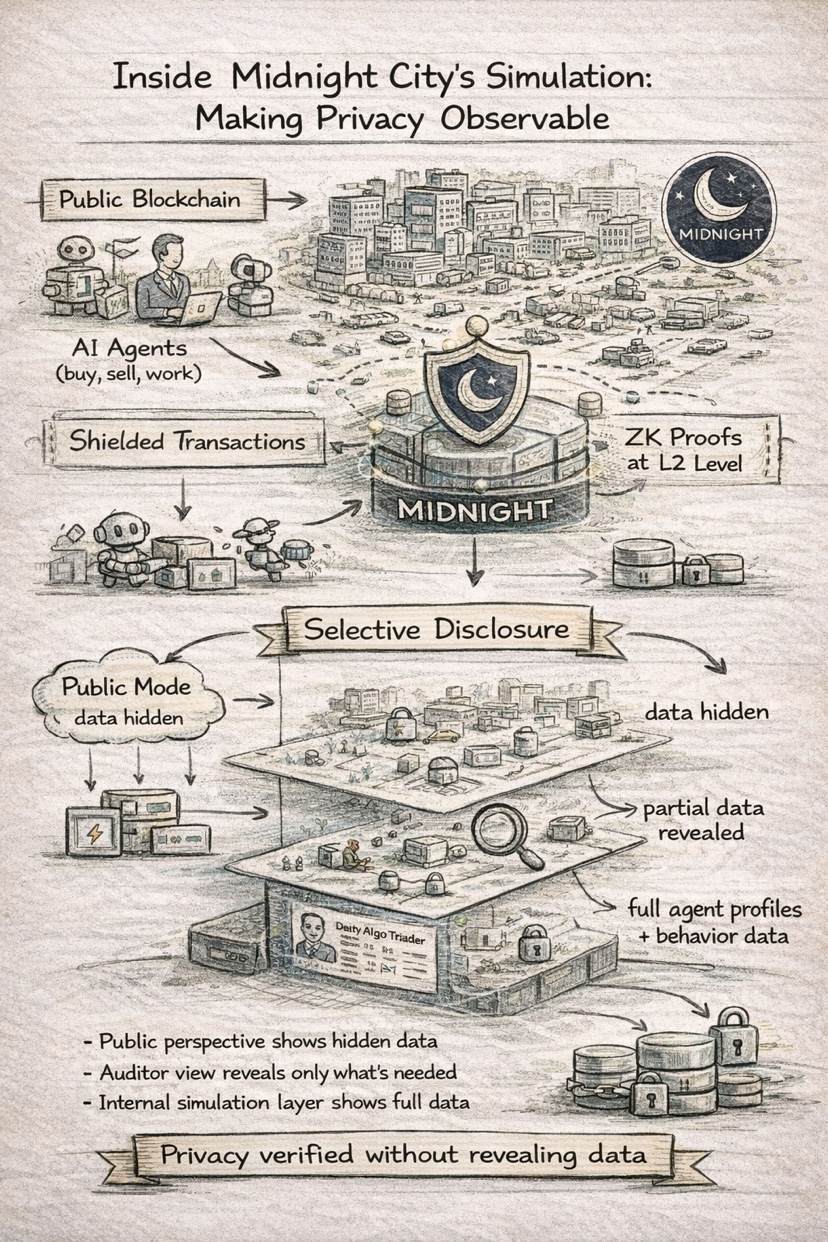
If the privacy layer can survive chaotic activity generated by autonomous agents, it begins to resemble something that could survive the real world as well.
What caught my attention most wasn’t the AI personalities or the district lore. It was the viewing modes.
The same transaction can appear differently depending on who is looking.
A public observer sees activity but not the underlying details.
An authorized auditor can reveal additional information when necessary.
Inside the simulation, the full context exists for debugging and observation.
Three perspectives. One system.
That structure reveals the real philosophy behind Midnight’s design. Privacy is not treated as a wall that blocks all information forever. Instead it becomes something adjustable, something that can reveal exactly the information required and nothing more.
Watching the city run made me realize something simple.
For years blockchain has struggled with a choice between two extremes: total transparency or total secrecy.
Midnight is experimenting with something in between.
A system where the network can confirm that something is true without forcing the world to see everything behind it.
And that idea — proving something without revealing it — might be one of the most important shifts blockchain infrastructure has attempted so far.
Watching the simulation run long enough, the question that started this whole experiment begins to feel different.
The problem was never that blockchains couldn’t process transactions. They proved that years ago. The problem was that they required every participant to reveal far more information than most real systems can tolerate.
Transparency solved one problem while quietly creating another.
Midnight is trying to answer that contradiction. Not by abandoning verification, and not by hiding activity completely, but by changing what the network actually needs to see.
If a system can prove that something happened without exposing everything behind it, the ledger no longer needs to behave like a public diary of human activity.
It becomes something else.
Infrastructure that confirms truth while allowing the world behind that truth to remain private.
And if blockchain is going to move into industries where confidentiality matters as much as trust, that shift may end up being more important than any improvement in speed, fees, or throughput.
Because the hardest thing to prove on a blockchain was never the transaction.
It was the absence of exposure.
#night $NIGHT @MidnightNetwork
