
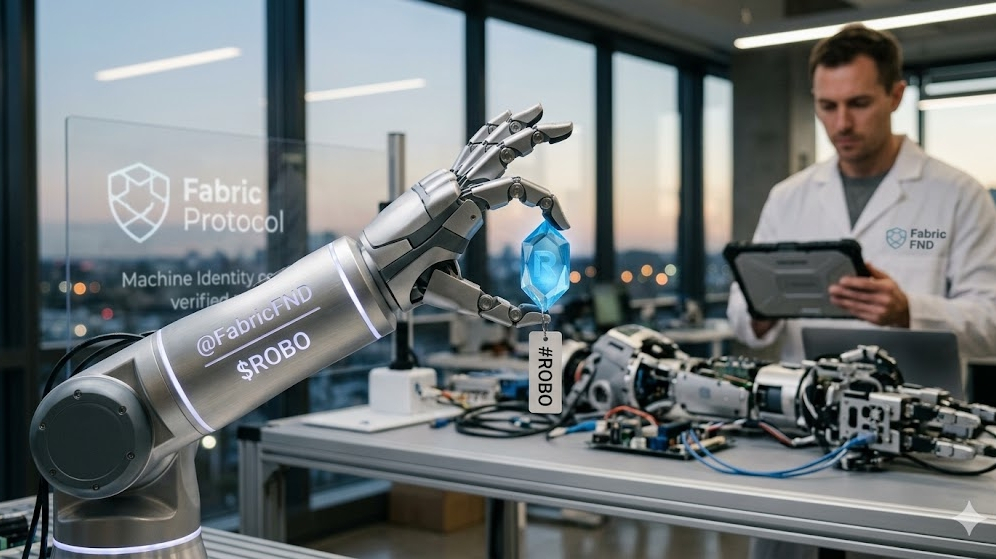
As we navigate through 2026, the intersection of Artificial Intelligence and Physical Robotics has transitioned from science fiction to a tangible economic reality. At the center of this revolution is the Fabric Foundation (@Fabric Foundation ), an independent non-profit building the decentralized "nervous system" for the world's first open robotics network.
Why the Robot Economy Needs Blockchain
For years, the robotics industry has been plagued by the "Isolation Problem"—where different manufacturers create closed-loop systems that cannot communicate or trade value with one another. Furthermore, robots have historically lacked a financial identity. They couldn't own wallets, sign contracts, or pay for their own resources.
The Fabric Protocol changes this by providing:
Unified Machine Identity: Every robot on the network receives an on-chain passport that tracks its capabilities and historical performance.
Autonomous Payments: Utilizing the ROBO token, machines can independently pay for their own charging, maintenance, and data upgrades without human intervention.
Proof of Robotic Work (PoRW): A unique consensus mechanism that rewards participants for verified machine labor and data contributions, ensuring that value is generated by utility, not just speculation.
The Role of $ROBO : More Than Just a Token
The ROBO token serves as the lifeblood of this ecosystem. Unlike many assets that rely on hype, ROBO has deep integration within the Fabric architecture:
Network Fees: Every micro-transaction, from identity verification to task settlement, is powered by $ROBO .
Work Bonds: Operators must stake $ROBO as a performance guarantee, creating a high-integrity environment where bad actors are penalized.
Governance: Through veROBO, the community guides the evolution of the protocol, ensuring the machine economy remains aligned with human interests.
2026 Roadmap: From Base to Native L1
Currently deployed on Base, @Fabric Foundation has a clear trajectory for the remainder of the year. While Q1 focused on establishing basic identity and wallet integration, Q2 is set to ignite the incentive engine for verified task completion. By Q3, we expect the migration toward a dedicated Layer 1 optimized for the high-frequency micro-payments required by autonomous fleets.
By investing in and supporting the #ROBO ecosystem, we aren't just betting on a single robot; we are supporting the infrastructure that will allow millions of intelligent agents to work, earn, and coordinate safely in our physical world.