
I spent five years working with enterprises trying to adopt blockchain. And I watched every single project hit the same wall.
The conversation always went like this:
Me: "Blockchain gives you transparency and immutability."
Enterprise client: "Great. So our competitors can see our supply chain data?"
Me: "Well, no, we can encrypt it."
Client: "Then how do we prove it's accurate?"
Me: "That's... actually a problem."
This is the privacy paradox that's killed more blockchain pilots than scalability ever did. You need transparency for trust, but privacy for business. Most chains force you to pick one.
Midnight's nightpaper proposes something different. And after reading through their architecture and some recent technical deep dives, I think they might have actually cracked it.

The "Zero-Knowledge" Misconception
Most people hear "zero-knowledge proofs" and think it means total anonymity. That's wrong, and Midnight's team knows it.
What ZK actually gives you is verifiable computation without data exposure. You can prove a statement is true without revealing why it's true.
Midnight's implementation goes further. Their Compact language (now called Minokawa under the Linux Foundation) lets developers bridge public and private data seamlessly. Private state stays on the user's local machine. Public state hits the ledger. The ZK proof connects them cryptographically .
A developer on their testnet explained it to me like this: "It's like having a sealed envelope with your sensitive data, and you can prove what's inside without ever opening it. The network never sees the actual contents."
That's not just privacy theater. That's fundamentally different architecture.
The Business Case Nobody's Talking About
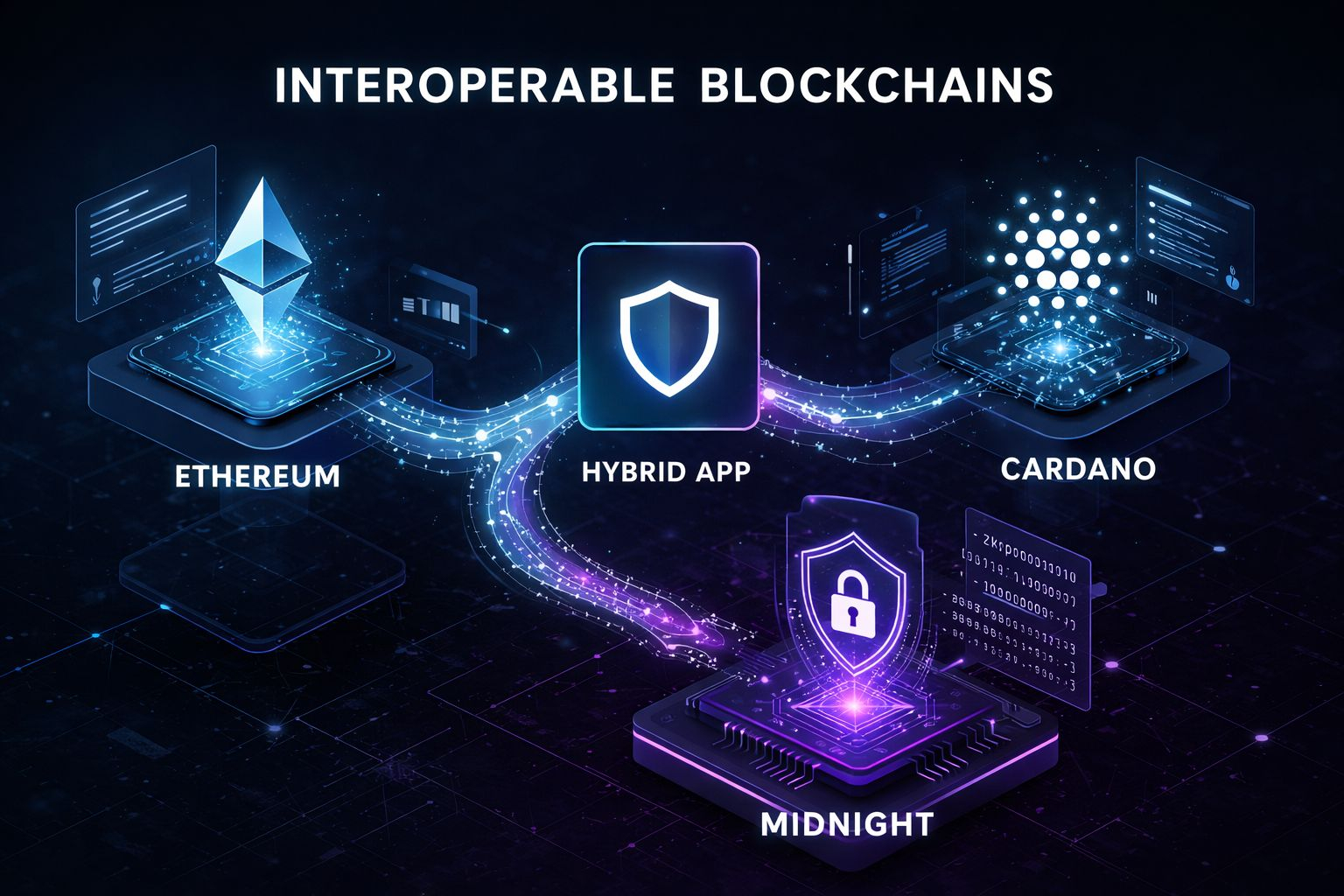
Here's something the nightpaper mentions but doesn't scream about: Midnight is designed for hybrid apps.
Most privacy chains want you to build everything inside their walled garden. Midnight's roadmap includes support for modular app architectures—meaning you can keep your core application on Ethereum or Cardano, but use Midnight's data protection for sensitive components .
Think about what that enables:
A DeFi protocol that needs private voting for governance. Keep the treasury on Ethereum, but run the ballot on Midnight. Prove vote legitimacy without exposing who voted which way.
A supply chain consortium using Hyperledger for operations, but needing selective disclosure for regulators. Keep the baseline on your existing infrastructure, use Midnight for compliance reporting.
This is practical interoperability, not just cross-chain token bridges.
The Fuel Mechanism Matters More Than You Think
I've ignored tokenomics in most articles because they're usually either copy-paste or completely broken. But Midnight's DUST mechanism deserves attention.
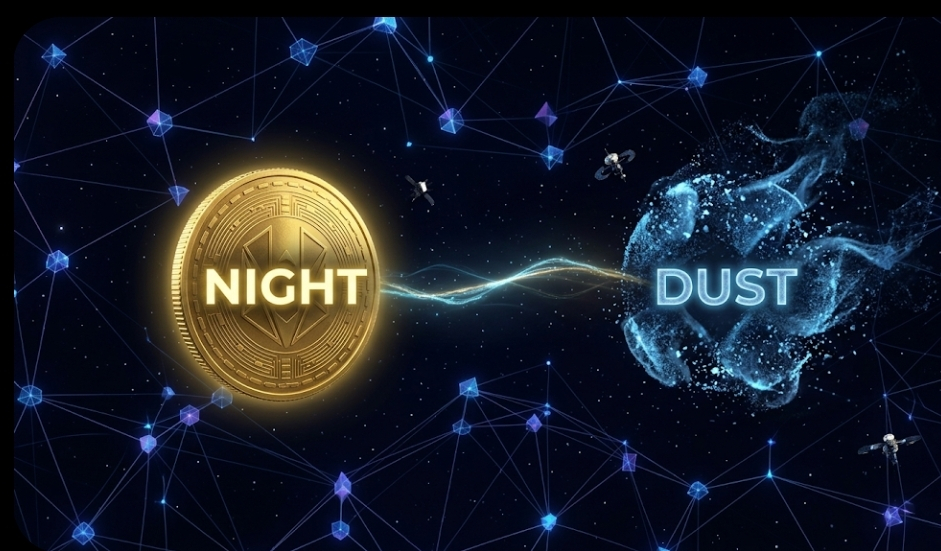
DUST is the network's transaction fuel. It decays over time. It can't be transferred. You generate it by holding NIGHT .
Why does this matter?
Because in most blockchains, transaction fees are paid in the same token that's being speculated on. When price spikes, using the network becomes expensive. When price crashes, security budgets shrink. It's a vicious cycle.
Midnight decouples them. NIGHT can be volatile—that's fine, it's an investment asset. DUST remains predictable because it's generated algorithmically and can't be hoarded .
A friend who runs a Web3 infrastructure company put it bluntly: "I can actually budget for this. That's never been true with Ethereum gas."
The Regulated Market Opportunity
Let's address the elephant in the room: regulated industries.
Banks, healthcare providers, and publicly traded companies have all stayed away from public blockchains because they can't control what leaks. Midnight's programmable disclosure changes that calculus.
The nightpaper highlights selective attestation—proving someone is KYC'd without revealing their identity document. Proving a transaction is below reporting thresholds without exposing the exact amount. Proving compliance without revealing business relationships .
A large California hospital system is reportedly exploring this for clinical trials. Multiple institutions need to verify patient eligibility and trial integrity without exposing protected health information. Midnight's architecture lets them do that .
That's not a "maybe someday" use case. That's happening now.
The Bootstrap Strategy Was Smart
Launching as a Cardano partner chain raised some eyebrows. Cardano's not the trendiest ecosystem right now.
But strategically, it makes sense. Cardano has:
· Established SPOs ready to validate
· UTXO architecture that pairs well with privacy requirements
· A community that's been waiting for actual dApp infrastructure
· Mature tooling for asset issuance (NIGHT is a Cardano native asset)
The Glacier Drop pulled users from eight ecosystems, not just Cardano. That tells me they're thinking about multichain adoption from day one .
The Hard Truth
Midnight isn't live on mainnet yet. Execution risk is real.
Privacy features always attract regulatory attention, even when designed responsibly. The dual-token model adds complexity that could confuse users. And convincing developers to build on a new chain is harder than ever.
But here's what gives me cautious optimism: Midnight isn't trying to be everything to everyone.
They're not competing with Solana on speed. They're not trying to out-Ethereum Ethereum. They're solving one specific problem—verifiable privacy for enterprises—and they've built architecture that actually addresses it.
If they execute, this becomes the infrastructure layer for every business that needs blockchain's benefits without exposing their secrets.
The nightpaper's worth reading. Or just watch testnet activity and see if developers actually show up.