

i mean a few weeks ago my older brother came home from his job and directly said "dude, we now have a machine in our warehouse that stocks shelves by itself. at night. without talking to anyone." he said it as if he was delivering bad news. but my first thought was dude, who manages the bank account for that machine? if that machine is given a task, how is the payment made? if a robot is working and no human is watching, then where does the trust come from?
this was the question that brought me to the Fabric Protocol.
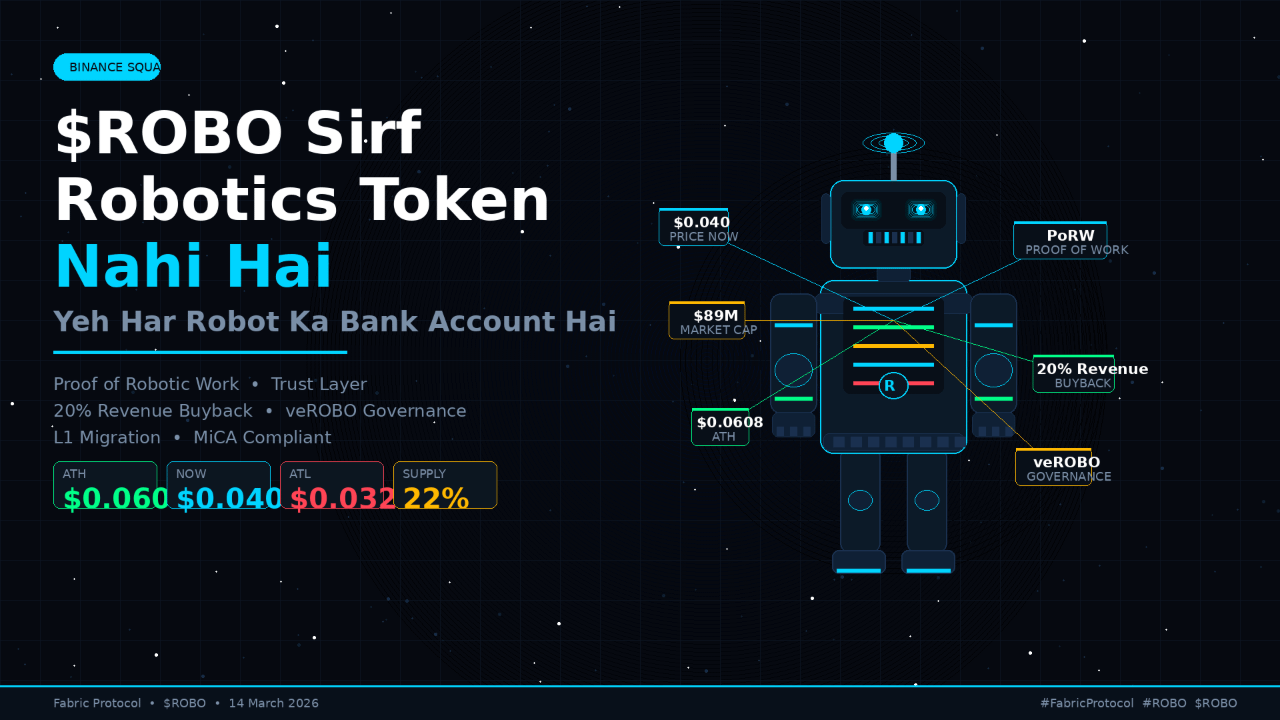
Today, March 14, 2026, $ROBO is trading at roughly $0.040 on Binance. Binance is currently around $89 million. The circulating supply is 2.23 billion tokens, with a maximum supply of 10 billion, meaning only 22% of the supply is currently in the market. The ATH was $0.0608 on March 2, 2026, then a pullback occurred, and now the token is down 34% from its ATH. And I find this interesting: when sentiment is cool and the narrative is still hot, that's when value is usually seen.
My thesis is pretty simple. $ROBO isn't a settlement token for a robot economy; it's the robot economy's trust layer. And in 2026, this distinction matters.
Listen to what's happening in the world right now. Tesla Optimus is on factory floors. Figure AI robots are being tested in Amazon warehouses. Humanoids have already been deployed in manufacturing units in China. All these machines are working, but none can talk to each other. They have no shared identity. There's no standard to verify a robot's work. There's no payment protocol that lets machine A pay machine B directly.
A simple analogy: Suppose you are a student. You work, the client does the homework, and the payment comes. But if the client is replaced by a machine and the student is also a machine, then who will run this approval/work and payment system? Not the bank, because banks are made for humans. Fabric Protocol's answer is: Blockchain will do it. $ROBO Will settle or the system of Fabric foundation is good.
Fabric has a mechanism called Proof of Robotic Work. It basically proves on-chain that a robot performed actual work, not just claimed it. Just like Proof of Work in Bitcoin proves energy usage, here robotic actions are verified. A robot's task is completed, verified, payment is released, everything is on-chain. No middle manager. No trust me brother, fully on-chain working system.
Let's be honest about tokenomics, because there's a mechanic I find genuinely interesting. 20% of protocol revenue is used to buy ROBOs on the open market. This isn't just a buyback; it creates a floor if the network is actually used. If real robots perform real tasks and fees are generated, a portion of that revenue is directly converted into token demand. This isn't theoretical; it's MIC-compliant and clearly spelled out in the Fabric Foundation whitepaper.
But let's be honest: this mechanic only works when real robots are using it. Currently, token prices are driven mostly by narrative, not utility. Of the 10 billion maximum supply, only 2.23 billion are currently in circulation. As the unlocking schedule for the remaining 7.77 billion approaches, dilution risk is real. There's a 1-year cliff in investor vesting, followed by a 36-month linear trend—this will also need to be tracked.
There is also VERBO governance, where stakeholder can make protocol decisions. L1 migration is planned from Base to Fabric's own chain. This is an important milestone as the project can capture more economic value there. According to the roadmap, initial components are being deployed in Q1 2026, contribution-based incentives will come in Q2, and data pipelines will scale in Q3/Q4. We are nearing the end of Q1, so visible evidence of the first milestone should emerge.
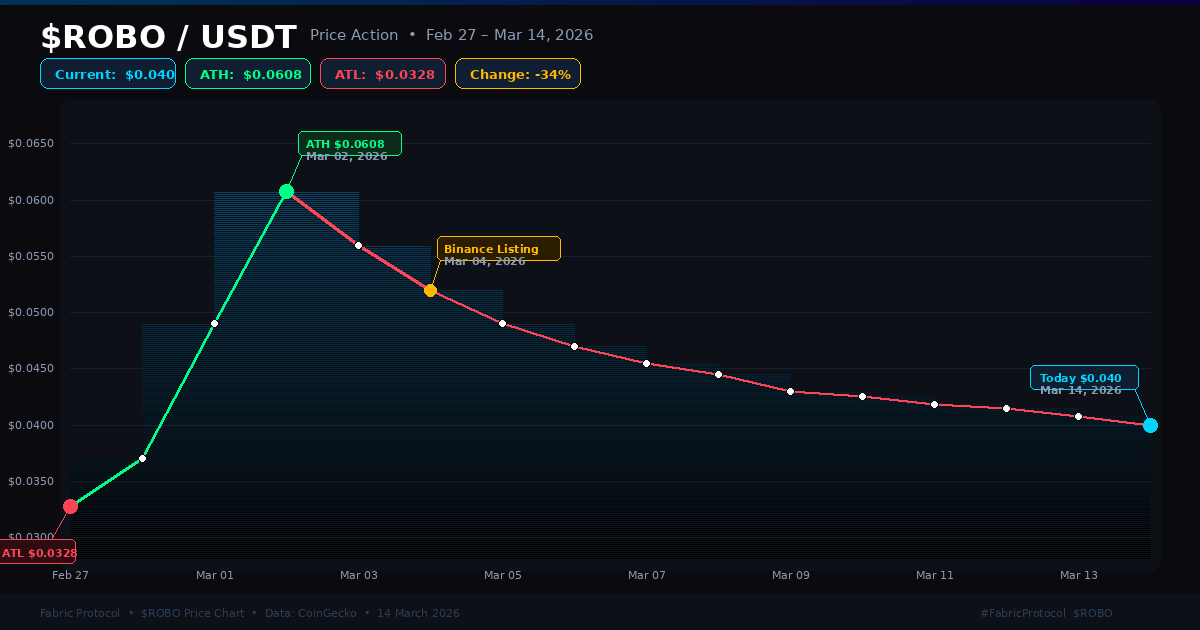
Recent catalysts honestly note that the Binance listing came on March 4, 2026 with ROBO/USDT, ROBO/USDC, ROBO/TRY spot pairs with Seed Tag. This was preceded by other trading platforms like Crypto.xzy etc. All within a month. This is extraordinary liquidity expansion for a new token. 24-hour volume at one point exceeded $92 million while the market cap was $126 million, which was essentially a 73% volume to market cap ratio. There was speculative frenzy, but this much volume does not come without serious eyes.

ATH was touched at $0.0608, then a pullback. Now it is sitting at $0.040. This is frustrating for those who were in early and couldn't sell at ATH, but for traders who take thesis-based positions, this again looks like an entry zone conditional on roadmap execution.
I talk straight about risks.
Risk execution. The success of the project depends on real robot adoption. The thesis holds if real operators actually run their robots on the Fabric Protocol. If partnerships remain on paper, the token will only run on narratives, and narratives expire, which is not true.
Risk supply dilution. 7.77 billion tokens are not yet unlocked. Investor vesting, foundation reserves, ecosystem incentives can all create future sell pressure. The buyback mechanic will only be meaningful if protocol fees are meaningful. They aren't yet.
Regulatory risk. Global regulation on AI and autonomous machines is currently underway. In the EU, MICs cover robots, but if the US or India introduce a new framework on robotics-linked tokens, there could be a short-term impact.
Market up case: If the Q1 roadmap deliverables come on time and even 2-3 real robot operators onboard Fabric Protocol, I think the market cap could hit $300-400 million. FDV is currently $400M, so the price would need to go up to roughly $0.13-0.18 for the circulating market to get there. This is 3-4x the current price. It's not aggressive to assume this if execution is real.
Market down case: If Q1 deliverables are missed or a major operator quietly steps aside, the token could fall back to the $0.032-0.033 range. ATL was $0.032809 on February 27. Holders there will have to wait 6-8 months if broader market sentiment is also against it.
I am personally getting ready for both the cases.
Metrics I'm tracking over the next 2 to 3 quarters: Proof of Robotic Work verified task count This is the most honest signal of actual usage. Trading volume sustainability after Binance listing If volume maintains $20M+ daily without any promotional events then there is genuine interest. L1 migration timeline announcement. And I'm watching to see if a real robot operator publicly announces Fabric Protocol integration, that day will be a game changer for the token.
$ROBO I'm also a bet that robots in the physical world will need a financial identity and that first mover advantage will be real. I'm not writing this as a think piece, it's justification for an actual position.
Disclaimer: This article is solely my personal research and point of view. I am not a financial advisor. Any numbers, price targets, or projections I write are based on my own analysis—not guaranteed returns. Crypto markets are highly volatile, and $ROBO also carries significant risk. Do your own research before investing and only invest what you are prepared to lose. This post is for educational purposes, not investment advice.
#FabricProtocol #ROBOAI #Crypto_Jobs🎯 #ROBO @Fabric Foundation